



 Chat with AI
Exam 16: Additional Topics in Time Series Regression

Exam 1: Economic Questions and Data17 Questions
Exam 2: Review of Probability70 Questions
Exam 3: Review of Statistics65 Questions
Exam 4: Linear Regression With One Regressor65 Questions
Exam 5: Regression With a Single Regressor: Hypothesis Tests and Confidence Intervals59 Questions
Exam 6: Linear Regression With Multiple Regressors65 Questions
Exam 7: Hypothesis Tests and Confidence Intervals in Multiple Regression64 Questions
Exam 8: Nonlinear Regression Functions63 Questions
Exam 9: Assessing Studies Based on Multiple Regression65 Questions
Exam 10: Regression With Panel Data50 Questions
Exam 11: Regression With a Binary Dependent Variable50 Questions
Exam 12: Instrumental Variables Regression50 Questions
Exam 13: Experiments and Quasi-Experiments50 Questions
Exam 14: Introduction to Time Series Regression and Forecasting50 Questions
Exam 15: Estimation of Dynamic Causal Effects50 Questions
Exam 16: Additional Topics in Time Series Regression50 Questions
Exam 17: The Theory of Linear Regression With One Regressor49 Questions
Exam 18: The Theory of Multiple Regression50 Questions
Select questions type


Using the ADL(1,1)regression Yt = ?0 + ?1Yt-1 + Xt-1 + ut, the ARCH model for the regression error assumes that ut is normally distributed with mean zero and variance , where
A) .
B) .
C) .
D) .
(Short Answer)
4.9/5  (75)
(75) The following is not a consequence of Xt and Yt being cointegrated:
(Multiple Choice)
4.7/5 (91)
(91) The biggest conceptual difference between using VARs for forecasting and using them for structural modeling is that
(Multiple Choice)
5.0/5 (95)
(95) You have collected quarterly data on inflation and unemployment rates for Canada from 1961:III to 1995:IV to estimate a VAR(4)model of the change in the rate of inflation and the unemployment rate. The results are 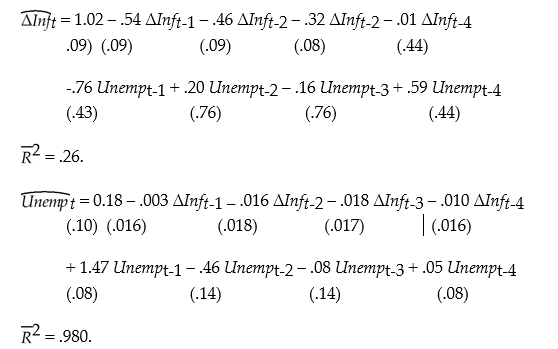 (a)Explain how you would use the above regressions to conduct one period ahead forecasts.
(b)Should you test for cointegration between the change in the inflation rate and the unemployment rate and, in the case of finding cointegration here, respecify the above model as a VECM?
(c)The Granger causality test yields the following F-statistics: 3.75 for the test that the coefficients on lagged unemployment rate in the change of inflation equation are all zero; and 0.36 for the test that the coefficients on lagged changes in the inflation rate are all zero. Based on these results, does unemployment Granger-cause inflation? Does inflation Granger-cause unemployment?
(a)Explain how you would use the above regressions to conduct one period ahead forecasts.
(b)Should you test for cointegration between the change in the inflation rate and the unemployment rate and, in the case of finding cointegration here, respecify the above model as a VECM?
(c)The Granger causality test yields the following F-statistics: 3.75 for the test that the coefficients on lagged unemployment rate in the change of inflation equation are all zero; and 0.36 for the test that the coefficients on lagged changes in the inflation rate are all zero. Based on these results, does unemployment Granger-cause inflation? Does inflation Granger-cause unemployment? (Essay)
4.8/5 (78)
(78) Consider the following model Yt = β0 + β1Xt + β2Xt-1 + β3Yt-1 + ut, where Xt is strictly exogenous. Show that by imposing the restriction , you can derive the following so-called Error Correction Mechanism (ECM)model
△Yt = β0 + β1△Xt - θ(Y - X)t-1 + ut
where θ = β1 + β2. What is the short-run (impact)response of a unit increase in X? What is the long-run solution? Why do you think the term in parenthesis in the above expression is called ECM?
(Essay)
4.8/5 (81)
(81) Economic theory suggests that the law of one price holds. Applying this concept to foreign and domestic goods implies that goods will sell for the same price across countries. The consumer price index is the price for a basket of goods, and is calculated for countries as a whole. Hence in the absence of barriers to trade, and large transportation costs (and the fact that not all goods are traded)you should observe Purchasing Power Parity (PPP)between two countries, or ExchRate × P = Pf, where ExchRate is the foreign exchange rate between the two countries, and P represents the price index, with f indicating the foreign country. Dividing both sides of the equation by the domestic price level then gives you the standard formulation for PPP: ExchRate = If PPP holds in the long run, then the exchange rate and the price ratio should share a common trend. Since it is a long-run concept, cointegration provides an interesting way to test for it.
a. Using monthly data for the U.S./U.K. exchange rate ($/₤)and the respective price indexes, you estimate the following regression: t = 0.44 + 0.69 (lnPUS - lnPUK)
Collecting the residuals from this regression and using an ADF test for cointegration, you find a t-statistic of -2.71. Can you reject the null-hypothesis of no cointegration? What is the critical value?
b. Was it good econometric practice to test for cointegration right away? What else should you have done before proceeding with the EG-ADF test?
(Essay)
4.9/5 (81)
(81) A VAR allows you to test joint hypothesis that involve restrictions across multiple equations by
(Multiple Choice)
4.8/5 (83)
(83) 
Filters
- Essay(0)
- Multiple Choice(0)
- Short Answer(0)
- True False(0)
- Matching(0)