



 Chat with AI
Exam 16: International Portfolio Theory and Diversification

Exam 1: Current Multinational Challenges and the Global Economy50 Questions
Exam 2: Corporate Ownership, Goals, and Governance63 Questions
Exam 3: The International Monetary System46 Questions
Exam 4: The Balance of Payments74 Questions
Exam 5: The Continuing Global Financial Crisis47 Questions
Exam 6: The Foreign Exchange Theory and Markets66 Questions
Exam 7: International Parity Conditions55 Questions
Exam 8: Foreign Currency Derivatives and Swaps85 Questions
Exam 9: Foreign Exchange Rate Determination and Forecasting52 Questions
Exam 10: Transaction Exposure50 Questions
Exam 11: Translation Exposure52 Questions
Exam 12: Operating Exposure57 Questions
Exam 13: The Global Cost and Availability of Capital59 Questions
Exam 14: Raising Equity and Debt Globally72 Questions
Exam 15: Multinational Tax Management46 Questions
Exam 16: International Portfolio Theory and Diversification51 Questions
Exam 17: Foreign Direct Investment and Political Risk59 Questions
Exam 18: Multinational Capital Budgeting and Cross-Border Acquisitions51 Questions
Exam 19: Working Capital Management57 Questions
Exam 20: International Trade Finance53 Questions
Select questions type


The addition of foreign securities to the domestic portfolio opportunity set shifts the efficient frontier:
(Multiple Choice)
4.9/5  (85)
(85) Instruction 16.2:Use the information to answer the following question(s).
A U.S. investor is considering a portfolio consisting of 60% invested in the U.S. equity index fund and 40% invested in the British equity index fund. The expected returns for the funds are 10% for the U.S. and 8% for the British, standard deviations of 20% for the U.S. and 18% for the British, and a correlation coefficient of 0.15 between the U.S. and British equity funds.
-Refer to Instruction 16.2. What is the standard deviation of the proposed portfolio?
(Multiple Choice)
4.9/5 (86)
(86) The authors present a comparison of correlation coefficients between major global equity markets over a variety of different periods. The comparison yields a number of conclusions listed here EXCEPT:
(Multiple Choice)
4.8/5 (82)
(82) Instruction 16.1:Use the information to answer the following question(s).
In September 2009 a U.S. investor chooses to invest $500,000 in German equity securities at a then current spot rate of $1.30/euro. At the end of one year the spot rate is $1.35/euro.
-Refer to Instruction 16.1. At the end of the year the investor sells his stock that now has an average price per share of €57. What is the investor's average rate of return after converting the stock back into dollars?
(Multiple Choice)
4.9/5 (76)
(76) The Sharpe measure uses ________ as the measure of risk and the Treynor measure uses ________ as the measure of risk.
(Multiple Choice)
4.9/5 (78)
(78) In an empirical study on national market returns in the 20th century, Dimson, Marsh, and Staunton (2002)determined that the equity returns in the United States out-performed the other 15 countries in the study.
(True/False)
4.8/5 (76)
(76) TABLE 16.1
Use the information to answer following question(s). 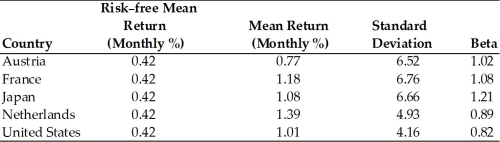 -Refer to Table 16.1. What is the value of the Treynor Measure for the Netherlands?
 (Multiple Choice)
4.9/5 (85)
(85) The internationally diversified portfolio opportunity set shifts TO THE RIGHT of the purely domestic opportunity set.
(True/False)
4.8/5 (89)
(89) In some respects, internationally diversified portfolios are the same in principle as a domestic portfolio because:
(Multiple Choice)
4.9/5 (85)
(85) Instruction 16.1:Use the information to answer the following question(s).
In September 2009 a U.S. investor chooses to invest $500,000 in German equity securities at a then current spot rate of $1.30/euro. At the end of one year the spot rate is $1.35/euro.
-Refer to Instruction 16.1. How many euros will the U.S. investor acquire with his initial $500,000 investment?
(Multiple Choice)
4.7/5 (74)
(74) 
Filters
- Essay(0)
- Multiple Choice(0)
- Short Answer(0)
- True False(0)
- Matching(0)