



 Chat with AI
Exam 6: The Foreign Exchange Theory and Markets

Exam 1: Current Multinational Challenges and the Global Economy50 Questions
Exam 2: Corporate Ownership, Goals, and Governance63 Questions
Exam 3: The International Monetary System46 Questions
Exam 4: The Balance of Payments74 Questions
Exam 5: The Continuing Global Financial Crisis47 Questions
Exam 6: The Foreign Exchange Theory and Markets66 Questions
Exam 7: International Parity Conditions55 Questions
Exam 8: Foreign Currency Derivatives and Swaps85 Questions
Exam 9: Foreign Exchange Rate Determination and Forecasting52 Questions
Exam 10: Transaction Exposure50 Questions
Exam 11: Translation Exposure52 Questions
Exam 12: Operating Exposure57 Questions
Exam 13: The Global Cost and Availability of Capital59 Questions
Exam 14: Raising Equity and Debt Globally72 Questions
Exam 15: Multinational Tax Management46 Questions
Exam 16: International Portfolio Theory and Diversification51 Questions
Exam 17: Foreign Direct Investment and Political Risk59 Questions
Exam 18: Multinational Capital Budgeting and Cross-Border Acquisitions51 Questions
Exam 19: Working Capital Management57 Questions
Exam 20: International Trade Finance53 Questions
Select questions type


Because the market for foreign exchange is worldwide, the volume of foreign exchange currency transactions is level throughout the 24-hour day.
(True/False)
4.8/5  (85)
(85) Define spot, forward, and swap transactions in the foreign exchange market and give an example of how each could be used.
(Essay)
4.8/5 (80)
(80) The authors identify two tiers of foreign exchange markets:
(Multiple Choice)
4.8/5 (68)
(68) For individuals and firms involved in the import and export of goods and services ,using the foreign exchange market is necessary, but incidental, to their underlying commercial or investment purpose.
(True/False)
5.0/5 (76)
(76) The greatest amount of foreign exchange trading takes place in the following three cities:
(Multiple Choice)
4.8/5 (79)
(79) Which of the following is NOT a motivation identified by the authors as a function of the foreign exchange market?
(Multiple Choice)
4.8/5 (80)
(80) The ________ is the mechanism by which participants transfer purchasing power between countries, obtain or provide credit for international trade transactions, and minimize exposure to the risks of exchange rate changes.
(Multiple Choice)
4.7/5 (78)
(78) ________ make money on currency exchanges by the difference between the ________ price, or the price they offer to pay, and the ________ price, or the price at which they offer to sell the currency.
(Multiple Choice)
4.8/5 (84)
(84) ________ are NOT one of the three categories reported for foreign exchange.
(Multiple Choice)
4.8/5 (82)
(82) Swap and forward transactions account for an insignificant portion of the foreign exchange market.
(True/False)
4.9/5 (77)
(77) TABLE 6.1
Use the table to answer following question(s). 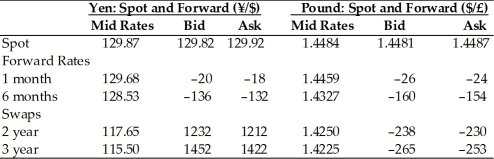 -Refer to Table 6.1. The one-month forward bid price for dollars as denominated in Japanese yen is:
 (Multiple Choice)
4.9/5 (82)
(82) Daily trading volume in the foreign exchange market was about ________ per ________ in 2010.
(Multiple Choice)
4.8/5 (81)
(81) What are some of the reasons central banks and treasuries enter the foreign exchange markets, and in what important ways are they different from other foreign exchange participants?
(Essay)
4.9/5 (89)
(89) Foreign exchange ________ earn a profit by a bid-ask spread on currencies they purchase and sell. Foreign exchange ________, on the other hand, earn a profit by bringing together buyers and sellers of foreign currencies and earning a commission on each sale and purchase.
(Multiple Choice)
4.9/5 (76)
(76) Currency trading is a service center rather than a profit center for commercial and investment banks.
(True/False)
5.0/5 (82)
(82) A ________ transaction in the interbank market is the simultaneous purchase and sale of a given amount of foreign exchange for two different value dates.
(Multiple Choice)
5.0/5 (75)
(75) The primary motive of foreign exchange activities by most central banks is profit.
(True/False)
4.7/5 (67)
(67) A spot transaction in the interbank market for foreign exchange would typically involve a two-day delay in the actual delivery of the currencies, while such a transaction between a bank and its commercial customer would not necessarily involve a two-day wait.
(True/False)
5.0/5 (83)
(83) Given the following exchange rates, which of the multiple-choice choices represents a potentially profitable intermarket arbitrage opportunity? ¥129.87/$
€1.1226/$
€0.00864/¥
(Multiple Choice)
4.7/5 (82)
(82) When the cross rate for currencies offered by two banks differs from the exchange rate offered by a third bank, a triangular arbitrage opportunity exists.
(True/False)
4.9/5 (69)
(69) 
Filters
- Essay(0)
- Multiple Choice(0)
- Short Answer(0)
- True False(0)
- Matching(0)