



 Chat with AI
Exam 5: Cash and Receivables

Exam 1: Fundamentals of Financial Accounting Theory33 Questions
Exam 2: Conceptual Frameworks for Financial Reporting60 Questions
Exam 3: Accrual Accounting159 Questions
Exam 4: Revenue Recognition110 Questions
Exam 5: Cash and Receivables120 Questions
Exam 6: Inventories156 Questions
Exam 7: Financial Assets141 Questions
Exam 8: Property, Plant, and Equipment127 Questions
Exam 9: Intangible Assets, Goodwill, Mineral Resources, and Government Grants81 Questions
Exam 10: Applications of Fair Value to Non-Current Assets120 Questions
Select questions type


Which statement is correct about estimating the allowance for doubtful accounts?
(Multiple Choice)
4.8/5  (64)
(64) Which of the following is a difference between trade and non-trade receivables?
(Multiple Choice)
4.9/5 (80)
(80) Family Fun reported credit sales of $800,000, cash collections of $550,000 and bad debt expense of $15,000 for last year. Accounts receivable had a balance of $1,000,000 at the beginning of the year. Assuming there are no write-offs made during the year, what was the ending balance in the accounts receivable account?
(Multiple Choice)
4.9/5 (81)
(81) Intercoastal Shelving Company made a sale to Superb Knives for $8,800 on December 10, 2013. Since it was approaching year end, Intercoastal wanted to encourage prompt payment, so it provided generous discounts for those clients able to pay promptly. Thus Intercoastal offered terms of 5/10, net 20. Superb paid the invoice on January 20, 2014.
How should Intercoastal record the invoice and its subsequent collection if the company uses (a)the gross method or (b)the net method?
(Essay)
4.8/5 (63)
(63) Micelle Inc. reported credit sales of $700,000 and cash sales of $100,000 for last year. The ending balance in accounts receivable was $1,500,000. Bad debt expense is estimated at 1% of credit sales. The allowance for doubtful accounts had a balance of $40,000 at the beginning of the year. Assuming there are no write-offs made during the year, what was the balance in the allowance for doubtful accounts at the end of the year?
(Multiple Choice)
5.0/5 (80)
(80) Explain the differences and relationships among expenditures, assets, and expenses. Use an example to support your discussion.
(Essay)
5.0/5 (73)
(73) Explain why it is important to segregate duties of employees dealing with cash in an organization. Provide an example of ways which this segregation could be made on the payables side
(Essay)
4.8/5 (87)
(87) Explain some controls that can be used in an organization to safeguard cash and other assets.
(Essay)
4.9/5 (67)
(67) A $50,000 sale transaction is made with terms of 2/10, net 30. What amount is debited to the accounts receivable account when the sale is made under the gross method of accounting for cash discounts?
(Multiple Choice)
4.8/5 (77)
(77) What amount will be included in "cash and cash equivalents"? 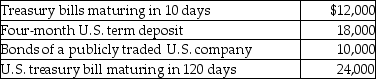
(Multiple Choice)
4.8/5 (75)
(75) Which statement best describes the gross method of accounting for cash discounts?
(Multiple Choice)
4.9/5 (68)
(68) Which statement is not correct about estimating the allowance for doubtful accounts under the balance sheet approach?
(Multiple Choice)
4.8/5 (74)
(74) Identify if the following investments meet the requirements to be classified as cash and cash equivalents. 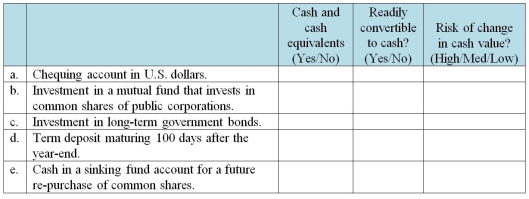
(Essay)
4.8/5 (71)
(71) At December 31, 2012, Pinebrook Inc. reported $135,000 in accounts receivable and $9,300 in the allowance for doubtful accounts. In 2013, the company had $875,000 in credit sales and collected $915,000 on accounts receivable. Pinebrook also wrote off $2,500 in uncollectible accounts. The company uses the aging method to estimate bad debts, and management has estimated that the allowance for doubtful accounts for December 31, 2013 should be $8,800.
Required:
a. Provide the journal entry to record bad debts expense for the year 2013. (Ignore information contained in part (b)below.)
b. While auditing the books of Pinebrook, you discover that the company's bookkeeper has erroneously recorded a transaction: for one customer who went bankrupt in 2013, she wrote off the $6,800 receivable with a debit to bad debts expense. Determine the error's effects (overstated/understated)on the December 31, 2013 balance sheet (accounts receivable, allowance for doubtful accounts)and the income statement for the year 2013.
c. In January 2014, the company factored all of its receivables ($95,000)without recourse for proceeds of $77,000. Present the journal entry to record this transaction.
(Essay)
4.8/5 (79)
(79) McGraw Motors both sells and leases vehicles. With sales temporarily slowing due to the economy, the company factored a significant portion of its lease receivables. The company factored with recourse receivables with a carrying amount of $22 million in exchange for $21.45 million less a holdback of $550,000 for potential uncollectible accounts. Due to poor economic conditions, the actual uncollectible accounts amounted to $900,000.
Record the entries on McGraw's books relating to the $22 million factoring of lease receivables.
(Essay)
4.8/5 (94)
(94) Fruit Valley Inc. reported cash sales of $250,000, credit sales of $850,000, cash collections from receivables of $500,000, bad debt write-offs of $25,000 and bad debt expense of $35,000 for last year. Accounts receivable had a balance of $1,000,000 at the end of the year. What was the balance in the accounts receivable account at the beginning of the year?
(Multiple Choice)
4.8/5 (82)
(82) Which of the following would not be an example of segregation of duties?
(Multiple Choice)
4.8/5 (74)
(74) Karin-Jones Ltd. reported an opening balance of $1,712,000 in accounts receivable and of $147,000 in allowance for doubtful accounts for last year. During the year, sales on account were $2,500,000, collections of accounts receivable were $1,300,000, and bad debt expense was $89,000. At the end of the year, the company had a credit balance of $172,000 in the allowance for doubtful accounts. What amount of accounts receivable was written off during the year?
(Multiple Choice)
4.8/5 (79)
(79) 
Filters
- Essay(0)
- Multiple Choice(0)
- Short Answer(0)
- True False(0)
- Matching(0)