



 Chat with AI
Exam 12: Analysis of Variance

Exam 1: What Is Statistics83 Questions
Exam 2: Describing Data: Frequency Tables, Frequency Distributions, and Graphic Presentation132 Questions
Exam 3: Describing Data: Numerical Measures124 Questions
Exam 4: Describing Data: Displaying and Exploring Data113 Questions
Exam 5: A Survey of Probability Concepts134 Questions
Exam 6: Discrete Probability Distributions131 Questions
Exam 7: Continuous Probability Distributions135 Questions
Exam 8: Sampling Methods and the Central Limit Theorem117 Questions
Exam 9: Estimation and Confidence Intervals131 Questions
Exam 10: One-Sample Tests of Hypothesis110 Questions
Exam 11: Two-Sample Tests of Hypothesis98 Questions
Exam 12: Analysis of Variance134 Questions
Exam 13: Correlation and Linear Regression138 Questions
Exam 14: Multiple Regression Analysis135 Questions
Exam 15: Nonparametric Methods: Nominal Level Hypothesis Tests181 Questions
Exam 16: Nonparametric Methods: Analysis of Ordinal Data138 Questions
Exam 17: Index Numbers137 Questions
Exam 18: Time Series and Forecasting139 Questions
Exam 19: Statistical Process Control and Quality Management136 Questions
Exam 20: An Introduction to Decision Theory115 Questions
Select questions type


Two accounting professors decided to compare the variance of their grading procedures. To accomplish this, they each graded the same 10 exams, with the following results:  At the 5% level of significance, what is the decision regarding the null hypothesis?
 (Multiple Choice)
4.9/5  (85)
(85) If an ANOVA test is conducted and the null hypothesis is rejected, what does this indicate?
(Multiple Choice)
4.7/5 (83)
(83) The annual dividend rates for a random sample of 16 companies in three different industries, utilities, banking, and insurance were recorded. The ANOVA comparing the mean annual dividend rate among three industries rejected the null hypothesis that the dividend rates were equal. The mean square error (MSE) was 3.36. The following table summarized the results:  Based on the comparison between the mean annual dividend rate for companies in the utilities and insurance industries, _______________________.
 (Multiple Choice)
4.9/5 (91)
(91) In an ANOVA problem involving three treatments and 12 observations per treatment, SSE = 297. The MSE for this scenario is _____.
(Multiple Choice)
4.8/5 (75)
(75) A manufacturer of automobile transmissions uses three different processes. Management ordered a study of the production costs to see if there is a difference among the three processes. A summary of the findings is shown next.  In an ANOVA table, what are the degrees of freedom for the treatment source of variation?
 (Multiple Choice)
4.8/5 (81)
(81) The college of business was interested in comparing the interaction of academic status and class time on class attendance. Three different classes were sampled for each cell in the table. The means for each cell follow.  What are the total degrees of freedom?
 (Multiple Choice)
5.0/5 (87)
(87) An ANOVA procedure is applied to data obtained from four distinct populations. The samples, each comprised of 15 observations, were taken from the four populations. The degrees of freedom for the numerator and denominator for the critical value of F are:
(Multiple Choice)
4.7/5 (73)
(73) A sum of squares divided by its corresponding degrees of freedom is called a ________________.
(Short Answer)
4.8/5 (92)
(92) A two-way ANOVA with interaction has how many sources of variation?
(Multiple Choice)
4.9/5 (74)
(74) An ANOVA showed the following comparison of four treatment means. 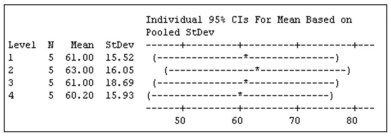 Which treatment means are significantly different?
 (Essay)
5.0/5 (87)
(87) The human resources department of a software company encourages their employees to participate in a wellness program. They sampled 16 employees, 2 males and 2 females from four different workout routines and measured their peak heart rate. The ANOVA for the research follows. 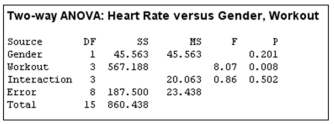 What is the F-statistic for Gender?
 (Essay)
4.7/5 (96)
(96) An experiment to determine the most effective way to teach safety principles applied four different teaching methods. Some employees were given programmed instruction booklets and worked through the course at their own pace. Other employees attended lectures. A third group watched a television presentation, and a fourth group was divided into small discussion groups. A high of 10 was possible. A sample of five tests was selected from each group. The test grade results were:  At the 0.01 level, what is the critical value?
 (Multiple Choice)
4.9/5 (79)
(79) The college of business was interested in comparing the attendance for three different class times for a business statistics class. The data follow.  What are the block and treatment degrees of freedom?
 (Multiple Choice)
4.8/5 (92)
(92) Given the following ANOVA table for three treatments each with six observations:  What are the degrees of freedom for the treatment and error sources of variation?
 (Multiple Choice)
4.7/5 (78)
(78) The following partial ANOVA table was derived from data having four treatments and a total of 16 observations.  The mean square between treatments (MST) is _______.
 (Multiple Choice)
5.0/5 (83)
(83) Two accounting professors decided to compare the variance of their grading procedures. To accomplish this, they each graded the same 10 exams, with the following results:  What is the critical value of F at the 0.05 level of significance?
 (Multiple Choice)
4.8/5 (78)
(78) In a study of protein breakfast bars, five bars from each of three brands were tested to see if the mean amount of protein per bar differs among the brands. To select a critical F-statistic, the number of degrees of freedom for the denominator is _____.
(Short Answer)
4.8/5 (68)
(68) The human resources department of a software company encourages their employees to participate in a wellness program. They sampled 16 employees, 2 males and 2 females from four different workout routines and measured their peak heart rate. The ANOVA for the research follows. 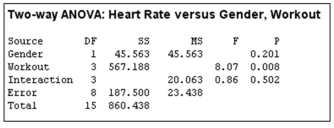 What is the Workout mean square?
 (Essay)
4.8/5 (76)
(76) 
Filters
- Essay(0)
- Multiple Choice(0)
- Short Answer(0)
- True False(0)
- Matching(0)