



 Chat with AI
Exam 4: Forces and Newtons Laws of Motion

Exam 1: Introduction and Mathematical Concepts70 Questions
Exam 2: Kinematics in One Dimension103 Questions
Exam 3: Kinematics in Two Dimensions68 Questions
Exam 4: Forces and Newtons Laws of Motion103 Questions
Exam 5: Dynamics of Uniform Circular Motion59 Questions
Exam 6: Work and Energy78 Questions
Exam 7: Impulse and Momentum66 Questions
Exam 8: Rotational Kinematics55 Questions
Exam 9: Rotational Dynamics57 Questions
Exam 10: Simple Harmonic Motion and Elasticity63 Questions
Exam 11: Fluids65 Questions
Exam 12: Temperature and Heat66 Questions
Exam 13: The Transfer of Heat42 Questions
Exam 14: The Ideal Gas Law and Kinetic Theory55 Questions
Exam 15: Thermodynamics79 Questions
Exam 16: Waves and Sound67 Questions
Exam 17: The Principle of Linear Superposition and Interference Phenomena46 Questions
Exam 18: Electric Forces and Electric Fields61 Questions
Exam 19: Electric Potential Energy and the Electric Potential70 Questions
Exam 20: Electric Circuits100 Questions
Exam 21: Magnetic Forces and Magnetic Fields66 Questions
Exam 22: Electromagnetic Induction71 Questions
Exam 23: Alternating Current Circuits84 Questions
Exam 24: Electromagnetic Waves66 Questions
Exam 25: The Refl Ection of Light: Mirrors43 Questions
Exam 26: The Refraction of Light: Lenses and Optical Instruments102 Questions
Exam 27: Interference and the Wave Nature of Light57 Questions
Exam 28: Special Relativity63 Questions
Exam 29: Particles and Waves54 Questions
Exam 30: The Nature of the Atom74 Questions
Exam 31: Nuclear Physics and Radioactivity37 Questions
Exam 32: Ionizing Radiation, Nuclear Energy, and Elementary Particles45 Questions
Select questions type


An object moves due east at constant speed. A net force directed due north then acts on the object for 5.0 s. At the end of the 5.0-second period, the net force drops to zero newtons. Which one of the following statements is necessarily true?
(Multiple Choice)
4.8/5  (73)
(73) Consider the following forces. (1) frictional (2) gravitational (3) tension (4) strong nuclear (5) normal (6) electroweak
Which of the forces listed are considered fundamental forces?
(Multiple Choice)
4.9/5 (87)
(87) A physics student in a hot air balloon ascends vertically at constant speed. Consider the following four forces present in this situation:
 11ec874b_21ea_ddf1_a44c_811fc40246c2_TB34225555_11 1= the weight of the hot air balloon
11ec874b_21ea_ddf1_a44c_811fc40246c2_TB34225555_11 3= the force of the student pulling on the earth
11ec874b_21ea_ddf1_a44c_811fc40246c2_TB34225555_11 2= the weight of the student
11ec874b_21ea_ddf1_a44c_811fc40246c2_TB34225555_11 4= the force of the hot air balloon pulling on the student
-Which one of the following relationships concerning the forces or their magnitudes is true?
11ec874b_21ea_ddf1_a44c_811fc40246c2_TB34225555_11 1= the weight of the hot air balloon
11ec874b_21ea_ddf1_a44c_811fc40246c2_TB34225555_11 3= the force of the student pulling on the earth
11ec874b_21ea_ddf1_a44c_811fc40246c2_TB34225555_11 2= the weight of the student
11ec874b_21ea_ddf1_a44c_811fc40246c2_TB34225555_11 4= the force of the hot air balloon pulling on the student
-Which one of the following relationships concerning the forces or their magnitudes is true? (Multiple Choice)
4.9/5 (74)
(74) A 975-kg car accelerates from rest to 26.7 m/s in a distance of 120 m. What is the magnitude of the average net force acting on the car?
(Multiple Choice)
4.7/5 (88)
(88) A 2.0-N rock slides on a frictionless inclined plane. Which one of the following statements is true concerning the normal force that the plane exerts on the rock? 
(Multiple Choice)
4.9/5 (84)
(84) Two identical blocks are pulled along a rough surface as suggested in the figure. Which one of the following statements is false? 
(Multiple Choice)
4.7/5 (73)
(73) A massless horizontal strut is attached to the wall at the hinge O. Which one of the following phrases best describes the force that the hinge pin applies to the strut if the weight of the cables is also neglected? 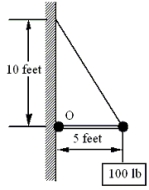
(Multiple Choice)
4.9/5 (90)
(90) A 20.0-kg package is dropped from a high tower in still air and is "tracked" by a radar system. When the package is 25 m above the ground, the radar tracking indicates that its acceleration is 7.0 m/s2. Determine the force of air resistance on the package.
(Multiple Choice)
5.0/5 (75)
(75) What is the weight of a 2.50-kg bag of sand on the surface of the earth?
(Multiple Choice)
5.0/5 (65)
(65) Two blocks rest on a horizontal frictionless surface as shown. The surface between the top and bottom blocks is roughened so that there is no slipping between the two blocks. A 30-N force is applied to the bottom block as suggested in the figure.  -What is the acceleration of the "two block" system?
 (Multiple Choice)
4.8/5 (69)
(69) A rock is suspended from a string and moves downward at constant speed. Which statement is true concerning the tension in the string if air resistance is ignored?
(Multiple Choice)
4.8/5 (80)
(80) A block is at rest on a rough inclined plane and is connected to an object with the same mass as shown. The rope may be considered massless; and the pulley may be considered frictionless. The coefficient of static friction between the block and the plane is μs; and the coefficient of kinetic friction is μk.
 -If the mass of the suspended object is doubled, what will be the acceleration of the block up the plane?
 (Multiple Choice)
4.7/5 (86)
(86) A block of weight W is suspended by a string of fixed length. The ends of the string are held at various positions as shown in the figures below. In which case, if any, is the magnitude of the tension along the string the largest? 
(Multiple Choice)
4.9/5 (78)
(78) Complete the following statement: An inertial reference frame is one in which
(Multiple Choice)
4.8/5 (69)
(69) Note the following situations:  In which case will the magnitude of the normal force on the block be equal to (Mg + F sin )?
 (Multiple Choice)
4.8/5 (75)
(75) pulls on a crate of mass m that is in contact with a rough surface. The figure shows the magnitudes and directions of the forces that act on the crate in this situation.  represents the weight of the crate.
 represents the normal force on the crate, and
 represents the frictional force.
 -Which statement best describes the motion of the crate?
represents the weight of the crate. represents the normal force on the crate, and represents the frictional force.
-Which statement best describes the motion of the crate? (Multiple Choice)
4.8/5 (75)
(75) A rock is thrown straight up from the earth's surface. Which one of the following statements concerning the net force acting on the rock at the top of its path is true?
(Multiple Choice)
4.9/5 (81)
(81) A muscle builder holds the ends of a massless rope. At the center of the rope, a 7.9-kg ball is hung as shown. What is the tension in the rope if the angle in the drawing is 6.0°? 
(Multiple Choice)
4.9/5 (74)
(74) Two forces act on a hockey puck. For which orientation of the forces will the puck acquire an acceleration with the largest magnitude?
(Multiple Choice)
4.8/5 (81)
(81) 
Filters
- Essay(0)
- Multiple Choice(0)
- Short Answer(0)
- True False(0)
- Matching(0)