



 Chat with AI
Exam 11: Fluids

Exam 1: Introduction and Mathematical Concepts70 Questions
Exam 2: Kinematics in One Dimension103 Questions
Exam 3: Kinematics in Two Dimensions68 Questions
Exam 4: Forces and Newtons Laws of Motion103 Questions
Exam 5: Dynamics of Uniform Circular Motion59 Questions
Exam 6: Work and Energy78 Questions
Exam 7: Impulse and Momentum66 Questions
Exam 8: Rotational Kinematics55 Questions
Exam 9: Rotational Dynamics57 Questions
Exam 10: Simple Harmonic Motion and Elasticity63 Questions
Exam 11: Fluids65 Questions
Exam 12: Temperature and Heat66 Questions
Exam 13: The Transfer of Heat42 Questions
Exam 14: The Ideal Gas Law and Kinetic Theory55 Questions
Exam 15: Thermodynamics79 Questions
Exam 16: Waves and Sound67 Questions
Exam 17: The Principle of Linear Superposition and Interference Phenomena46 Questions
Exam 18: Electric Forces and Electric Fields61 Questions
Exam 19: Electric Potential Energy and the Electric Potential70 Questions
Exam 20: Electric Circuits100 Questions
Exam 21: Magnetic Forces and Magnetic Fields66 Questions
Exam 22: Electromagnetic Induction71 Questions
Exam 23: Alternating Current Circuits84 Questions
Exam 24: Electromagnetic Waves66 Questions
Exam 25: The Refl Ection of Light: Mirrors43 Questions
Exam 26: The Refraction of Light: Lenses and Optical Instruments102 Questions
Exam 27: Interference and the Wave Nature of Light57 Questions
Exam 28: Special Relativity63 Questions
Exam 29: Particles and Waves54 Questions
Exam 30: The Nature of the Atom74 Questions
Exam 31: Nuclear Physics and Radioactivity37 Questions
Exam 32: Ionizing Radiation, Nuclear Energy, and Elementary Particles45 Questions
Select questions type


A column of oil of height 70.0 cm supports a column of an unknown liquid as suggested in the figure (not drawn to scale). Assume that both liquids are at rest and that the density of the oil is 840 kg/m3. Determine the density of the unknown liquid. 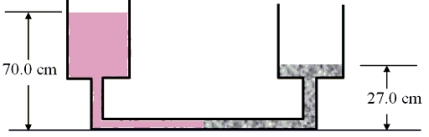
(Multiple Choice)
4.9/5  (75)
(75) When a block of volume 1.00 × 10⁻³ m3 is hung from a spring scale as shown in Figure A, the scale reads 10.0 N. When the same block is then placed in an unknown liquid, it floats with 2/3 of its volume submerged as suggested in Figure B. The density of water is 1.00 × 10³ kg/m3. 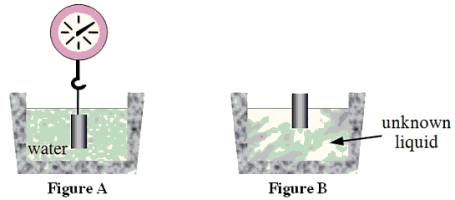 -Determine the density of the unknown liquid.
 (Multiple Choice)
4.9/5 (77)
(77) Oil ( = 925 kg/m3) is flowing through a pipeline at a constant speed when it encounters a vertical bend in the pipe raising it 4.0 m. The cross sectional area of the pipe does not change. What is the difference in pressure (PB - PA) in the portions of the pipe before and after the rise? 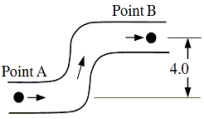
(Multiple Choice)
4.7/5 (74)
(74) An ice cube, = 917 kg/m3, is sliding down a frictionless incline as shown in the drawing. The sides of the cube each have a length of 0.75 m. What pressure does the cube exert on the incline? 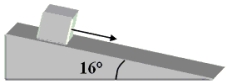
(Multiple Choice)
4.9/5 (73)
(73) A woman is enjoying a tropical drink while lying on a beach. The acceleration due to gravity at her location is 9.78 m/s2. What gauge pressure must exist in the woman's mouth if she is drinking through a straw extending 0.075 m above the surface of the drink? Note: Assume the drink has a density of 1020 kg/m3.
(Multiple Choice)
4.8/5 (72)
(72) Which one of the following statements concerning streamline flow is true?
(Multiple Choice)
4.9/5 (82)
(82) Selena uses a garden hose to fill a bucket of water. The water enters the hose through a faucet with a 6.0-cm diameter. The speed of the water at the faucet is 5 m/s. If the faucet and the nozzle are at the same height, and the water leaves the nozzle with a speed of 20 m/s, what is the diameter of the nozzle?
(Multiple Choice)
4.9/5 (67)
(67) At standard temperature and pressure, carbon dioxide has a density of 1.98 kg/m3. What volume does 1.70 kg of carbon dioxide occupy at standard temperature and pressure?
(Multiple Choice)
4.9/5 (81)
(81) When a block of volume 1.00 × 10⁻³ m3 is hung from a spring scale as shown in Figure A, the scale reads 10.0 N. When the same block is then placed in an unknown liquid, it floats with 2/3 of its volume submerged as suggested in Figure B. The density of water is 1.00 × 10³ kg/m3.
-Determine the mass of the block.
-Determine the mass of the block. (Multiple Choice)
4.9/5 (76)
(76) A u-shaped tube is connected to a flexible tube that has a membrane-covered funnel on the opposite end as shown in the drawing. Justin finds that no matter which way he orients to membrane, the height of the liquid in the u-shaped tube does not change. Which of the following choices best describes this behavior? 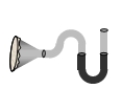
(Multiple Choice)
4.8/5 (91)
(91) What mass of water (at 4.0 °C) can be contained in a rectangular box whose dimensions are 10.0 cm by 5.00 cm by 1.00 cm? The density of water at 4.0 °C is 1.000 × 10³ kg/m3.
(Multiple Choice)
4.8/5 (83)
(83) How much force does the atmosphere exert on one side of a vertical wall 4.00-m high and 10.0-m long?
(Multiple Choice)
5.0/5 (81)
(81) Which one of the following statements concerning fluid streamlines is true?
(Multiple Choice)
4.8/5 (75)
(75) The density of ice is 0.92 g/cm3; and the density of seawater is 1.03 g/cm3. A large iceberg floats in Arctic waters. What fraction of the volume of the iceberg is exposed?
(Multiple Choice)
4.8/5 (77)
(77) A balloon is released from a tall building. The total mass of the balloon including the enclosed gas is 2.0 kg. Its volume is 5.0 m3. The density of air is 1.3 kg/m3.
-What is the magnitude of the initial acceleration of the balloon?
(Multiple Choice)
4.8/5 (77)
(77) The average density of the material in intergalactic space is approximately 2.5 × 10⁻²⁷ kg/m3. What is the volume of a lead sample, = 11 300 kg/m3, that has the same mass as 8.0 × 1024 m3 of intergalactic space?
(Multiple Choice)
4.9/5 (74)
(74) In a classroom demonstration, a 79.2-kg physics professor lies on a "bed of nails." The bed consists of a large number of evenly spaced, relatively sharp nails mounted in a board so that the points extend vertically outward from the board. While the professor is lying down, approximately 1950 nails make contact with his body.
-What is the average force exerted by each nail on the professor's body?
(Multiple Choice)
4.7/5 (84)
(84) Within a certain type of star called a neutron star, the material at the center has a mass density of 1.0 × 10¹⁸ kg/m3. If a tiny sphere of this material of radius 1.0 × 10⁻⁵ m were somehow transported to the surface of the earth, what would be the weight of this sphere?
(Multiple Choice)
4.8/5 (82)
(82) A force of 250 N is applied to a hydraulic jack piston that is 0.02 m in diameter. If the piston that supports the load has a diameter of 0.15 m, approximately how much mass can be lifted by the jack? Ignore any difference in height between the pistons.
(Multiple Choice)
4.8/5 (92)
(92) A glass tube has several different cross-sectional areas with the values indicated in the figure. A piston at the left end of the tube exerts pressure so that mercury within the tube flows from the right end with a speed of 8.0 m/s. Three points within the tube are labeled A, B, and C. 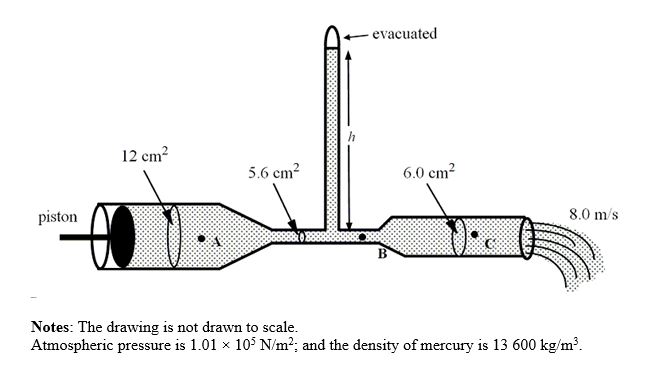 -At what speed is mercury flowing past the point labeled B?
 (Multiple Choice)
4.7/5 (87)
(87) 
Filters
- Essay(0)
- Multiple Choice(0)
- Short Answer(0)
- True False(0)
- Matching(0)