



 Chat with AI
Exam 12: Temperature and Heat

Exam 1: Introduction and Mathematical Concepts70 Questions
Exam 2: Kinematics in One Dimension103 Questions
Exam 3: Kinematics in Two Dimensions68 Questions
Exam 4: Forces and Newtons Laws of Motion103 Questions
Exam 5: Dynamics of Uniform Circular Motion59 Questions
Exam 6: Work and Energy78 Questions
Exam 7: Impulse and Momentum66 Questions
Exam 8: Rotational Kinematics55 Questions
Exam 9: Rotational Dynamics57 Questions
Exam 10: Simple Harmonic Motion and Elasticity63 Questions
Exam 11: Fluids65 Questions
Exam 12: Temperature and Heat66 Questions
Exam 13: The Transfer of Heat42 Questions
Exam 14: The Ideal Gas Law and Kinetic Theory55 Questions
Exam 15: Thermodynamics79 Questions
Exam 16: Waves and Sound67 Questions
Exam 17: The Principle of Linear Superposition and Interference Phenomena46 Questions
Exam 18: Electric Forces and Electric Fields61 Questions
Exam 19: Electric Potential Energy and the Electric Potential70 Questions
Exam 20: Electric Circuits100 Questions
Exam 21: Magnetic Forces and Magnetic Fields66 Questions
Exam 22: Electromagnetic Induction71 Questions
Exam 23: Alternating Current Circuits84 Questions
Exam 24: Electromagnetic Waves66 Questions
Exam 25: The Refl Ection of Light: Mirrors43 Questions
Exam 26: The Refraction of Light: Lenses and Optical Instruments102 Questions
Exam 27: Interference and the Wave Nature of Light57 Questions
Exam 28: Special Relativity63 Questions
Exam 29: Particles and Waves54 Questions
Exam 30: The Nature of the Atom74 Questions
Exam 31: Nuclear Physics and Radioactivity37 Questions
Exam 32: Ionizing Radiation, Nuclear Energy, and Elementary Particles45 Questions
Select questions type


Heat is added to a 1.0-kg solid sample of a material at -200 °C. The figure shows the temperature of the material as a function of the heat added. 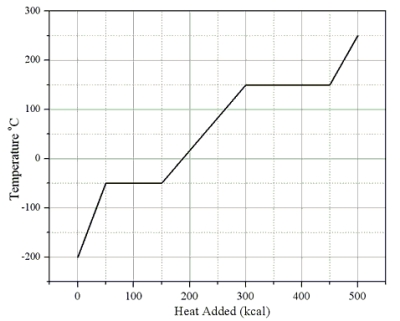 -What is the specific heat capacity of this substance in its liquid state?
 (Multiple Choice)
4.8/5  (81)
(81) Absolute zero on the Celsius temperature scale is -273.15 °C. What is absolute zero on the Fahrenheit temperature scale?
(Multiple Choice)
4.9/5 (87)
(87) A circular hole in an copper plate is 2.925 cm in diameter at 20.0 °C. What is the diameter of the hole if the temperature of the plate is raised to 120.0 °C? The coefficient of linear expansion of copper is 17 × 10-6/C°.
(Multiple Choice)
4.9/5 (85)
(85) The digital sign outside a local bank reports that the temperature is 41 °C. What is the temperature in degrees Fahrenheit?
(Multiple Choice)
4.8/5 (74)
(74) Heat is added to a 1.0-kg solid sample of a material at -200 °C. The figure shows the temperature of the material as a function of the heat added.
-Which one of the following statements concerning this substance is true?
-Which one of the following statements concerning this substance is true? (Multiple Choice)
4.9/5 (91)
(91) A 2.00-kg metal object requires 1.00 × 10⁴ J of heat to raise its temperature from 20.0 °C to 40.0 °C. What is the specific heat capacity of the metal?
(Multiple Choice)
4.9/5 (79)
(79) An aluminum plate has a length of 0.12 m and a width of 0.10 m at 25 °C. The plate is uniformly heated to 225 °C. If the linear expansion coefficient for aluminum is 2.3 × 10⁻⁵/C°, what is the change in the area of the plate as a result of the increase in temperature?
(Multiple Choice)
4.8/5 (75)
(75) The coefficient of volumetric expansion for gold is 4.20 × 10⁻⁵/C°. The density of gold is 19 300 kg/m3 at 0.0 °C. What is the density of gold at 1050 °C?
(Multiple Choice)
4.9/5 (68)
(68) What is the minimum amount of energy required to completely melt a 7.25-kg lead brick which has a starting temperature of 18.0 °C? The melting point of lead is 328 °C. The specific heat capacity of lead is 128 J/(kg · C°); and its latent heat of fusion is 23 200 J/kg.
(Multiple Choice)
4.9/5 (82)
(82) A thermos bottle contains 3.0 kg of water and 2.0 kg of ice in thermal equilibrium at 0 °C. How much heat is required to bring the system to thermal equilibrium at 50 °C?
(Multiple Choice)
4.7/5 (81)
(81) Heat is added to a substance, but its temperature does not rise. Which one of the following statements provides the best explanation for this observation?
(Multiple Choice)
4.8/5 (66)
(66) A metal rod 40.0000-cm long at 55.0 °C is heated to 85.0 °C. The length of the rod is then measured to be 40.0264 cm. What is the coefficient of linear expansion of the metal?
(Multiple Choice)
4.8/5 (86)
(86) A 0.040-kg ice cube at 0 °C is placed in an insulated box that contains 0.0075 kg of steam at 100 °C. What is the equilibrium temperature reached by this closed system? Note: Assume that all of the ice melts. 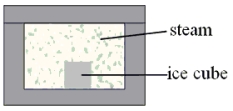
(Multiple Choice)
4.7/5 (85)
(85) A 0.0500-kg lead bullet of volume 5.00 × 10⁻⁶ m3 at 20.0 °C hits a block that is made of an ideal thermal insulator and comes to rest at its center. At that time, the temperature of the bullet is 327 °C. Use the following information for lead: 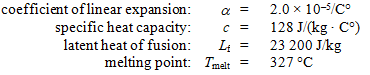 -What additional heat would be needed to melt the bullet?
 (Multiple Choice)
4.9/5 (78)
(78) Complete the following statement: A temperature decrease of 30 C° is equal to a temperature decrease of
(Multiple Choice)
4.8/5 (79)
(79) In an insulated container, 0.50 kg of steam, initially at 140 °C, is mixed with 2.0 kg of ice, initially at -20.0 °C. What is the final temperature inside the container if heat exchanges with the container are ignored?
(Multiple Choice)
4.9/5 (83)
(83) Given the following information, determine the relative humidity at 15 °C. 
(Multiple Choice)
4.7/5 (93)
(93) A 0.0500-kg lead bullet of volume 5.00 × 10⁻⁶ m3 at 20.0 °C hits a block that is made of an ideal thermal insulator and comes to rest at its center. At that time, the temperature of the bullet is 327 °C. Use the following information for lead:
-What is the volume of the bullet when it comes to rest?
-What is the volume of the bullet when it comes to rest? (Multiple Choice)
4.7/5 (88)
(88) At a certain temperature, a simple pendulum has a period of 1.500 seconds. The support wire is made of brass and has a coefficient of linear thermal expansion of 1.90 × 10⁻⁵/C°. How much must the temperature be increased to increase the period to 1.506 seconds?
(Multiple Choice)
4.7/5 (77)
(77) Three thermometers are in the same water bath. After thermal equilibrium is established, it is found that the Celsius thermometer reads 0 °C, the Fahrenheit thermometer reads 12 °F, and the Kelvin thermometer reads 273 K. Which one of the following statements is the most reasonable conclusion?
(Multiple Choice)
4.9/5 (82)
(82) 
Filters
- Essay(0)
- Multiple Choice(0)
- Short Answer(0)
- True False(0)
- Matching(0)