



 Chat with AI
Exam 13: The Transfer of Heat

Exam 1: Introduction and Mathematical Concepts70 Questions
Exam 2: Kinematics in One Dimension103 Questions
Exam 3: Kinematics in Two Dimensions68 Questions
Exam 4: Forces and Newtons Laws of Motion103 Questions
Exam 5: Dynamics of Uniform Circular Motion59 Questions
Exam 6: Work and Energy78 Questions
Exam 7: Impulse and Momentum66 Questions
Exam 8: Rotational Kinematics55 Questions
Exam 9: Rotational Dynamics57 Questions
Exam 10: Simple Harmonic Motion and Elasticity63 Questions
Exam 11: Fluids65 Questions
Exam 12: Temperature and Heat66 Questions
Exam 13: The Transfer of Heat42 Questions
Exam 14: The Ideal Gas Law and Kinetic Theory55 Questions
Exam 15: Thermodynamics79 Questions
Exam 16: Waves and Sound67 Questions
Exam 17: The Principle of Linear Superposition and Interference Phenomena46 Questions
Exam 18: Electric Forces and Electric Fields61 Questions
Exam 19: Electric Potential Energy and the Electric Potential70 Questions
Exam 20: Electric Circuits100 Questions
Exam 21: Magnetic Forces and Magnetic Fields66 Questions
Exam 22: Electromagnetic Induction71 Questions
Exam 23: Alternating Current Circuits84 Questions
Exam 24: Electromagnetic Waves66 Questions
Exam 25: The Refl Ection of Light: Mirrors43 Questions
Exam 26: The Refraction of Light: Lenses and Optical Instruments102 Questions
Exam 27: Interference and the Wave Nature of Light57 Questions
Exam 28: Special Relativity63 Questions
Exam 29: Particles and Waves54 Questions
Exam 30: The Nature of the Atom74 Questions
Exam 31: Nuclear Physics and Radioactivity37 Questions
Exam 32: Ionizing Radiation, Nuclear Energy, and Elementary Particles45 Questions
Select questions type


A blue supergiant star has a radius of 7.4 × 10¹⁰ m. The spherical surface behaves as a blackbody radiator. If the surface temperature is 2.4 × 10⁴ K, what is the rate at which energy is radiated from the star?
(Multiple Choice)
4.8/5  (81)
(81) Two kilograms of ice at 0.0 °C are placed in a sealed glass container [k = 0.80 W/(m · C°)]. The container is then placed in a room that is maintained at 30.0 °C. The top cover is a thermal insulator and all other sides of the container are exposed to room air. The surface area of the container is 6.53 × 10⁻² m2; and its glass walls are 0.0050 m thick.
-How much heat is required to melt the ice?
(Multiple Choice)
4.9/5 (80)
(80) Assuming a filament in a 100 W light bulb acts like a perfect blackbody, what is the temperature of the hottest portion of the filament if it has a surface area of 6.3 × 10⁻⁵ m2? The Stefan-Boltzmann constant is 5.67 × 10⁻⁸ W/(m2 · K2).
(Multiple Choice)
5.0/5 (83)
(83) Two bars, A and B, each of length 2.0 m and cross sectional area 1.0 m2, are placed end to end as shown in the figure. 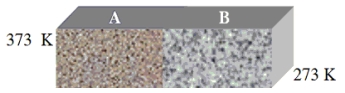 The thermal conductivities of the bars are
kA = 439 J/(s . m . K) and kB = 887 J/(s . m . K), respectively. The left end of bar A is maintained at 373 K while the right end of B is maintained at 273 K.
-What is the temperature at the interface between A and B?
The thermal conductivities of the bars are
kA = 439 J/(s . m . K) and kB = 887 J/(s . m . K), respectively. The left end of bar A is maintained at 373 K while the right end of B is maintained at 273 K.
-What is the temperature at the interface between A and B? (Multiple Choice)
4.9/5 (75)
(75) Complete the following statement: Most of the heat that is lost to space from the earth occurs by
(Multiple Choice)
4.9/5 (79)
(79) Which one of the following is not an example of convection?
(Multiple Choice)
4.9/5 (84)
(84) Two identical solid spheres have the same temperature. One of the spheres is cut into two identical pieces. These two hemispheres are then separated. The intact sphere radiates an energy Q during a given time interval. During the same interval, the two hemispheres radiate a total energy Q'. What is the ratio Q'/Q?
(Multiple Choice)
4.7/5 (80)
(80) The two ends of an iron rod are maintained at different temperatures. The amount of heat that flows through the rod by conduction during a given time interval does not depend upon
(Multiple Choice)
4.9/5 (84)
(84) Two bars, A and B, each of length 2.0 m and cross sectional area 1.0 m2, are placed end to end as shown in the figure. The thermal conductivities of the bars are
kA = 439 J/(s . m . K) and kB = 887 J/(s . m . K), respectively. The left end of bar A is maintained at 373 K while the right end of B is maintained at 273 K.
-How much heat passes the interface between A and B in 6.0 s?
The thermal conductivities of the bars are
kA = 439 J/(s . m . K) and kB = 887 J/(s . m . K), respectively. The left end of bar A is maintained at 373 K while the right end of B is maintained at 273 K.
-How much heat passes the interface between A and B in 6.0 s? (Multiple Choice)
4.9/5 (77)
(77) Assume that the sun is a sphere of radius 6.96 × 10⁸ m and that its surface temperature is 5.8 × 10³ K. If the sun radiates at a rate of 3.90 × 1026 W and is a perfect emitter, at what rate is energy emitted per square meter at the sun's surface?
(Multiple Choice)
4.8/5 (74)
(74) On a cold winter day, the outside temperature is -5.0 °C while the interior of a well-insulated garage is maintained at 20.0 °C by an electric heater. Assume the walls have a total area of 75 m2, a thickness of 0.15 m, and a thermal conductivity of 0.042 W/(m · C°). What is the cost to heat the garage for six hours at these temperatures if the cost of electricity is $ 0.11/kWh? Note: 1 kWh = 3.6 × 10⁶ J.
(Multiple Choice)
4.8/5 (87)
(87) The sun continuously radiates energy into space in all directions. Some of the sun's energy is intercepted by the earth. The average temperature of the surface of the earth remains a little above 300 K. Why doesn't the earth's temperature rise as it intercepts the sun's energy?
(Multiple Choice)
4.8/5 (93)
(93) Which one of the following statements concerning the Stefan-Boltzmann equation is true?
(Multiple Choice)
4.8/5 (86)
(86) Heat is conducted by two cylindrical rods, one carbon and one aluminum, with identical cross-sectional area and length. The temperature difference between the ends of each rod is the same. Carbon has a thermal conductivity of 1100 J/(s . m . C°) and that of aluminum is 240 J/(s . m . C°). What percentage of the total energy transferred by the two rods each second is conducted by the silver rod?
(Multiple Choice)
4.9/5 (76)
(76) Which one of the following graphs shows the rate at which heat is emitted from a hot body as a function of its Kelvin temperature T? 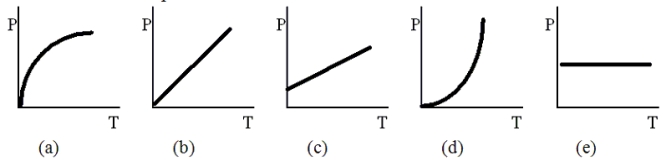
(Multiple Choice)
5.0/5 (79)
(79) Which one of the following statements concerning emissivity is false?
(Multiple Choice)
4.7/5 (68)
(68) A slab of insulation is made of three layers, as Drawing I indicates. Each of the layers A, B, and C has the same thickness, but a different thermal conductivity. Heat flows through the slab, and the temperatures are as shown. What are the temperatures T1 and T2 in Drawing II where the layers are arranged in a different order? 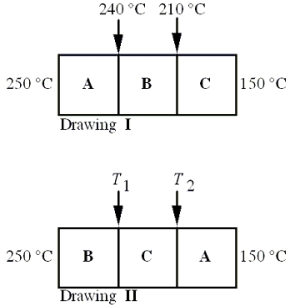
(Multiple Choice)
4.9/5 (80)
(80) Which one of the following objects, all initially at the same temperature, will be most efficient in losing heat?
(Multiple Choice)
4.9/5 (79)
(79) A hot metal ball is hung in an oven that is maintained at 700 K; and it cools. When the temperature of the ball is 950 K, it is losing heat at a rate of 0.15 J/min. At what rate will the ball lose heat when the ball reaches 820 K? Assume that the emissivity of the ball and its surface area do not change appreciably with temperature.
(Multiple Choice)
4.9/5 (72)
(72) Two cylindrical steel rods A and B have radii of 0.02 m and 0.04 m, respectively. The two steel rods conduct the same amount of heat per unit time for the same temperature differences between their two ends. What is the ratio of the lengths of the rods, LA/LB?
(Multiple Choice)
4.9/5 (75)
(75) 
Filters
- Essay(0)
- Multiple Choice(0)
- Short Answer(0)
- True False(0)
- Matching(0)