



 Chat with AI
Exam 17: The Principle of Linear Superposition and Interference Phenomena

Exam 1: Introduction and Mathematical Concepts70 Questions
Exam 2: Kinematics in One Dimension103 Questions
Exam 3: Kinematics in Two Dimensions68 Questions
Exam 4: Forces and Newtons Laws of Motion103 Questions
Exam 5: Dynamics of Uniform Circular Motion59 Questions
Exam 6: Work and Energy78 Questions
Exam 7: Impulse and Momentum66 Questions
Exam 8: Rotational Kinematics55 Questions
Exam 9: Rotational Dynamics57 Questions
Exam 10: Simple Harmonic Motion and Elasticity63 Questions
Exam 11: Fluids65 Questions
Exam 12: Temperature and Heat66 Questions
Exam 13: The Transfer of Heat42 Questions
Exam 14: The Ideal Gas Law and Kinetic Theory55 Questions
Exam 15: Thermodynamics79 Questions
Exam 16: Waves and Sound67 Questions
Exam 17: The Principle of Linear Superposition and Interference Phenomena46 Questions
Exam 18: Electric Forces and Electric Fields61 Questions
Exam 19: Electric Potential Energy and the Electric Potential70 Questions
Exam 20: Electric Circuits100 Questions
Exam 21: Magnetic Forces and Magnetic Fields66 Questions
Exam 22: Electromagnetic Induction71 Questions
Exam 23: Alternating Current Circuits84 Questions
Exam 24: Electromagnetic Waves66 Questions
Exam 25: The Refl Ection of Light: Mirrors43 Questions
Exam 26: The Refraction of Light: Lenses and Optical Instruments102 Questions
Exam 27: Interference and the Wave Nature of Light57 Questions
Exam 28: Special Relativity63 Questions
Exam 29: Particles and Waves54 Questions
Exam 30: The Nature of the Atom74 Questions
Exam 31: Nuclear Physics and Radioactivity37 Questions
Exam 32: Ionizing Radiation, Nuclear Energy, and Elementary Particles45 Questions
Select questions type


A string with a linear density of 0.035 kg/m and a mass of 0.014 kg is clamped at both ends. Under what tension in the string will it have a fundamental frequency of 110 Hz?
(Multiple Choice)
5.0/5  (69)
(69) What is the distance to the nearest antinode from the fixed end of a guitar string vibrating at its first harmonic?
(Multiple Choice)
4.9/5 (69)
(69) A guitar string has a linear density of 8.30 × 10⁻⁴ kg/m and a length of 0.660 m. The tension in the string is 56.7 N. When the fundamental frequency of the string is sounded with a 196.0-Hz tuning fork, what beat frequency is heard?
(Multiple Choice)
4.9/5 (68)
(68) A 6.00-m long string sustains a three-loop standing wave pattern as shown. The wave speed is 2.00 × 10² m/s.  -What is the lowest possible frequency for standing waves on this string?
 (Multiple Choice)
4.9/5 (77)
(77) A 4.00-m long string, clamped at both ends, vibrates at 2.00 × 10² Hz. If the string resonates in six segments, what is the speed of transverse waves on the string?
(Multiple Choice)
4.8/5 (84)
(84) Water waves approach an aperture. The resulting patterns are shown for two different cases, A and B, in which the wavelength and aperture size are varied. 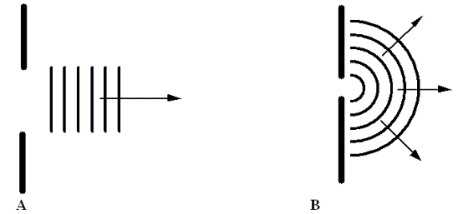 Which one of the following statements concerning these cases is true?
 (Multiple Choice)
4.9/5 (94)
(94) When a tuba is played, the player makes a buzzing sound and blows into one end of a tube that has an effective length of 3.50 m. The other end of the tube is open. If the speed of sound in air is 343 m/s, what is the lowest frequency the tuba can produce?
(Multiple Choice)
5.0/5 (70)
(70) A pebble is dropped in a lake; and it produces ripples with a frequency of 0.50 Hz. When should a second pebble be dropped at the same place to produce destructive interference?
(Multiple Choice)
4.8/5 (74)
(74) A certain string, clamped at both ends, vibrates in seven segments at a frequency of 2.40 × 10² Hz. What frequency will cause it to vibrate in four segments?
(Multiple Choice)
4.8/5 (81)
(81) Two loudspeakers, A and B, are separated by a distance of 2.0 m. The speakers emit sound waves at a frequency of 680 Hz that are exactly out of phase. The speed of sound is 343 m/s. How far from speaker A along the +x axis will a point of constructive interference occur? 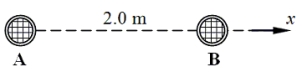
(Multiple Choice)
4.7/5 (77)
(77) A cylindrical tube sustains a fundamental frequency f1 when both of its ends are open. A second cylindrical tube with one end closed has the same fundamental frequency. What is the ratio of the length of the second tube to that of the first, L2/L1?
(Multiple Choice)
4.8/5 (77)
(77) Pipe A is 0.50 m long and open at both ends. Pipe B is open at one end and closed at the other end. Determine the length of pipe B so that it has the same fundamental frequency as A.
(Multiple Choice)
4.8/5 (74)
(74) The beat period occurring when two tuning forks are vibrating is 0.333 s. One of the forks is known to vibrate at 588.0 Hz. What are the possible vibration frequencies of the second tuning fork?
(Multiple Choice)
4.7/5 (96)
(96) Vibrations with frequency 6.00 × 10² Hz are established on a 1.33-m length of string that is clamped at both ends. The speed of waves on the string is 4.00 × 10² m/s.
-How far from either end of the string does the first node occur?
(Multiple Choice)
4.9/5 (98)
(98) A string with a length of 3.0 m has two adjacent resonances at frequencies 112 Hz and 140 Hz.
-How many antinodes will be found on the 112 Hz resonance?
(Multiple Choice)
4.9/5 (88)
(88) Consider the figures depicting rectangular pulses on a string. 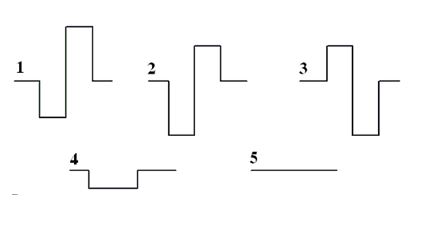 -Complete the following statement: If pulse 2 were superimposed on pulse 3,
 (Multiple Choice)
4.7/5 (86)
(86) When plucked, a 0.62-m guitar string produces a sound wave with a fundamental frequency of 196 Hz. The speed of sound in air is 343 m/s. Determine the ratio of the wavelength of the sound wave to the wavelength of the waves that travel on the string.
(Multiple Choice)
4.9/5 (69)
(69) One string on a guitar is exactly in tune. The guitarist uses this string to produce a tone with a frequency of 196 Hz by pressing down at the proper fret. An adjacent string can also be used to produce this tone without being pressed against a fret. However, this adjacent string is out of tune and produces a tone that sounds lower in frequency than the other tone. When the tones are produced simultaneously, the beat frequency is 5.0 Hz. What frequency does the adjacent string produce?
(Multiple Choice)
4.9/5 (84)
(84) A string with a length of 3.0 m has two adjacent resonances at frequencies 112 Hz and 140 Hz.
-Determine the wavelength of the 140 Hz resonance.
(Multiple Choice)
5.0/5 (87)
(87) A speaker generates a continuous tone of 440 Hz. In the drawing, sound travels into a tube that splits into two segments, one longer than the other. The sound waves recombine before being detected by a microphone. The speed of sound in air is 339 m/s. What is the minimum difference in the lengths of the two paths for sound travel if the waves arrive exactly out of phase at the microphone? 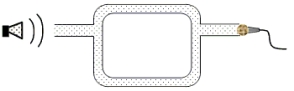
(Multiple Choice)
4.9/5 (76)
(76) 
Filters
- Essay(0)
- Multiple Choice(0)
- Short Answer(0)
- True False(0)
- Matching(0)