



 Chat with AI
Exam 19: Electric Potential Energy and the Electric Potential

Exam 1: Introduction and Mathematical Concepts70 Questions
Exam 2: Kinematics in One Dimension103 Questions
Exam 3: Kinematics in Two Dimensions68 Questions
Exam 4: Forces and Newtons Laws of Motion103 Questions
Exam 5: Dynamics of Uniform Circular Motion59 Questions
Exam 6: Work and Energy78 Questions
Exam 7: Impulse and Momentum66 Questions
Exam 8: Rotational Kinematics55 Questions
Exam 9: Rotational Dynamics57 Questions
Exam 10: Simple Harmonic Motion and Elasticity63 Questions
Exam 11: Fluids65 Questions
Exam 12: Temperature and Heat66 Questions
Exam 13: The Transfer of Heat42 Questions
Exam 14: The Ideal Gas Law and Kinetic Theory55 Questions
Exam 15: Thermodynamics79 Questions
Exam 16: Waves and Sound67 Questions
Exam 17: The Principle of Linear Superposition and Interference Phenomena46 Questions
Exam 18: Electric Forces and Electric Fields61 Questions
Exam 19: Electric Potential Energy and the Electric Potential70 Questions
Exam 20: Electric Circuits100 Questions
Exam 21: Magnetic Forces and Magnetic Fields66 Questions
Exam 22: Electromagnetic Induction71 Questions
Exam 23: Alternating Current Circuits84 Questions
Exam 24: Electromagnetic Waves66 Questions
Exam 25: The Refl Ection of Light: Mirrors43 Questions
Exam 26: The Refraction of Light: Lenses and Optical Instruments102 Questions
Exam 27: Interference and the Wave Nature of Light57 Questions
Exam 28: Special Relativity63 Questions
Exam 29: Particles and Waves54 Questions
Exam 30: The Nature of the Atom74 Questions
Exam 31: Nuclear Physics and Radioactivity37 Questions
Exam 32: Ionizing Radiation, Nuclear Energy, and Elementary Particles45 Questions
Select questions type


At what distance from a 1.0-C charge is the electric potential equal to 12 V?
(Multiple Choice)
4.9/5  (89)
(89) The sketch below shows cross sections of equipotential surfaces between two charged conductors that are shown in solid grey. Various points on the equipotential surfaces near the conductors are labeled A, B, C, ..., I. 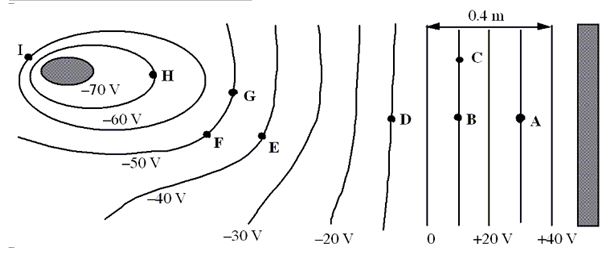 -At which of the labeled points will an electron have the greatest potential energy?
 (Multiple Choice)
4.9/5 (88)
(88) Two positive charges are located at points A and B as shown in the figure. The distance from each charge to the point P is a = 2.0 m. 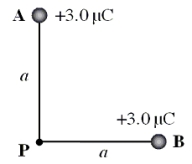 -Which statement is true concerning the direction of the electric field at P?
 (Multiple Choice)
4.9/5 (84)
(84) Which one of the following statements best describes the equipotential surfaces surrounding a point charge?
(Multiple Choice)
4.9/5 (89)
(89) The plates of a parallel plate capacitor each have an area of 0.40 m2 and are separated by a distance of 0.02 m. They are charged until the potential difference between the plates is 3000 V. The charged capacitor is then isolated.
-Determine the magnitude of the electric field between the capacitor plates.
(Multiple Choice)
4.9/5 (73)
(73) A +1.0 C point charge is moved from point A to B in the uniform electric field as shown. Which one of the following statements is necessarily true concerning the potential energy of the point charge? 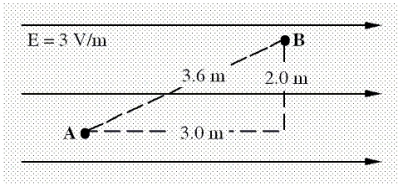
(Multiple Choice)
4.8/5 (88)
(88) Two charges of opposite sign and equal magnitude Q = 0.82 C are held 2.0 m apart as shown in the figure. 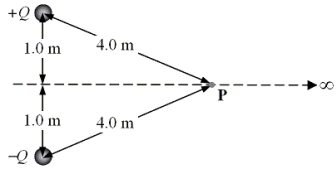 -How much work is required to move a 1.0 C charge from infinity to the point P?
 (Multiple Choice)
4.9/5 (60)
(60) Which one of the following statements best explains why it is possible to define an electrostatic potential in a region of space that contains an electrostatic field?
(Multiple Choice)
4.9/5 (76)
(76) Two point charges are arranged along the x axis as shown in the figure. At which of the following values of x is the electric potential equal to zero? Note: At infinity, the electric potential is zero. 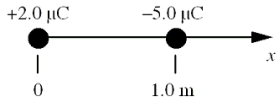
(Multiple Choice)
4.7/5 (75)
(75) The sketch shows cross sections of equipotential surfaces between two charged conductors shown in solid black. Points on the equipotential surfaces near the conductors are labeled A, B, C, ..., H. 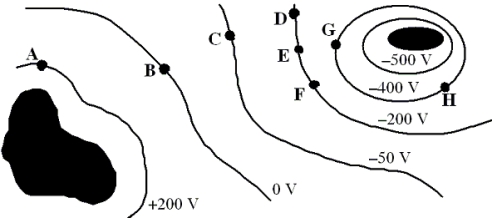 -How much work is required to move a +6.0 µC point charge from B to F to D to A?
 (Multiple Choice)
4.7/5 (86)
(86) 
Filters
- Essay(0)
- Multiple Choice(0)
- Short Answer(0)
- True False(0)
- Matching(0)