



 Chat with AI
Exam 21: Magnetic Forces and Magnetic Fields

Exam 1: Introduction and Mathematical Concepts70 Questions
Exam 2: Kinematics in One Dimension103 Questions
Exam 3: Kinematics in Two Dimensions68 Questions
Exam 4: Forces and Newtons Laws of Motion103 Questions
Exam 5: Dynamics of Uniform Circular Motion59 Questions
Exam 6: Work and Energy78 Questions
Exam 7: Impulse and Momentum66 Questions
Exam 8: Rotational Kinematics55 Questions
Exam 9: Rotational Dynamics57 Questions
Exam 10: Simple Harmonic Motion and Elasticity63 Questions
Exam 11: Fluids65 Questions
Exam 12: Temperature and Heat66 Questions
Exam 13: The Transfer of Heat42 Questions
Exam 14: The Ideal Gas Law and Kinetic Theory55 Questions
Exam 15: Thermodynamics79 Questions
Exam 16: Waves and Sound67 Questions
Exam 17: The Principle of Linear Superposition and Interference Phenomena46 Questions
Exam 18: Electric Forces and Electric Fields61 Questions
Exam 19: Electric Potential Energy and the Electric Potential70 Questions
Exam 20: Electric Circuits100 Questions
Exam 21: Magnetic Forces and Magnetic Fields66 Questions
Exam 22: Electromagnetic Induction71 Questions
Exam 23: Alternating Current Circuits84 Questions
Exam 24: Electromagnetic Waves66 Questions
Exam 25: The Refl Ection of Light: Mirrors43 Questions
Exam 26: The Refraction of Light: Lenses and Optical Instruments102 Questions
Exam 27: Interference and the Wave Nature of Light57 Questions
Exam 28: Special Relativity63 Questions
Exam 29: Particles and Waves54 Questions
Exam 30: The Nature of the Atom74 Questions
Exam 31: Nuclear Physics and Radioactivity37 Questions
Exam 32: Ionizing Radiation, Nuclear Energy, and Elementary Particles45 Questions
Select questions type


A particle with a mass of 6.64 × 10⁻²⁷ kg and a charge of +3.20 × 10⁻¹⁹ C is accelerated from rest through a potential difference of 2.45 × 10⁶ V. The particle then enters a uniform 1.60-T magnetic field. If the particle's velocity is perpendicular to the magnetic field at all times, what is the magnitude of the magnetic force exerted on the particle?
(Multiple Choice)
4.8/5  (78)
(78) A wire is bent into the shape of a circle of radius r = 0.10 m and carries a 20.0-A current in the direction shown. 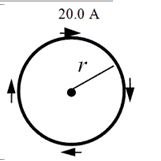 -Determine the magnetic moment of the loop.
 (Multiple Choice)
4.9/5 (91)
(91) A long, straight, vertical segment of wire traverses a magnetic field of magnitude 2.0 T in the direction shown in the diagram. The length of the wire that lies in the magnetic field is 0.060 m. When the switch is closed, a current of 4.0 A flows through the wire from point P to point Q. 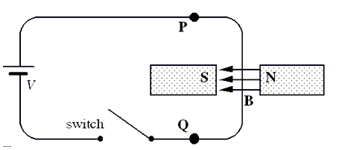 -What is the magnitude of the magnetic force acting on the wire?
 (Multiple Choice)
4.7/5 (85)
(85) A single circular loop of wire with radius 0.025 m carries a current of 6.0 A. It is placed at the center of a solenoid that has length 0.60 m, radius 0.075 m, and 1200 turns. 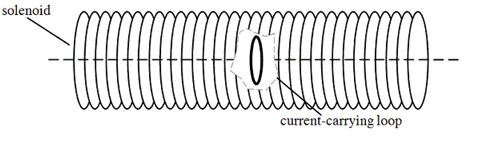 -Determine the magnitude of the total magnetic field at the center of the loop (due both to the loop and the solenoid) if the current in the loop is reversed in direction from that needed to make the total field equal to zero tesla.
 (Multiple Choice)
4.9/5 (77)
(77) A solenoid of length 0.250 m and radius 0.0250 m is comprised of 440 turns of wire. Determine the magnitude of the magnetic field at the center of the solenoid when it carries a current of 12.0 A.
(Multiple Choice)
4.8/5 (67)
(67) A proton is traveling south as it enters a region that contains a magnetic field. The proton is deflected downward toward the earth. What is the direction of the magnetic field?
(Multiple Choice)
4.8/5 (65)
(65) A long, coaxial cable, shown in cross-section in the drawing, is made using two conductors that share a common central axis, labeled C. The conductors are separated by an electrically insulating material that is also used as the outer cover of the cable. The current in the inner conductor is 2.0 A directed into the page and that in the outer conductor is 2.5 A directed out of the page. The distance from point C to point A is 0.0015 m; and the distance from C to B is 0.0030 m. The radii a and b of the conductors are 6.0 × 10⁻⁴ m and 1.9 × 10⁻³ m, respectively. 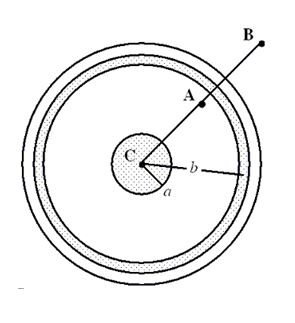 -What is the magnitude and direction of the magnetic field at point A?
 (Multiple Choice)
4.8/5 (94)
(94) A charged particle is moving in a uniform, constant magnetic field. Which one of the following statements concerning the magnetic force exerted on the particle is false?
(Multiple Choice)
4.9/5 (84)
(84) An electron is moving with a speed of 3.5 × 10⁵ m/s when it encounters a magnetic field of 0.60 T. The direction of the magnetic field makes an angle of 60.0° with respect to the velocity of the electron. What is the magnitude of the magnetic force on the electron?
(Multiple Choice)
4.8/5 (90)
(90) A long, straight wire carries a current I. If the magnetic field at a distance d from the wire has magnitude B, what is the magnitude of the magnetic field at a distance 2d from the wire?
(Multiple Choice)
4.7/5 (84)
(84) A rectangular loop has sides of length 0.06 m and 0.08 m. The wire carries a current of 10 A in the direction shown. The loop is in a uniform magnetic field of magnitude 0.2 T and directed in the positive x direction. What is the magnitude of the torque on the loop? 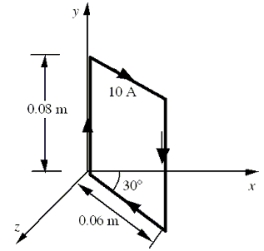
(Multiple Choice)
4.9/5 (69)
(69) Two long, straight, parallel wires separated by a distance d carry currents in opposite directions as shown in the figure. The bottom wire carries a current of 6.0 A. Point C is at the midpoint between the wires and point O is a distance 0.50d below the 6-A wire as suggested in the figure. The total magnetic field at point O is zero tesla. 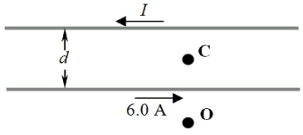 -Determine the value of the current, I, in the top wire.
 (Multiple Choice)
4.8/5 (72)
(72) Two electrons are located in a region of space where the magnetic field is zero. Electron A is at rest; and electron B is moving westward with a constant velocity. A non-zero magnetic field directed eastward is then applied to the region. In what direction, if any, will each electron be moving after the field is applied? 
(Multiple Choice)
4.9/5 (80)
(80) Which one of the following statements concerning the magnetic force on a charged particle in a magnetic field is true?
(Multiple Choice)
5.0/5 (69)
(69) An electron traveling due south enters a region that contains both a magnetic field and an electric field. The electric field lines point due west. It is observed that the electron continues to travel in a straight line due south. In which direction must the magnetic field lines point?
(Multiple Choice)
4.9/5 (92)
(92) An overhead electric power line carries a maximum current of 125 A. What is the magnitude of the maximum magnetic field at a point 4.50 m directly below the power line?
(Multiple Choice)
5.0/5 (83)
(83) Two long, straight wires separated by 0.10 m carry currents of 18 A and 6 A in the same direction as shown. 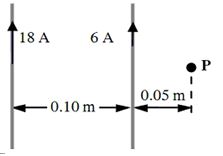 -Determine the magnitude of the magnetic field at the point P.
 (Multiple Choice)
4.8/5 (76)
(76) A beam consisting of five types of ions labeled A, B, C, D, and E enters a region that contains a uniform magnetic field as shown in the figure below. The field is perpendicular to the plane of the paper, but its precise direction is not given. All ions in the beam travel with the same speed. The table below gives the masses and charges of the ions. Note: 1 mass unit = 1.67 × 10⁻²⁷ kg and e = 1.6 × 10⁻¹⁹ C 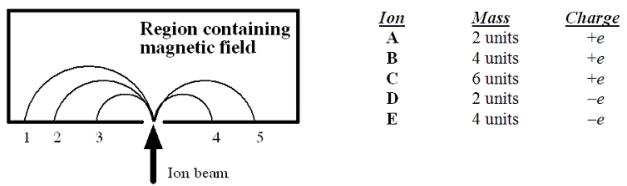 -Which ion falls at position 2?
 (Multiple Choice)
4.7/5 (81)
(81) Four long, straight wires are parallel to each other; and their cross-section forms a square. Each side of the square is 0.020 m as shown in the figure. If each wire carries a current of 8.0 A in the direction shown in the figure, determine the magnitude of the total magnetic field at P, the center of the square. 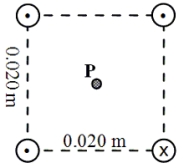
(Multiple Choice)
4.8/5 (83)
(83) A wire is bent into the shape of a circle of radius r = 0.10 m and carries a 20.0-A current in the direction shown.
-What is the direction of the magnetic field at the center of the loop?
-What is the direction of the magnetic field at the center of the loop? (Multiple Choice)
4.9/5 (72)
(72) 
Filters
- Essay(0)
- Multiple Choice(0)
- Short Answer(0)
- True False(0)
- Matching(0)