



 Chat with AI
Exam 24: Electromagnetic Waves

Exam 1: Introduction and Mathematical Concepts70 Questions
Exam 2: Kinematics in One Dimension103 Questions
Exam 3: Kinematics in Two Dimensions68 Questions
Exam 4: Forces and Newtons Laws of Motion103 Questions
Exam 5: Dynamics of Uniform Circular Motion59 Questions
Exam 6: Work and Energy78 Questions
Exam 7: Impulse and Momentum66 Questions
Exam 8: Rotational Kinematics55 Questions
Exam 9: Rotational Dynamics57 Questions
Exam 10: Simple Harmonic Motion and Elasticity63 Questions
Exam 11: Fluids65 Questions
Exam 12: Temperature and Heat66 Questions
Exam 13: The Transfer of Heat42 Questions
Exam 14: The Ideal Gas Law and Kinetic Theory55 Questions
Exam 15: Thermodynamics79 Questions
Exam 16: Waves and Sound67 Questions
Exam 17: The Principle of Linear Superposition and Interference Phenomena46 Questions
Exam 18: Electric Forces and Electric Fields61 Questions
Exam 19: Electric Potential Energy and the Electric Potential70 Questions
Exam 20: Electric Circuits100 Questions
Exam 21: Magnetic Forces and Magnetic Fields66 Questions
Exam 22: Electromagnetic Induction71 Questions
Exam 23: Alternating Current Circuits84 Questions
Exam 24: Electromagnetic Waves66 Questions
Exam 25: The Refl Ection of Light: Mirrors43 Questions
Exam 26: The Refraction of Light: Lenses and Optical Instruments102 Questions
Exam 27: Interference and the Wave Nature of Light57 Questions
Exam 28: Special Relativity63 Questions
Exam 29: Particles and Waves54 Questions
Exam 30: The Nature of the Atom74 Questions
Exam 31: Nuclear Physics and Radioactivity37 Questions
Exam 32: Ionizing Radiation, Nuclear Energy, and Elementary Particles45 Questions
Select questions type


What would the speed of an observer be if a red (4.688 × 10¹⁴ Hz) traffic light appeared green (5.555 × 10¹⁴ Hz) to the observer?
(Multiple Choice)
4.9/5  (85)
(85) A cellular telephone transmits electromagnetic waves at a frequency of 835 MHz. What is the wavelength of these waves?
(Multiple Choice)
5.0/5 (79)
(79) Which one of the following statements concerning the wavelength of an electromagnetic wave in a vacuum is true?
(Multiple Choice)
4.8/5 (60)
(60) The peak value of the electric field component of an electromagnetic wave is E. At a particular instant, the intensity of the wave is of 0.020 W/m2. If the electric field were increased to 5E, what would be the intensity of the wave?
(Multiple Choice)
4.7/5 (76)
(76) A linearly polarized electromagnetic wave is sent through two sheets of polarizing material. The first sheet, A, is oriented so that its transmission axis makes an angle of 30° with respect to the incident electric field of the wave. The second sheet, B, is oriented so that its transmission axis makes an angle of 90° with the incident electric field of the wave. The incident beam has an electric field of peak magnitude E0 and average intensity S0. 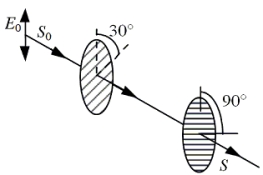 -What is the peak value of the electric field amplitude after it goes through sheet A?
 (Multiple Choice)
4.7/5 (71)
(71) The figure shows the time variation of the magnitude of the electric field of an electromagnetic wave produced by a wire antenna. 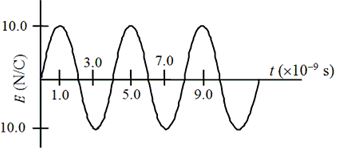 -What is the average total energy density of this electromagnetic wave?
 (Multiple Choice)
4.7/5 (75)
(75) The figure shows the time variation of the magnitude of the electric field of an electromagnetic wave produced by a wire antenna.
-Determine the wavelength of the wave.
-Determine the wavelength of the wave. (Multiple Choice)
4.8/5 (76)
(76) Which one of the following statements concerning electromagnetic waves is false?
(Multiple Choice)
4.8/5 (76)
(76) A linearly polarized electromagnetic wave is sent through two sheets of polarizing material. The first sheet, A, is oriented so that its transmission axis makes an angle of 30° with respect to the incident electric field of the wave. The second sheet, B, is oriented so that its transmission axis makes an angle of 90° with the incident electric field of the wave. The incident beam has an electric field of peak magnitude E0 and average intensity S0.
-What is the average intensity of the wave after it passes through B?
-What is the average intensity of the wave after it passes through B? (Multiple Choice)
5.0/5 (84)
(84) The figure shows the time variation of the magnitude of the electric field of an electromagnetic wave produced by a wire antenna.
-What is the magnitude of the magnetic field at t = 6.0 × 10⁻⁹ s?
-What is the magnitude of the magnetic field at t = 6.0 × 10⁻⁹ s? (Multiple Choice)
5.0/5 (79)
(79) The electromagnetic wave of the radiation field from a wire antenna travels toward the plane of your paper (which is in the -z direction). At time t = 0 s, the wave strikes your paper at normal incidence. The magnetic field vector at point O in the figure points in the -y direction and has a magnitude of 4.0 × 10⁻⁸ T. The frequency of the wave is 1.0 × 10¹⁶ Hz. 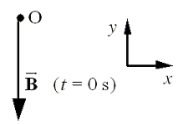 -What is the rms value of the electric field? Assume that the figure shows the peak value of
 .
-What is the rms value of the electric field? Assume that the figure shows the peak value of . (Multiple Choice)
4.9/5 (87)
(87) The amplitude of the electric field component of an electromagnetic wave is increased from E to 3E. What is the corresponding change in the intensity of the wave?
(Multiple Choice)
4.8/5 (92)
(92) The magnitude of the magnetic field component of a plane polarized electromagnetic wave traveling in vacuum is given by By = Bo sin[k z - t]. Which one of the following statements concerning this electromagnetic wave is true?
(Multiple Choice)
4.9/5 (83)
(83) Which one of the following statements concerning the energy carried by an electromagnetic wave is true?
(Multiple Choice)
4.8/5 (88)
(88) The electromagnetic wave of the radiation field from a wire antenna travels toward the plane of your paper (which is in the -z direction). At time t = 0 s, the wave strikes your paper at normal incidence. The magnetic field vector at point O in the figure points in the -y direction and has a magnitude of 4.0 × 10⁻⁸ T. The frequency of the wave is 1.0 × 10¹⁶ Hz.
-What is the magnitude of the associated electric field at time t = 0 s?
-What is the magnitude of the associated electric field at time t = 0 s? (Multiple Choice)
4.8/5 (80)
(80) Light emerges from a polarizer that has its transmission axis located along the x axis. The light then passes through two additional sheets of polarizing material. It is desired to orient the two sheets so that, after passing through both of them, the electromagnetic wave has the maximum possible intensity and is polarized 90° with respect to the x axis. How should the transmission axes of the sheets be oriented? Note: the following answers give the angles that the transmission axes make with respect to the x axis. 
(Multiple Choice)
4.8/5 (71)
(71) What is the correct order, beginning with shortest wavelength and extending to the longest wavelength, of the following colors in the visible light spectrum: blue, green, red, violet, and yellow?
(Multiple Choice)
4.9/5 (85)
(85) An electromagnetic wave has an electric field with a peak value of 250 N/C. What is the average intensity of the wave?
(Multiple Choice)
4.9/5 (80)
(80) The figure shows the time variation of the magnitude of the electric field of an electromagnetic wave produced by a wire antenna.
-What is the magnitude of the magnetic field at t = 6.67 × 10⁻¹⁰ s?
-What is the magnitude of the magnetic field at t = 6.67 × 10⁻¹⁰ s? (Multiple Choice)
4.8/5 (84)
(84) The electromagnetic wave of the radiation field from a wire antenna travels toward the plane of your paper (which is in the -z direction). At time t = 0 s, the wave strikes your paper at normal incidence. The magnetic field vector at point O in the figure points in the -y direction and has a magnitude of 4.0 × 10⁻⁸ T. The frequency of the wave is 1.0 × 10¹⁶ Hz.
-What is the intensity of the electromagnetic wave at time t = 0 s?
-What is the intensity of the electromagnetic wave at time t = 0 s? (Multiple Choice)
4.9/5 (75)
(75) 
Filters
- Essay(0)
- Multiple Choice(0)
- Short Answer(0)
- True False(0)
- Matching(0)