



 Chat with AI
Exam 25: The Refl Ection of Light: Mirrors

Exam 1: Introduction and Mathematical Concepts70 Questions
Exam 2: Kinematics in One Dimension103 Questions
Exam 3: Kinematics in Two Dimensions68 Questions
Exam 4: Forces and Newtons Laws of Motion103 Questions
Exam 5: Dynamics of Uniform Circular Motion59 Questions
Exam 6: Work and Energy78 Questions
Exam 7: Impulse and Momentum66 Questions
Exam 8: Rotational Kinematics55 Questions
Exam 9: Rotational Dynamics57 Questions
Exam 10: Simple Harmonic Motion and Elasticity63 Questions
Exam 11: Fluids65 Questions
Exam 12: Temperature and Heat66 Questions
Exam 13: The Transfer of Heat42 Questions
Exam 14: The Ideal Gas Law and Kinetic Theory55 Questions
Exam 15: Thermodynamics79 Questions
Exam 16: Waves and Sound67 Questions
Exam 17: The Principle of Linear Superposition and Interference Phenomena46 Questions
Exam 18: Electric Forces and Electric Fields61 Questions
Exam 19: Electric Potential Energy and the Electric Potential70 Questions
Exam 20: Electric Circuits100 Questions
Exam 21: Magnetic Forces and Magnetic Fields66 Questions
Exam 22: Electromagnetic Induction71 Questions
Exam 23: Alternating Current Circuits84 Questions
Exam 24: Electromagnetic Waves66 Questions
Exam 25: The Refl Ection of Light: Mirrors43 Questions
Exam 26: The Refraction of Light: Lenses and Optical Instruments102 Questions
Exam 27: Interference and the Wave Nature of Light57 Questions
Exam 28: Special Relativity63 Questions
Exam 29: Particles and Waves54 Questions
Exam 30: The Nature of the Atom74 Questions
Exam 31: Nuclear Physics and Radioactivity37 Questions
Exam 32: Ionizing Radiation, Nuclear Energy, and Elementary Particles45 Questions
Select questions type


A convex mirror has a radius of curvature of 0.50 m. Where must an object be placed in front of the mirror such that the image is formed 0.15 m behind the mirror?
(Multiple Choice)
4.7/5  (73)
(73) Which one of the following phrases most accurately describes the term wave front?
(Multiple Choice)
4.9/5 (74)
(74) The inverted image of a light bulb is formed on a screen located 9.00 m from a spherical mirror. The image is 4.00 times larger than the light bulb. Determine the object distance and the type of mirror used.
(Multiple Choice)
4.9/5 (89)
(89) An object with a height of 3.0-cm is placed 8.0 cm in front of a mirror. The virtual image is 4.0 cm further from the mirror when the mirror is concave than when it is planar.
-Determine the focal length of the concave mirror.
(Multiple Choice)
4.8/5 (82)
(82) A concave mirror in an amusement park has a radius of curvature of 4.0 m. A child stands in front of the mirror so that she appears 3.0 times taller than her actual height. If the image is upright, how far is she standing from the mirror?
(Multiple Choice)
4.8/5 (73)
(73) A convex mirror in an amusement park has a radius of curvature of 3.00 m. A man stands in front of the mirror so that his image is half as tall as his actual height. At what distance must the man focus his eyes in order to see his image?
(Multiple Choice)
4.9/5 (82)
(82) The focal length of a spherical concave mirror is 25 cm. What is its radius of curvature?
(Multiple Choice)
4.7/5 (95)
(95) An object is placed 20 cm in front of a concave spherical mirror that has a radius of curvature 60 cm. Which one of the following phrases best describes the image?
(Multiple Choice)
4.8/5 (83)
(83) An object is placed in front of a concave spherical mirror as shown below. The three rays 1, 2, and 3, leave the top of the object and, after reflection, converge at a point on the top of the image. Ray 1 is parallel to the principal axis, ray 2 passes through F, and ray 3 passes through C. 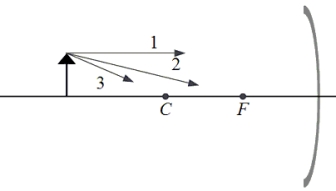 -Which ray(s) will pass through F after reflection?
 (Multiple Choice)
4.7/5 (80)
(80) A spherical concave mirror has a radius of curvature of 6.0 cm. At what distance from the mirror should a 6.0-cm object be placed to obtain an image that is 48 cm tall?
(Multiple Choice)
4.8/5 (84)
(84) An object is placed in front of a concave spherical mirror as shown below. The three rays 1, 2, and 3, leave the top of the object and, after reflection, converge at a point on the top of the image. Ray 1 is parallel to the principal axis, ray 2 passes through F, and ray 3 passes through C.
-Which one of the following groups of terms best describes the image?
-Which one of the following groups of terms best describes the image? (Multiple Choice)
4.9/5 (81)
(81) Which one of the following phrases most accurately describes paraxial rays?
(Multiple Choice)
4.8/5 (87)
(87) The view in the figure is from above a plane mirror suspended by a thread connected to the center of the mirror at point C. A scale is located 0.65 m (the distance from point C to point A) to the right of the center of the mirror. Initially, the plane of the mirror is parallel to the side of the scale; and the angle of incidence of a light ray which is directed at the center of the mirror is 30°. A small torque applied to the thread causes the mirror to turn 12° away from its initial position. The reflected ray then intersects the scale at point B. What is the distance from point A to point B on the scale? 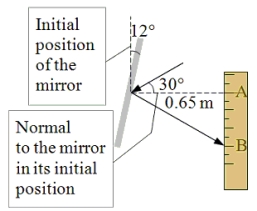
(Multiple Choice)
4.9/5 (61)
(61) A concave mirror is found to focus parallel rays at a distance of 18 cm. Where is the image formed when an object is placed 6.0 cm in front of the mirror?
(Multiple Choice)
4.8/5 (77)
(77) Which one of the following statements concerning a convex mirror is true?
(Multiple Choice)
4.9/5 (88)
(88) Makenzie walks directly toward a plane mirror at a speed of 0.30 m/s. Determine the speed of the image relative to her.
(Multiple Choice)
4.9/5 (81)
(81) A rubber ball is held 4.0 m above a concave spherical mirror with a radius of curvature of 1.5 m. At time equals zero, the ball is dropped from rest and falls along the principal axis of the mirror. How much time elapses before the ball and its image are at the same location?
(Multiple Choice)
4.7/5 (75)
(75) An object is placed in front of a concave spherical mirror as shown below. The three rays 1, 2, and 3, leave the top of the object and, after reflection, converge at a point on the top of the image. Ray 1 is parallel to the principal axis, ray 2 passes through F, and ray 3 passes through C.
-Which ray(s) will reflect back on itself (themselves)?
-Which ray(s) will reflect back on itself (themselves)? (Multiple Choice)
4.9/5 (72)
(72) Which one of the following statements is not a characteristic of a plane mirror?
(Multiple Choice)
4.9/5 (81)
(81) The table below lists object and image distances for five objects placed in front of mirrors. For which one of the following cases is the image formed by a convex spherical mirror? 
(Multiple Choice)
4.9/5 (90)
(90) 
Filters
- Essay(0)
- Multiple Choice(0)
- Short Answer(0)
- True False(0)
- Matching(0)