



 Chat with AI
Exam 30: The Nature of the Atom

Exam 1: Introduction and Mathematical Concepts70 Questions
Exam 2: Kinematics in One Dimension103 Questions
Exam 3: Kinematics in Two Dimensions68 Questions
Exam 4: Forces and Newtons Laws of Motion103 Questions
Exam 5: Dynamics of Uniform Circular Motion59 Questions
Exam 6: Work and Energy78 Questions
Exam 7: Impulse and Momentum66 Questions
Exam 8: Rotational Kinematics55 Questions
Exam 9: Rotational Dynamics57 Questions
Exam 10: Simple Harmonic Motion and Elasticity63 Questions
Exam 11: Fluids65 Questions
Exam 12: Temperature and Heat66 Questions
Exam 13: The Transfer of Heat42 Questions
Exam 14: The Ideal Gas Law and Kinetic Theory55 Questions
Exam 15: Thermodynamics79 Questions
Exam 16: Waves and Sound67 Questions
Exam 17: The Principle of Linear Superposition and Interference Phenomena46 Questions
Exam 18: Electric Forces and Electric Fields61 Questions
Exam 19: Electric Potential Energy and the Electric Potential70 Questions
Exam 20: Electric Circuits100 Questions
Exam 21: Magnetic Forces and Magnetic Fields66 Questions
Exam 22: Electromagnetic Induction71 Questions
Exam 23: Alternating Current Circuits84 Questions
Exam 24: Electromagnetic Waves66 Questions
Exam 25: The Refl Ection of Light: Mirrors43 Questions
Exam 26: The Refraction of Light: Lenses and Optical Instruments102 Questions
Exam 27: Interference and the Wave Nature of Light57 Questions
Exam 28: Special Relativity63 Questions
Exam 29: Particles and Waves54 Questions
Exam 30: The Nature of the Atom74 Questions
Exam 31: Nuclear Physics and Radioactivity37 Questions
Exam 32: Ionizing Radiation, Nuclear Energy, and Elementary Particles45 Questions
Select questions type


An argon-ion laser emits a blue-green beam of light with a wavelength of 514.5 nm in a vacuum. What is the difference in energy in joules between the two energy states for the atomic transition that produces this light?
(Multiple Choice)
4.9/5  (75)
(75) The second ionization energy (the energy required to remove the second outermost electron) of calcium is 11.9 eV. Determine the maximum wavelength of incident radiation that can be used to remove the second electron from a calcium atom?
(Multiple Choice)
5.0/5 (85)
(85) Which quantum number applies to most of the electrons in a collection of hydrogen atoms at room temperature?
(Multiple Choice)
4.7/5 (84)
(84) The figure shows an energy level diagram for the hydrogen atom. Several transitions are shown and are labeled by letters. 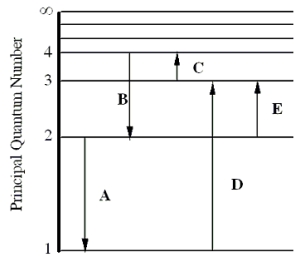 Note: The diagram is not drawn to scale.
-Determine the energy of the photon involved in transition E.
Note: The diagram is not drawn to scale.
-Determine the energy of the photon involved in transition E. (Multiple Choice)
4.7/5 (69)
(69) What energy (in eV) is required to remove the remaining electron from a singly ionized helium atom, He+ (Z = 2)?
(Multiple Choice)
4.8/5 (84)
(84) A neutral atom has the following electronic configuration: 1s2 2s2 2p6 3s2 3p5
-To which group of the periodic table does this element belong?
(Multiple Choice)
4.9/5 (77)
(77) Consider the following list of electron configurations:  -Which one of the above configurations represents a neutral atom that readily forms a singly charged positive ion?
 (Multiple Choice)
4.8/5 (101)
(101) According to the quantum mechanical picture of the atom, which one of the following statements is true concerning the magnitude of the angular momentum L of an electron in the n = 3 level of the hydrogen atom?
(Multiple Choice)
4.7/5 (79)
(79) The figure shows an energy level diagram for the hydrogen atom. Several transitions are shown and are labeled by letters. Note: The diagram is not drawn to scale.
-Which transition will occur when a hydrogen atom is irradiated with radiation of frequency 1.60 × 10¹⁴ Hz?
Note: The diagram is not drawn to scale.
-Which transition will occur when a hydrogen atom is irradiated with radiation of frequency 1.60 × 10¹⁴ Hz? (Multiple Choice)
4.7/5 (81)
(81) The figure shows an energy level diagram for the hydrogen atom. Several transitions are shown and are labeled by letters. Note: The diagram is not drawn to scale.
-Which transition involves the longest wavelength line in the visible portion of the hydrogen spectrum?
Note: The diagram is not drawn to scale.
-Which transition involves the longest wavelength line in the visible portion of the hydrogen spectrum? (Multiple Choice)
4.9/5 (77)
(77) What is the operating voltage of a medical X-ray machine that has a cut-off wavelength of 2.20 × 10⁻¹¹ m?
(Multiple Choice)
4.7/5 (75)
(75) Which one of the following factors best explains why the six electrons of a carbon atom are not all in the 1s state?
(Multiple Choice)
4.9/5 (85)
(85) Electrons have been removed from a lithium atom (Z = 3) until only one remains. Determine the energy of the photon that can be emitted if the remaining electron is in the n = 2 level.
(Multiple Choice)
4.8/5 (79)
(79) The figure shows an energy level diagram for the hydrogen atom. Several transitions are shown and are labeled by letters. Note: The diagram is not drawn to scale.
-Which transition corresponds to the absorption of the photon with the longest wavelength?
Note: The diagram is not drawn to scale.
-Which transition corresponds to the absorption of the photon with the longest wavelength? (Multiple Choice)
4.9/5 (80)
(80) 
Filters
- Essay(0)
- Multiple Choice(0)
- Short Answer(0)
- True False(0)
- Matching(0)