



 Chat with AI
Exam 4: Why Do Interest Rates Change

Exam 1: Why Study Financial Markets and Institutions63 Questions
Exam 2: Overview of the Financial System80 Questions
Exam 3: What Do Interest Rates Mean and What Is Their Role in Valuation95 Questions
Exam 4: Why Do Interest Rates Change106 Questions
Exam 5: How Do Risk and Term Structure Affect Interest Rates98 Questions
Exam 6: Are Financial Markets Efficient58 Questions
Exam 7: Why Do Financial Institutions Exist119 Questions
Exam 8: Why Do Financial Crises Occur and Why Are They so Damaging to the Economy55 Questions
Exam 9: Central Banks and the Federal Reserve System98 Questions
Exam 10: Conduct of Monetary Policy: Tools, Goals, Strategy, and Tactics95 Questions
Exam 11: The Money Markets76 Questions
Exam 12: The Bond Market88 Questions
Exam 13: The Stock Market68 Questions
Exam 14: The Mortgage Markets75 Questions
Exam 15: The Foreign Exchange Market85 Questions
Exam 16: The International Financial System88 Questions
Exam 17: Banking and the Management of Financial Institutions104 Questions
Exam 18: Financial Regulation73 Questions
Exam 19: Banking Industry: Structure and Competition134 Questions
Exam 20: The Mutual Fund Industry57 Questions
Exam 21: Insurance Companies and Pension Funds79 Questions
Exam 22: Investment Banks, Security Brokers and Dealers, and Venture Capital Firms84 Questions
Exam 23: Risk Management in Financial Institutions63 Questions
Exam 24: Hedging With Financial Derivatives114 Questions
Exam 25: Savings Associations and Credit Unions87 Questions
Exam 26: Finance Companies41 Questions
Select questions type


Factors that can cause the supply curve for bonds to shift to the right include
(Multiple Choice)
4.9/5  (81)
(81) A rise in the price level causes the demand for money to ________ and the demand curve to shift to the ________
(Multiple Choice)
4.8/5 (79)
(79) When the expected inflation rate increases, the demand for bonds ________, the supply of bonds ________, and the interest rate ________.
(Multiple Choice)
4.9/5 (89)
(89) When the economy enters into a boom, normally the demand for bonds ________, the supply of bonds ________, and the interest rate ________.
(Multiple Choice)
4.9/5 (94)
(94) An increase in an asset's expected return relative to that of an alternative asset, holding everything else unchanged, raises the quantity demanded of the asset.
(True/False)
4.8/5 (87)
(87) The higher the standard deviation of returns on an asset, the ________ the asset's ________.
(Multiple Choice)
4.8/5 (78)
(78) When income and wealth are rising, the demand for bonds rises and the demand curve shifts to the right.
(True/False)
4.9/5 (70)
(70) 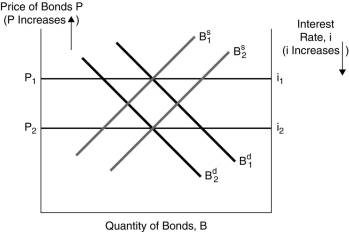 Figure 4.1
-In Figure 4.1, the most likely cause of a decrease in the equilibrium interest rate from i2 to i1 is
Figure 4.1
-In Figure 4.1, the most likely cause of a decrease in the equilibrium interest rate from i2 to i1 is (Multiple Choice)
4.7/5 (79)
(79) Interest rates are procyclical in that they tend to rise during business cycle expansions and fall during recessions.
(True/False)
4.8/5 (78)
(78) 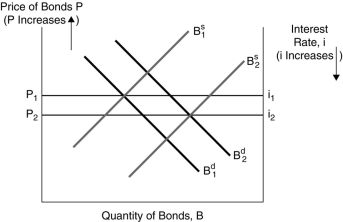 Figure 4.2
-In Figure 4.2, one possible explanation for the increase in the interest rate from i1 to i2 is
Figure 4.2
-In Figure 4.2, one possible explanation for the increase in the interest rate from i1 to i2 is (Multiple Choice)
4.9/5 (87)
(87) Use the bond demand and supply framework to explain the Fisher effect and why it occurs.
(Not Answered)
This question doesn't have any answer yet
When the growth rate of the money supply increases, interest rates end up being permanently lower if
(Multiple Choice)
4.9/5 (82)
(82) When the federal government's budget deficit decreases, the demand curve for bonds shifts to the right.
(True/False)
4.8/5 (75)
(75) Factors that cause the demand curve for bonds to shift to the left include
(Multiple Choice)
4.8/5 (64)
(64) When the interest rate on a bond is below the equilibrium interest rate, there is excess ________ in the bond market and the interest rate will ________.
(Multiple Choice)
4.9/5 (67)
(67) Figure 4.2
-In Figure 4.2, one possible explanation for the increase in the interest rate from i1 to i2 is a(n)________ in ________.
Figure 4.2
-In Figure 4.2, one possible explanation for the increase in the interest rate from i1 to i2 is a(n)________ in ________. (Multiple Choice)
4.9/5 (77)
(77) When the demand for bonds ________ or the supply of bonds ________, bond prices fall.
(Multiple Choice)
4.9/5 (86)
(86) Holding everything else constant, an increase in wealth lowers the quantity demanded of an asset.
(True/False)
4.8/5 (86)
(86) When the price of a bond is below the equilibrium price, there is excess ________ in the bond market and the price will ________.
(Multiple Choice)
4.7/5 (84)
(84) When the inflation rate is expected to increase, the expected return on bonds relative to real assets falls for any given interest rate; as a result, the ________ bonds falls and the ________ curve shifts to the left.
(Multiple Choice)
4.9/5 (79)
(79) 
Filters
- Essay(0)
- Multiple Choice(0)
- Short Answer(0)
- True False(0)
- Matching(0)