



 Chat with AI
Exam 10: The Basics of Capital Budgeting: Evaluating Cash Flows

Exam 1: An Overview of Financial Management and the Financial Environment41 Questions
Exam 2: Financial Statements, Cash Flow, and Taxes70 Questions
Exam 3: Analysis of Financial Statements85 Questions
Exam 4: Time Value of Money165 Questions
Exam 5: Bonds, Bond Valuation, and Interest Rates100 Questions
Exam 6: Risk and Return141 Questions
Exam 7: Corporate Valuation and Stock Valuation80 Questions
Exam 8: Financial Options and Applications in Corporate Finance28 Questions
Exam 9: The Cost of Capital91 Questions
Exam 10: The Basics of Capital Budgeting: Evaluating Cash Flows80 Questions
Exam 11: Cash Flow Estimation and Risk Analysis61 Questions
Exam 12: Financial Planning and Applications to Corporate Valuation41 Questions
Exam 13: Corporate Governance6 Questions
Exam 14: Distributions to Shareholders: Dividends and Repurchases54 Questions
Exam 15: Capital Structure Decisions64 Questions
Exam 16: Supply Chains and Working Capital Management132 Questions
Exam 17: Multinational Financial Management49 Questions
Exam 18: Public and Private Financing: Initial Offerings, Seasoned Offerings, and Investment Banks27 Questions
Exam 19: Lease Financing22 Questions
Exam 20: Hybrid Financing: Preferred Stock, Warrants, and Convertibles30 Questions
Exam 21: Dynamic Capital Structures and Corporate Valuation25 Questions
Exam 22: Mergers and Corporate Control44 Questions
Exam 23: Enterprise Risk Management14 Questions
Exam 24: Bankruptcy, Reorganization, and Liquidation12 Questions
Exam 25: Portfolio Theory and Asset Pricing Models27 Questions
Exam 26: Real Options19 Questions
Exam 27: Providing and Obtaining Credit38 Questions
Exam 28: Advanced Issues in Cash Management and Inventory Control29 Questions
Exam 29: Pension Plan Management10 Questions
Exam 30: Financial Management in Not-For-Profit Businesses10 Questions
Select questions type


If the IRR of normal Project X is greater than the IRR of mutually exclusive (and also normal)Project Y,we can conclude that the firm should always select X rather than Y if X has NPV > 0.
(True/False)
4.7/5  (78)
(78) Which of the following statements is NOT a disadvantage of the regular payback method?
(Multiple Choice)
4.9/5 (76)
(76) Suzanne's Cleaners is considering a project that has the following cash flow data.What is the project's payback?
Year
0
1
2
3
4
5
Cash flows
−$1,100
$300
$310
$320
$330
$340
(Multiple Choice)
4.8/5 (73)
(73) Lancaster Corp.is considering two equally risky,mutually exclusive projects,both of which have normal cash flows.Project A has an IRR of 11%,while Project B's IRR is 14%.When the cost of capital is 8%,the projects have the same NPV.Given this information,which of the following statements is CORRECT?
(Multiple Choice)
4.9/5 (82)
(82) You are considering two mutually exclusive,equally risky,projects.Both have IRRs that exceed the cost of capital.Which of the following statements is CORRECT? Assume that the projects have normal cash flows,with one outflow followed by a series of inflows.
(Multiple Choice)
5.0/5 (86)
(86) In theory,capital budgeting decisions should depend solely on forecasted cash flows and the opportunity cost of capital.The decision criterion should not be affected by managers' tastes,choice of accounting method,or the profitability of other independent projects.
(True/False)
4.9/5 (67)
(67) Assuming that their NPVs based on the firm's cost of capital are equal,the NPV of a project whose cash flows accrue relatively rapidly will be more sensitive to changes in the discount rate than the NPV of a project whose cash flows come in later in its life.
(True/False)
5.0/5 (78)
(78) Under certain conditions,a project may have more than one IRR.One such condition is when,in addition to the initial investment at time = 0,a negative cash flow (or cost)occurs at the end of the project's life.
(True/False)
4.8/5 (94)
(94) A project's IRR is independent of the firm's cost of capital.In other words,a project's IRR doesn't change with a change in the firm's cost of capital.
(True/False)
4.9/5 (79)
(79) Martin Manufacturing is considering two normal,equally risky,mutually exclusive,but not repeatable projects.Martin's cost of capital is 10%.The two projects have the same investment costs,but Project A has an IRR of 15%,while Project B has an IRR of 20%.Assuming the projects' NPV profiles cross in the upper right quadrant,which of the following statements is CORRECT?
(Multiple Choice)
4.9/5 (66)
(66) An increase in the firm's cost of capital will decrease projects' NPVs,which could change the accept/reject decision for any potential project.However,such a change would have no impact on projects' IRRs.Therefore,the accept/reject decision under the IRR method is independent of the cost of capital.
(True/False)
4.7/5 (75)
(75) Because "present value" refers to the value of cash flows that occur at different points in time,a series of present values of cash flows should not be summed to determine the value of a capital budgeting project.
(True/False)
4.8/5 (79)
(79) McGlothin Inc.is considering a project that has the following cash flow data.What is the project's payback?
Year
0
1
2
3
Cash flows
−$1,150
$500
$500
$500
(Multiple Choice)
4.8/5 (81)
(81) The primary reason that the NPV method is conceptually superior to the IRR method for evaluating mutually exclusive investments is that multiple IRRs may exist,and when that happens,we don't know which IRR is relevant.
(True/False)
4.8/5 (91)
(91) The NPV and IRR methods,when used to evaluate two equally risky but mutually exclusive projects,will lead to different accept/reject decisions and thus capital budgets if the cost of capital at which the projects' NPV profiles cross is less than the projects' cost of capital.
(True/False)
4.9/5 (89)
(89) Projects A and B have identical expected lives and identical initial cash outflows (costs).However,most of one project's cash flows come in the early years,while most of the other project's cash flows occur in the later years.The two NPV profiles are given below: 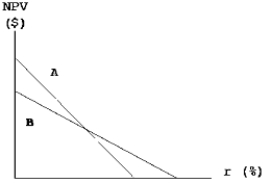 Which of the following statements is CORRECT?
 (Multiple Choice)
4.8/5 (72)
(72) 
Filters
- Essay(0)
- Multiple Choice(0)
- Short Answer(0)
- True False(0)
- Matching(0)