



 Chat with AI
Exam 10: Monopoly

Exam 1: The Economic Problem157 Questions
Exam 2: Demand and Supply: An Introduction185 Questions
Exam 3: Demand and Supply: An Elaboration139 Questions
Exam 4: Elasticity195 Questions
Exam 5: Consumer Choice144 Questions
Exam 6: A Firms Production Decisions and Costs in the Short Run179 Questions
Exam 7: Costs in the Long Run132 Questions
Exam 8: Perfect Competition172 Questions
Exam 9: An Evaluation of Competitive Markets149 Questions
Exam 10: Monopoly179 Questions
Exam 11: Imperfect Competition145 Questions
Exam 12: The Factors of Production151 Questions
Exam 13: International Trade166 Questions
Select questions type


 -Refer to the graph above.If the monopoly firm maximizes profit,it will produce:
 (Multiple Choice)
4.8/5  (86)
(86) What will be the effect of a monopoly sales tax imposed on a monopolist's output?
(Multiple Choice)
4.9/5 (83)
(83) Suppose a monopolist was charging a price of $70 for its product and was selling 60 units.If it lowers its price to $69,the monopolist sells 61 units.What is the marginal revenue of that product?
(Essay)
4.8/5 (86)
(86) All the following,except one,are types of barriers to entry.Which is the exception?
(Multiple Choice)
4.8/5 (73)
(73) All of the following statements,except one,are true about a monopolist.Which is the exception?
(Multiple Choice)
4.8/5 (86)
(86) If the marginal cost of the 1000th unit produced by a monopolist is $16 and its marginal revenue is $20,what should the monopolist do?
(Multiple Choice)
4.7/5 (83)
(83) A monopolist is free to charge any price it wishes for its product.
(True/False)
4.7/5 (86)
(86) "A monopolist can charge whatever price it wishes because it is the only firm in the market,therefore it will set the highest price it can charge." Evaluate this statement.
(Essay)
4.9/5 (95)
(95) All of the following except one are examples of price discrimination.Which is the exception?
(Multiple Choice)
4.8/5 (74)
(74) The following graph shows the market demand and average cost curve for electricity (in millions of kilowatts)in an urban centre:
 -Refer to the above graph to answer this question.Suppose that the price is $3,and the market is served by a monopolist.What quantity will be sold,and what will be the total profit or loss?
 (Multiple Choice)
4.9/5 (78)
(78) Differentiate between a demand curve for a perfectly competitive firm and that for a monopolist.
(Essay)
4.9/5 (77)
(77) Suppose a monopolist can divide its market into two segments and it is able to practice price discrimination.If the two segments do not have the same price elasticity of demand,will the monopolist charge a higher or lower price in the market where the demand is relatively more inelastic?
(Essay)
5.0/5 (66)
(66) The following table gives the cost and demand data for a monopolist:
 -Refer to the above information to answer this question.Suppose that the monopolist is unregulated.What will be the level of maximum profit?
 (Multiple Choice)
4.9/5 (78)
(78)
-Refer to the graph above.Producer surplus that is lost to society as a result of monopoly is:
-Refer to the graph above.Producer surplus that is lost to society as a result of monopoly is: (Multiple Choice)
4.8/5 (87)
(87) The following table gives the cost and demand data for a monopolist:
-Refer to the above information to answer this question.Suppose that the monopolist is regulated and forced to charge a socially optimum price.What will be the price and output?
-Refer to the above information to answer this question.Suppose that the monopolist is regulated and forced to charge a socially optimum price.What will be the price and output? (Multiple Choice)
4.9/5 (85)
(85) Figure 10.10 depicts the cost and revenue curves for a monopolist.
 -Refer to Figure 10.10 to answer this question.What are the profit-maximizing level of output and price respectively?
 (Multiple Choice)
4.9/5 (70)
(70) Suppose a monopolist was charging a price of $120 for its product and was selling 80 units.If it lowers its price to $119 and,as a result,sells 81 units what is the marginal revenue for the product?
(Multiple Choice)
4.8/5 (68)
(68) Table 10.4 outlines the cost and revenue data for a monopolist.
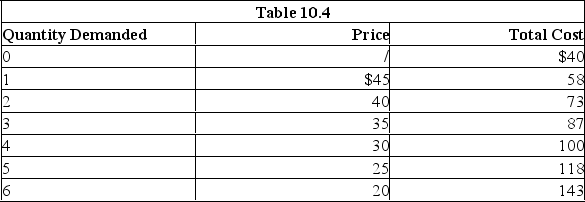 -Refer to Table 10.4 to answer this question.What are the profit-maximizing level of output and price respectively?
 (Multiple Choice)
4.7/5 (79)
(79) 
Filters
- Essay(0)
- Multiple Choice(0)
- Short Answer(0)
- True False(0)
- Matching(0)