



 Chat with AI
Exam 11: Imperfect Competition

Exam 1: The Economic Problem157 Questions
Exam 2: Demand and Supply: An Introduction185 Questions
Exam 3: Demand and Supply: An Elaboration139 Questions
Exam 4: Elasticity195 Questions
Exam 5: Consumer Choice144 Questions
Exam 6: A Firms Production Decisions and Costs in the Short Run179 Questions
Exam 7: Costs in the Long Run132 Questions
Exam 8: Perfect Competition172 Questions
Exam 9: An Evaluation of Competitive Markets149 Questions
Exam 10: Monopoly179 Questions
Exam 11: Imperfect Competition145 Questions
Exam 12: The Factors of Production151 Questions
Exam 13: International Trade166 Questions
Select questions type


A monopolistic competitive firm is producing 30 units when MR = MC = $30.At that level of output,the price is $60,average total cost is $75,and average variable cost is $65.How much economic profit is the monopolistic competitive firm making? Should the firm continue to operate?
(Essay)
4.9/5  (63)
(63) Below are data for a monopolistically competitive firm.
 -Refer to the information above to answer this question.What is true if the firm is producing at the profit-maximizing output?
 (Multiple Choice)
4.8/5 (89)
(89) Draw a linear demand curve,marginal revenue curve,marginal cost curve,and an average total cost curve for a monopolistically competitive firm in the long-run.Clearly identify the excess capacity that occurs with monopolistic competition.
(Essay)
4.8/5 (77)
(77) "Since monopolistically competitive firms do not earn economic profits in the long-run,they are both allocatively and productively efficient." Evaluate this statement.
(Essay)
4.9/5 (78)
(78) The assumption that firms attempt to maximize sales revenue underlies much of the analysis in microeconomics.
(True/False)
4.8/5 (74)
(74) From 1990 to 2005,what manufacturing industry has become four times as concentrated?
(Essay)
4.9/5 (88)
(88) Demonstrate graphically and explain verbally the case of a monopolistically competitive firm earning a positive economic profit.Is this firm in a short run or a long-run equilibrium? How does this case differ from the monopoly market outcome?
(Essay)
4.9/5 (83)
(83) All of the following,except one,are examples of product differentiation.Which is the exception?
(Multiple Choice)
4.7/5 (76)
(76) The franchise system attempts to limit the entry of new firms into an existing industry.
(True/False)
4.9/5 (86)
(86) In what way does the theory of the kinked-demand curve explain price stability in an oligopoly industry?
(Multiple Choice)
4.9/5 (81)
(81) Draw a linear demand curve,marginal revenue curve,marginal cost curve,average total cost curve,and an average variable cost curve for a monopolistic competitor making an economic loss in the short run.
(Essay)
4.7/5 (82)
(82) Explain why there is excess capacity in a monopolistically competitive market structure in the long-run?
(Essay)
4.9/5 (91)
(91)  -Refer to the graph above to answer this question.Which one of the following statements is correct in the long run?
 (Multiple Choice)
4.8/5 (76)
(76) The following graph shows the costs and revenues of a typical firm operating in a monopolistically competitive industry.
 -Refer to the graph above to answer this question.Which of the following statements is correct?
 (Multiple Choice)
4.8/5 (86)
(86) 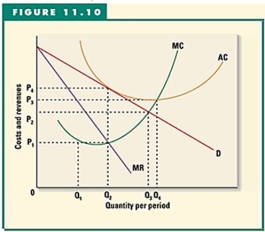 -Refer to Figure 11.10 to answer this question.What price will the firm charge?
 (Multiple Choice)
4.8/5 (87)
(87) What is true about both perfectly competitive and monopolistically competitive firms in long-run equilibrium?
(Multiple Choice)
4.7/5 (73)
(73) Imperfect competition is characterized by firms competing on price.
(True/False)
4.9/5 (76)
(76) The following information is for a monopolistically competitive firm operating in the long-run.When:
MC = MR,Q = 60
MC = P,Q = 85
AC = MC,Q = 90
a)What output is economic capacity?
b)What is the amount of the firm's excess capacity?
(Essay)
5.0/5 (72)
(72) 
Filters
- Essay(0)
- Multiple Choice(0)
- Short Answer(0)
- True False(0)
- Matching(0)