



 Chat with AI
Exam 13: International Trade

Exam 1: The Economic Problem157 Questions
Exam 2: Demand and Supply: An Introduction185 Questions
Exam 3: Demand and Supply: An Elaboration139 Questions
Exam 4: Elasticity195 Questions
Exam 5: Consumer Choice144 Questions
Exam 6: A Firms Production Decisions and Costs in the Short Run179 Questions
Exam 7: Costs in the Long Run132 Questions
Exam 8: Perfect Competition172 Questions
Exam 9: An Evaluation of Competitive Markets149 Questions
Exam 10: Monopoly179 Questions
Exam 11: Imperfect Competition145 Questions
Exam 12: The Factors of Production151 Questions
Exam 13: International Trade166 Questions
Select questions type


All the following,except one,are forms of protectionism.Which is the exception?
(Multiple Choice)
4.9/5  (66)
(66) Below is some hypothetical data for the countries of Canada and Mexico.(Assume that Canada has 10 million workers per month available and Mexico has 20 million. )
Canada's Production Possibilities
(Output in millions of bushels per month)
 Mexico's Production Possibilities
(Output in millions of bushels per month)
 Output Before Trade
(Output in millions of bushels per month)
 -Refer to the information above to answer this question.In what product does Canada and Mexico have a comparative advantage?
Mexico's Production Possibilities
(Output in millions of bushels per month)
Output Before Trade
(Output in millions of bushels per month)
-Refer to the information above to answer this question.In what product does Canada and Mexico have a comparative advantage? (Multiple Choice)
4.9/5 (79)
(79) Below is the total market demand and supply of wine for France and Germany.Quantities are in millions of litres per month.
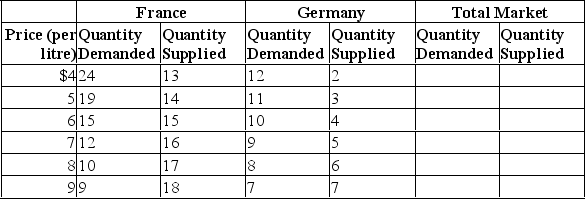 -Refer to the information above to answer this question.Assume that France and Germany enter into a free trade agreement (and there are no extra transportation costs,etc. )what will Germany do?
 (Multiple Choice)
4.8/5 (69)
(69) Table 13.14 shows the output of kumquats per month.
 -If comparative cost is the basis for trade,why are the developing nations,which have very low wage rates,not the world's greatest trading nations?
 (Essay)
4.9/5 (83)
(83) Below is some data on the output of kumquats in Smith Island.
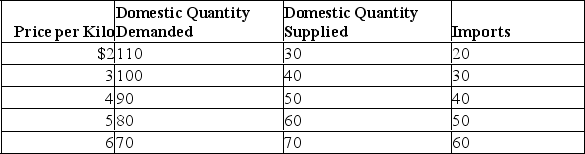 -Refer to information above to answer this question.If Smith Island imposed a tariff on kumquats of $3 per kilo,what would be the equilibrium price and quantity traded?
 (Multiple Choice)
4.9/5 (76)
(76) Refer to the data above to answer this question.Suppose that initially each country allocated 5 million of its population to the rice industry,the rest being employed in the beer industry.If they now decide to totally specialize in the products in which each has a comparative advantage,what will be the resulting gains from trade?
(Multiple Choice)
4.8/5 (90)
(90) On what basis are the gains from trade divided between countries?
(Multiple Choice)
4.7/5 (63)
(63) Below is a graph illustrating the market for mustard seeds in Rysen III.(Sd is domestic supply,and Dd is domestic demand. ).The world price of mustard seeds is $100.
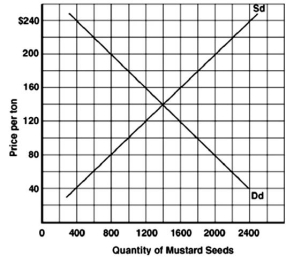 -Refer to the graph above to answer this question.After the introduction of a $20 tariff,what is the volume of imports into Rysen III?
 (Multiple Choice)
4.9/5 (74)
(74) Below is some hypothetical data for the countries of Canada and Mexico.(Assume that Canada has 10 million workers per month available and Mexico has 20 million. )
Canada's Production Possibilities
(Output in millions of bushels per month)
Mexico's Production Possibilities
(Output in millions of bushels per month)
Output Before Trade
(Output in millions of bushels per month)
-Refer to the information above to answer this question.If each country totally specializes according to its comparative advantage and the terms of trade are 1 bushel of beans for 1.25 bushels of rye,what will be the gains from trade?
Mexico's Production Possibilities
(Output in millions of bushels per month)
Output Before Trade
(Output in millions of bushels per month)
-Refer to the information above to answer this question.If each country totally specializes according to its comparative advantage and the terms of trade are 1 bushel of beans for 1.25 bushels of rye,what will be the gains from trade? (Multiple Choice)
5.0/5 (78)
(78) Table 13.14 shows the output of kumquats per month.
-Define tariffs and Quotas,and explain the similarities and differences between them.
-Define tariffs and Quotas,and explain the similarities and differences between them. (Essay)
4.8/5 (71)
(71) Refer to the data above to answer this question.Suppose that each country allocates 5 million of its population to the rice industry,the rest being employed in the beer industry.What is their (joint)total production?
(Multiple Choice)
4.8/5 (90)
(90) Table 13.14 shows the output of kumquats per month.
-A country has a comparative advantage over another only if it is able to produce all products more cheaply.
-A country has a comparative advantage over another only if it is able to produce all products more cheaply. (True/False)
4.9/5 (66)
(66) Below is a graph illustrating the market for mustard seeds in Rysen III.(Sd is domestic supply,and Dd is domestic demand. ).The world price of mustard seeds is $100.
-Refer to the graph above to answer this question.Suppose that the government introduces a quota of 400 on imports of mustard seeds,what will be the new price?
-Refer to the graph above to answer this question.Suppose that the government introduces a quota of 400 on imports of mustard seeds,what will be the new price? (Multiple Choice)
4.9/5 (84)
(84) All of the following except one are initials of international trade organizations.Which is the exception?
(Multiple Choice)
4.8/5 (88)
(88) Table 13.14 shows the output of kumquats per month.
-Does the principle of comparative advantage tell us how the gains from trade will be distributed? Explain.
-Does the principle of comparative advantage tell us how the gains from trade will be distributed? Explain. (Essay)
4.9/5 (89)
(89) What term describes the ability to produce something at a lower opportunity cost than others are able to?
(Multiple Choice)
4.9/5 (71)
(71) The chart below refers to the economy of Smith Island.
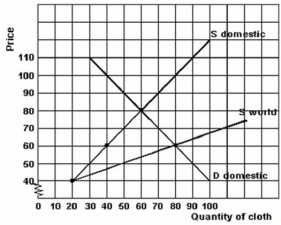 -Refer to the graph above to answer this question.What is the world (free trade)price of cloth?
 (Multiple Choice)
4.9/5 (75)
(75) Suppose that the productivity per worker in the Good X and Good Y industries of Country A and Country B are as follows:
 In order for there to be no gains from trade,what would the Country B productivity per worker in the Good X industry need to be?
 (Short Answer)
4.8/5 (86)
(86) Below is a graph illustrating the market for mustard seeds in Rysen III.(Sd is domestic supply,and Dd is domestic demand. ).The world price of mustard seeds is $100.
-Refer to the graph above to answer this question.After the introduction of a $20 tariff,what is the value of the tax revenue collected by the Rysen III government?
-Refer to the graph above to answer this question.After the introduction of a $20 tariff,what is the value of the tax revenue collected by the Rysen III government? (Multiple Choice)
4.8/5 (75)
(75) 
Filters
- Essay(0)
- Multiple Choice(0)
- Short Answer(0)
- True False(0)
- Matching(0)