



 Chat with AI
Exam 13: Auditing, tax-Exempt Organizations, and Evaluating Performance

Exam 1: Introduction to Accounting and Financial Reporting for Governmental and Not-For-Profit Organizations144 Questions
Exam 2: Overview of Financial Reporting for State and Local Governments143 Questions
Exam 3: Modified Accrual Accounting: Including the Role of Fund Balances and Budgetary Authority154 Questions
Exam 4: Accounting for the General and Special Revenue Funds128 Questions
Exam 5: Accounting for Other Governmental Fund Types: Capital Projects, debt Service, and Permanent170 Questions
Exam 6: Proprietary Funds143 Questions
Exam 7: Fiduciary Trustfunds162 Questions
Exam 8: Government-Wide Statements, capital Assets, long-Term Debt162 Questions
Exam 9: Advanced Topics for State and Local Governments104 Questions
Exam 10: Accounting for Private Not-For-Profit Organizations154 Questions
Exam 11: College and University Accounting128 Questions
Exam 12: Accounting for Hospitals and Other Health Care Providers99 Questions
Exam 13: Auditing, tax-Exempt Organizations, and Evaluating Performance144 Questions
Exam 14: Financial Reporting by the Federal Government68 Questions
Select questions type


What is the principle advantage of obtaining section 501(c)3 status?
(Multiple Choice)
4.9/5  (76)
(76) Entities that are tax exempt under IRS Section 501(c)3 are prohibited from endorsing political candidates or attempting to influence legislation.
(True/False)
4.8/5 (77)
(77) Governmental Auditing Standards identifies four categories of professional engagements:
financial audits,performance audits,attestation engagements,and non-audit services.
(True/False)
4.8/5 (87)
(87) Which of the following may be deducted in computing income from unrelated business activities?
(Multiple Choice)
4.8/5 (73)
(73) Which organization promulgates the Government Auditing Standards?
(Multiple Choice)
4.9/5 (75)
(75) Net Asset classification for a tax-exempt organization are consistent with GASB standards.
(True/False)
4.9/5 (71)
(71) Which of the following is not prohibited of organizations receiving tax exempt status under IRS Section 501(c)3?
(Multiple Choice)
4.9/5 (71)
(71) Entities that are tax exempt under Section 501(c)3 of the Internal Revenue Code do not have to pay income taxes,even if some of their activities compete with commercial enterprises.
(True/False)
4.8/5 (72)
(72) Which of the following tax-exempt organizations would be required to file a form 990 or 990-EZ?
(Multiple Choice)
5.0/5 (74)
(74) Which of the following is true concerning tax exempt organizations with unrelated business income?
(Multiple Choice)
4.9/5 (84)
(84) What is the correct hierarchy of performance indicators of SEA's?
(Multiple Choice)
4.9/5 (84)
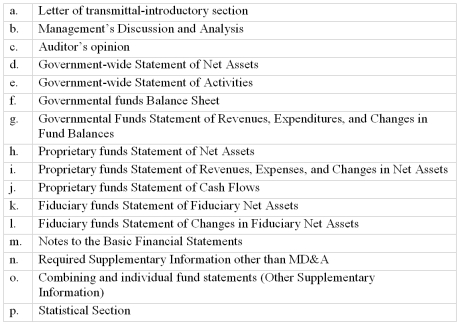
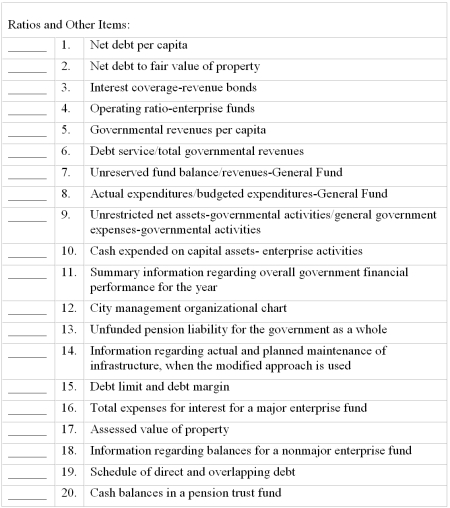
(84) The Comprehensive Annual Financial Report of a local governmental unit includes several statements and sections.When a financial analyst is computing ratios and extracting other information,he or she needs to know where in the CAFR to look.Use the following classification to indicate where an analyst would look in the CAFR to compute the ratios and gather information by placing the appropriate letter(s)in the space next to each item.When possible,choose the location in the basic financial statements or notes that would be subject to examination:
(Essay)
4.8/5 (72)
(72) While the Sarbanes-Oxley Act applies only to corporations filing with the Securities and Exchange Commission,several provisions of the Act already existed in governmental auditing standards,and others are being voluntarily adopted by not-for-profit organizations
(True/False)
4.8/5 (72)
(72) If an auditor is not independent which type of audit opinion is appropriate?
(Multiple Choice)
4.8/5 (79)
(79) Which of the following conditions would exempt income-producing activities from the Unrelated Business Income Tax (UBIT)?
(Multiple Choice)
4.8/5 (82)
(82) Supporting expenses are not included in the numerator of the program expense ratio.
(True/False)
4.8/5 (93)
(93) The program expense ratio for a not-for-profit organization will improve if the organization shifts costs from fund raising to program expenses.
(True/False)
4.8/5 (85)
(85) The use of opinion units allows an auditor to issue different opinions on different statements,instead of issuing one opinion.
(True/False)
4.8/5 (91)
(91) 
Filters
- Essay(0)
- Multiple Choice(0)
- Short Answer(0)
- True False(0)
- Matching(0)