



 Chat with AI
Exam 23: Mirrors and Lenses

Exam 1: Introduction60 Questions
Exam 1: Introduction: Part A47 Questions
Exam 2: Motion in One Dimension64 Questions
Exam 2: Motion in One Dimension: Part A42 Questions
Exam 3: Vectors and Two-Dimensional Motion74 Questions
Exam 3: Vectors and Two-Dimensional Motion: Part A64 Questions
Exam 4: The Laws of Motion93 Questions
Exam 4: The Laws of Motion: Part A69 Questions
Exam 5: Energy84 Questions
Exam 5: Energy: Part A32 Questions
Exam 6: Momentum and Collisions83 Questions
Exam 6: Momentum and Collisions: Part A61 Questions
Exam 7: Rotational Motion and the Law of Gravity84 Questions
Exam 7: Rotational Motion and the Law of Gravity: Part A48 Questions
Exam 8: Rotational Equilibrium and Rotational Dynamics60 Questions
Exam 8: Rotational Equilibrium and Rotational Dynamics: Part A61 Questions
Exam 9: Solids and Fluids78 Questions
Exam 9: Solids and Fluids: Part A46 Questions
Exam 10: Thermal Physics82 Questions
Exam 10: Thermal Physics: Part A56 Questions
Exam 11: Energy in Thermal Processes Heat and Internal Energy82 Questions
Exam 11: Energy in Thermal Processes Heat and Internal Energy: Part A54 Questions
Exam 12: The Laws of Thermodynamics Work in Thermodynamic Processes70 Questions
Exam 12: The Laws of Thermodynamics Work in Thermodynamic Processes: Part A40 Questions
Exam 13: Vibrations and Waves83 Questions
Exam 13: Vibrations and Waves: Part A48 Questions
Exam 14: Sound81 Questions
Exam 14: Sound: Part A67 Questions
Exam 15: Electric Forces and Electric Fields81 Questions
Exam 15: Electric Forces and Electric Fields: Part A42 Questions
Exam 16: Electrical Energy and Capacitance81 Questions
Exam 16: Electrical Energy and Capacitance: Part A33 Questions
Exam 17: Current and Resistance Electric Current83 Questions
Exam 17: Current and Resistance Electric Current: Part A37 Questions
Exam 18: Direct-Current Circuits Sources of EMF77 Questions
Exam 18: Direct-Current Circuits Sources of EMF: Part A54 Questions
Exam 19: Magnetism Magnets82 Questions
Exam 19: Magnetism Magnets: Part A67 Questions
Exam 20: Induced Voltages and Inductance83 Questions
Exam 20: Induced Voltages and Inductance: Part A46 Questions
Exam 21: Alternating-Current Circuits and Electromagnetic Waves98 Questions
Exam 21: Alternating-Current Circuits and Electromagnetic Waves: Part A32 Questions
Exam 22: Reflection and Refraction of Light81 Questions
Exam 22: Reflection and Refraction of Light: Part A49 Questions
Exam 23: Mirrors and Lenses82 Questions
Exam 23: Mirrors and Lenses: Part A31 Questions
Exam 24: Wave Optics88 Questions
Exam 24: Wave Optics: Part A71 Questions
Exam 25: Optical Instruments79 Questions
Exam 25: Optical Instruments: Part A59 Questions
Exam 26: Relativity62 Questions
Exam 26: Relativity: Part A29 Questions
Exam 27: Quantum Physics Blackbody Radiation and Plancks Hypothesis79 Questions
Exam 27: Quantum Physics Blackbody Radiation and Plancks Hypothesis: Part A52 Questions
Exam 28: Atomic Physics71 Questions
Exam 28: Atomic Physics: Part A38 Questions
Exam 29: Nuclear Physics75 Questions
Exam 29: Nuclear Physics: Part A43 Questions
Exam 30: Nuclear Energy and Elementary Particles88 Questions
Exam 30: Nuclear Energy and Elementary Particles: Part A37 Questions
Exam 31: Particle Collisions, Mediating Photons, and Quark Structures: Exploring the Fundamentals of Physics16 Questions
Select questions type


Two thin lenses,with focal lengths of 22.0 cm and -40.0 cm are placed in contact in an orientation so that their optic axes coincide.What is the focal length of the two in combination? {Hint: A thin lens is one whose thickness is negligible).
(Multiple Choice)
5.0/5  (89)
(89) Parallel rays of light that hit a concave mirror will come together:
(Multiple Choice)
4.9/5 (78)
(78) A contact lens is made of plastic with an index of refraction 2.70.The lens has an outer radius of curvature of + 3.3 cm and an inner radius of curvature of + 4.5 cm.What is its focal length?
(Multiple Choice)
5.0/5 (87)
(87) A lens of 10.0-cm focal length is placed 29.0 cm to the right of the object and a mirror of focal length -20.0 cm is placed 49.0 cm to the right of the lens.Where is the image formed by the mirror?
(Multiple Choice)
4.9/5 (77)
(77) A lens has a focal length of 41 cm in air.If this lens were immersed in water,what focal length would result? The index of refraction of the lens is 2.200 and that of water is 1.333.The focal length of a thin lens with index n1 submerged in a liquid with index n2 is given by the modified lens maker's formula: 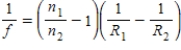 )
) (Multiple Choice)
4.8/5 (68)
(68) A lens of 13.0-cm focal length is placed 29.0 cm to the right of the object and a mirror of focal length -19.0 cm is placed 39.6 cm to the right of the lens.Where is the final image formed?
(Multiple Choice)
4.8/5 (72)
(72) A glass block,for which n = 1.52,has a blemish located 5.0 cm from one surface.At what distance from that surface does the image of the blemish appear to the outside observer?
(Multiple Choice)
4.7/5 (85)
(85) A convex mirror with a focal length of -17 cm forms an image 12 cm behind the surface.If the object height is 1.0 cm what is the image height?
(Multiple Choice)
4.9/5 (69)
(69) A 80-cm focal length thin lens is placed in contact with one of 59.5 cm focal length.A 2.3 cm tall object is placed 55 cm in front of the combination.What is the size of the image?
(Multiple Choice)
5.0/5 (68)
(68) An object and a screen are separated by 26.0 cm.A convex lens is placed between them,9.00 cm from the object.In this position it causes a sharp image of the object to form on the screen.What is the focal length of the lens?
(Multiple Choice)
4.9/5 (74)
(74) Which of the following effects is the result of the fact that the index of refraction of glass will vary with wavelength?
(Multiple Choice)
4.9/5 (88)
(88) An object,located 96 cm from a concave lens,forms an image 34 cm from the lens on the same side as the object.What is the focal length of the lens?
(Multiple Choice)
4.8/5 (89)
(89) Which of the following best describes the image of a concave mirror when the object is at a distance greater than twice the focal point distance from the mirror?
(Multiple Choice)
4.7/5 (81)
(81) A goldfish is swimming in water (n = 1.33)inside a spherical plastic bowl of index of refraction 1.33.If the goldfish is 12 cm from the front wall of the 23-cm radius bowl,where does the goldfish appear to an observer in front of the bowl?
(Multiple Choice)
4.7/5 (86)
(86) In an ideal case rays coming from an object toward a lens or mirror should be reasonably close to the optic axis.To the extent that this condition is not completely met,which one of the following effects occurs?
(Multiple Choice)
4.7/5 (84)
(84) An object placed 18.0 cm from a concave mirror produces a real image 16.0 cm from the mirror.If the object is now moved to a new position 22.0 cm from the mirror,where is the new image located as measured from the mirror?
(Multiple Choice)
4.8/5 (84)
(84) For a diverging lens with one flat surface,the radius of curvature for the curved surface is 27.0 cm.What must the index of refraction be so that the focal length is -15.0 cm?
(Multiple Choice)
4.9/5 (74)
(74) When the reflection of an object is seen in a concave mirror the image will:
(Multiple Choice)
4.8/5 (68)
(68) An eyeglass lens is cut with one surface having a radius R1 and the other surface having a radius R2,with R1 < R2.Both positive radii are measured from the same side with R1 being the side closer to the eye.Is this convex-concave lens a converging lens or a diverging lens?
(Multiple Choice)
4.9/5 (89)
(89) A container is filled with fluid 1 and the apparent depth of the fluid is 5 cm.The container is next filled with fluid 2,and the apparent depth of this fluid is 3 cm.What is the ratio of the indices of refraction of these fluids?
(Multiple Choice)
4.8/5 (85)
(85) 
Filters
- Essay(0)
- Multiple Choice(0)
- Short Answer(0)
- True False(0)
- Matching(0)