



 Chat with AI
Exam 15: Electric Forces and Electric Fields

Exam 1: Introduction60 Questions
Exam 1: Introduction: Part A47 Questions
Exam 2: Motion in One Dimension64 Questions
Exam 2: Motion in One Dimension: Part A42 Questions
Exam 3: Vectors and Two-Dimensional Motion74 Questions
Exam 3: Vectors and Two-Dimensional Motion: Part A64 Questions
Exam 4: The Laws of Motion93 Questions
Exam 4: The Laws of Motion: Part A69 Questions
Exam 5: Energy84 Questions
Exam 5: Energy: Part A32 Questions
Exam 6: Momentum and Collisions83 Questions
Exam 6: Momentum and Collisions: Part A61 Questions
Exam 7: Rotational Motion and the Law of Gravity84 Questions
Exam 7: Rotational Motion and the Law of Gravity: Part A48 Questions
Exam 8: Rotational Equilibrium and Rotational Dynamics60 Questions
Exam 8: Rotational Equilibrium and Rotational Dynamics: Part A61 Questions
Exam 9: Solids and Fluids78 Questions
Exam 9: Solids and Fluids: Part A46 Questions
Exam 10: Thermal Physics82 Questions
Exam 10: Thermal Physics: Part A56 Questions
Exam 11: Energy in Thermal Processes Heat and Internal Energy82 Questions
Exam 11: Energy in Thermal Processes Heat and Internal Energy: Part A54 Questions
Exam 12: The Laws of Thermodynamics Work in Thermodynamic Processes70 Questions
Exam 12: The Laws of Thermodynamics Work in Thermodynamic Processes: Part A40 Questions
Exam 13: Vibrations and Waves83 Questions
Exam 13: Vibrations and Waves: Part A48 Questions
Exam 14: Sound81 Questions
Exam 14: Sound: Part A67 Questions
Exam 15: Electric Forces and Electric Fields81 Questions
Exam 15: Electric Forces and Electric Fields: Part A42 Questions
Exam 16: Electrical Energy and Capacitance81 Questions
Exam 16: Electrical Energy and Capacitance: Part A33 Questions
Exam 17: Current and Resistance Electric Current83 Questions
Exam 17: Current and Resistance Electric Current: Part A37 Questions
Exam 18: Direct-Current Circuits Sources of EMF77 Questions
Exam 18: Direct-Current Circuits Sources of EMF: Part A54 Questions
Exam 19: Magnetism Magnets82 Questions
Exam 19: Magnetism Magnets: Part A67 Questions
Exam 20: Induced Voltages and Inductance83 Questions
Exam 20: Induced Voltages and Inductance: Part A46 Questions
Exam 21: Alternating-Current Circuits and Electromagnetic Waves98 Questions
Exam 21: Alternating-Current Circuits and Electromagnetic Waves: Part A32 Questions
Exam 22: Reflection and Refraction of Light81 Questions
Exam 22: Reflection and Refraction of Light: Part A49 Questions
Exam 23: Mirrors and Lenses82 Questions
Exam 23: Mirrors and Lenses: Part A31 Questions
Exam 24: Wave Optics88 Questions
Exam 24: Wave Optics: Part A71 Questions
Exam 25: Optical Instruments79 Questions
Exam 25: Optical Instruments: Part A59 Questions
Exam 26: Relativity62 Questions
Exam 26: Relativity: Part A29 Questions
Exam 27: Quantum Physics Blackbody Radiation and Plancks Hypothesis79 Questions
Exam 27: Quantum Physics Blackbody Radiation and Plancks Hypothesis: Part A52 Questions
Exam 28: Atomic Physics71 Questions
Exam 28: Atomic Physics: Part A38 Questions
Exam 29: Nuclear Physics75 Questions
Exam 29: Nuclear Physics: Part A43 Questions
Exam 30: Nuclear Energy and Elementary Particles88 Questions
Exam 30: Nuclear Energy and Elementary Particles: Part A37 Questions
Exam 31: Particle Collisions, Mediating Photons, and Quark Structures: Exploring the Fundamentals of Physics16 Questions
Select questions type


A charge Q accumulates on the hollow metallic dome,of radius R,of a Van de Graaff generator.A probe measures the electric field strength at various points outside the sphere surface.If the probe is initially at a distance 3R from the sphere's center and then is moved to 4R,by what factor will the electric field reading change?
(Multiple Choice)
4.8/5  (91)
(91) A proton initially moves left to right long the x axis at a speed of 9.00 × 10³ m/s.It moves into an electric field,which points in the negative x direction,and travels a distance of 0.900 m before coming to rest.What acceleration magnitude does the proton experience?
(Multiple Choice)
4.8/5 (81)
(81) In x-ray machines,electrons are subjected to electric fields as great as 6 × 10⁵ N/C.Find an electron's acceleration in this field.(me = 9.11 × 10⁻³¹ kg,e = 1.6 × 10⁻¹⁹ C)
(Multiple Choice)
4.9/5 (85)
(85) If a charge +Q is placed inside a hollow isolated conductor that is originally neutral and the charge does not touch that conductor at any time:
(Multiple Choice)
4.8/5 (73)
(73) Two charges,+Q and −Q,are located two meters apart and there is a point along the line that is equidistant from the two charges as indicated.Which vector best represents the direction of the electric field at that point? 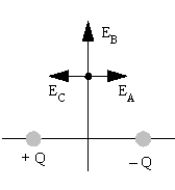
(Multiple Choice)
4.8/5 (82)
(82) I wish to use a positively charged rod to charge a ball by induction.Which statement is correct?
(Multiple Choice)
5.0/5 (81)
(81) When a glass rod is rubbed with silk,which of the following statements best describes what happens?
(Multiple Choice)
4.7/5 (84)
(84) The electric field of a point charge has an inverse ________ behavior.
(Multiple Choice)
4.7/5 (77)
(77) A repelling force must occur between two charged objects under which conditions?
(Multiple Choice)
4.9/5 (73)
(73) The electric field in a cathode ray tube is supposed to accelerate electrons from 0 to 4.8 × 10⁷ m/s in a distance of 5.00 cm.What electric field is required? (me = 9.11 × 10⁻³¹ kg and e = 1.60 × 10⁻¹⁹ C)
(Multiple Choice)
4.8/5 (72)
(72) A spherical volume of space has an electric field of intensity 140 N/C directed radially outward from it surface of radius 0.7 m.What is the net charge enclosed within this surface?
(Multiple Choice)
4.9/5 (69)
(69) The combination of two separated point charges of opposite sign but equal magnitude is called an electric:
(Multiple Choice)
4.9/5 (74)
(74) A charge Q accumulates on the hollow metallic dome,of radius R,of a Van de Graaff generator.A probe measures the electric field strength at various points outside the sphere surface.By what factor will the electric field value at the 2R distance be changed if the charge value were increased to (9/4)Q?
(Multiple Choice)
4.8/5 (85)
(85) The number of electric field lines passing through a unit cross sectional area is indicative of:
(Multiple Choice)
4.9/5 (85)
(85) The average distance of the electron from the proton in the hydrogen atom is 0.5 × 10⁻¹⁰ m.What is the electric field from the proton's charge at the location of the electron? (ke = 8.99 × 10⁹ N⋅m2/C2,e = 1.6 × 10⁻¹⁹ C)
(Multiple Choice)
4.9/5 (85)
(85) A proton moving at 3.0 × 10⁴ m/s is projected at an angle of 30° above a horizontal plane.If an electric field of 400 N/C is acting down,how long does it take the proton to return to the horizontal plane? (Hint: Ignore gravity.mproton = 1.67 × 10⁻²⁷ kg,qproton = 1.6 × 10⁻¹⁹ C)
(Multiple Choice)
5.0/5 (85)
(85) In a thundercloud there may be an electric charge of +50 C near the top of the cloud and −50 C near the bottom of the cloud.These charges are separated by about 4 km.What is the electric force between these two sets of charges? (ke = 8.99 × 10⁹ N·m2/C2)
(Multiple Choice)
5.0/5 (82)
(82) The electric field at the surface of a positively charged conductor has a direction characterized by which of the following?
(Multiple Choice)
4.8/5 (75)
(75) Which of the following best characterizes electrical conductors?
(Multiple Choice)
4.9/5 (90)
(90) 
Filters
- Essay(0)
- Multiple Choice(0)
- Short Answer(0)
- True False(0)
- Matching(0)