



 Chat with AI
Exam 13: Vibrations and Waves

Exam 1: Introduction60 Questions
Exam 1: Introduction: Part A47 Questions
Exam 2: Motion in One Dimension64 Questions
Exam 2: Motion in One Dimension: Part A42 Questions
Exam 3: Vectors and Two-Dimensional Motion74 Questions
Exam 3: Vectors and Two-Dimensional Motion: Part A64 Questions
Exam 4: The Laws of Motion93 Questions
Exam 4: The Laws of Motion: Part A69 Questions
Exam 5: Energy84 Questions
Exam 5: Energy: Part A32 Questions
Exam 6: Momentum and Collisions83 Questions
Exam 6: Momentum and Collisions: Part A61 Questions
Exam 7: Rotational Motion and the Law of Gravity84 Questions
Exam 7: Rotational Motion and the Law of Gravity: Part A48 Questions
Exam 8: Rotational Equilibrium and Rotational Dynamics60 Questions
Exam 8: Rotational Equilibrium and Rotational Dynamics: Part A61 Questions
Exam 9: Solids and Fluids78 Questions
Exam 9: Solids and Fluids: Part A46 Questions
Exam 10: Thermal Physics82 Questions
Exam 10: Thermal Physics: Part A56 Questions
Exam 11: Energy in Thermal Processes Heat and Internal Energy82 Questions
Exam 11: Energy in Thermal Processes Heat and Internal Energy: Part A54 Questions
Exam 12: The Laws of Thermodynamics Work in Thermodynamic Processes70 Questions
Exam 12: The Laws of Thermodynamics Work in Thermodynamic Processes: Part A40 Questions
Exam 13: Vibrations and Waves83 Questions
Exam 13: Vibrations and Waves: Part A48 Questions
Exam 14: Sound81 Questions
Exam 14: Sound: Part A67 Questions
Exam 15: Electric Forces and Electric Fields81 Questions
Exam 15: Electric Forces and Electric Fields: Part A42 Questions
Exam 16: Electrical Energy and Capacitance81 Questions
Exam 16: Electrical Energy and Capacitance: Part A33 Questions
Exam 17: Current and Resistance Electric Current83 Questions
Exam 17: Current and Resistance Electric Current: Part A37 Questions
Exam 18: Direct-Current Circuits Sources of EMF77 Questions
Exam 18: Direct-Current Circuits Sources of EMF: Part A54 Questions
Exam 19: Magnetism Magnets82 Questions
Exam 19: Magnetism Magnets: Part A67 Questions
Exam 20: Induced Voltages and Inductance83 Questions
Exam 20: Induced Voltages and Inductance: Part A46 Questions
Exam 21: Alternating-Current Circuits and Electromagnetic Waves98 Questions
Exam 21: Alternating-Current Circuits and Electromagnetic Waves: Part A32 Questions
Exam 22: Reflection and Refraction of Light81 Questions
Exam 22: Reflection and Refraction of Light: Part A49 Questions
Exam 23: Mirrors and Lenses82 Questions
Exam 23: Mirrors and Lenses: Part A31 Questions
Exam 24: Wave Optics88 Questions
Exam 24: Wave Optics: Part A71 Questions
Exam 25: Optical Instruments79 Questions
Exam 25: Optical Instruments: Part A59 Questions
Exam 26: Relativity62 Questions
Exam 26: Relativity: Part A29 Questions
Exam 27: Quantum Physics Blackbody Radiation and Plancks Hypothesis79 Questions
Exam 27: Quantum Physics Blackbody Radiation and Plancks Hypothesis: Part A52 Questions
Exam 28: Atomic Physics71 Questions
Exam 28: Atomic Physics: Part A38 Questions
Exam 29: Nuclear Physics75 Questions
Exam 29: Nuclear Physics: Part A43 Questions
Exam 30: Nuclear Energy and Elementary Particles88 Questions
Exam 30: Nuclear Energy and Elementary Particles: Part A37 Questions
Exam 31: Particle Collisions, Mediating Photons, and Quark Structures: Exploring the Fundamentals of Physics16 Questions
Select questions type


The position of a 0.71-kg mass undergoing simple harmonic motion is given by x = (0.160 m)cos (πt/16).What is its position at t = 6.8 s?
(Multiple Choice)
4.9/5  (81)
(81) A simple pendulum of length 1.68 m has a mass of 100 g attached.It is drawn back 35.5° and then released.What is the maximum speed of the mass?
(Multiple Choice)
4.7/5 (78)
(78) The position of a 0.67-kg mass undergoing simple harmonic motion is given by x = (0.160 m)cos (πt/15).What is its period of oscillation?
(Multiple Choice)
5.0/5 (77)
(77) A 0.36-kg object is oscillating on a spring with a spring constant of k = 18 N/m.What is the potential energy of the system when the object displacement is 0.041 m,exactly half the maximum amplitude?
(Multiple Choice)
5.0/5 (79)
(79) Two water waves meet at the same point,one having a displacement above equilibrium of 30 cm and the other having a displacement above equilibrium of 90 cm.At this moment,what is the resulting displacement above equilibrium?
(Multiple Choice)
4.9/5 (75)
(75) Tripling the weight suspended vertically from a coil spring will result in a change in the displacement of the spring's lower end by what factor?
(Multiple Choice)
4.9/5 (71)
(71) A 0.36-kg block rests on a frictionless level surface and is attached to a horizontally aligned spring with a spring constant of 40 N/m.The block is initially displaced 6 cm from the equilibrium point and then released to set up a simple harmonic motion.A frictional force of 0.3 N exists between the block and surface.What is the speed of the block when it passes through the equilibrium point after being released from the 6-cm displacement point?
(Multiple Choice)
4.9/5 (75)
(75) Quadruple the mass of the bob on a simple pendulum will cause a change in the frequency of the pendulum swing by what factor?
(Multiple Choice)
4.8/5 (70)
(70) Three identical springs each have the same spring constant k.If these three springs are attached end to end forming a spring three times the length of one of the original springs,what will be the spring constant of the combination?
(Multiple Choice)
5.0/5 (75)
(75) Consider the curve f(x)= A cos(2πx/λ).The wavelength of the wave will be: 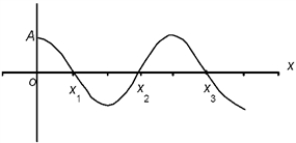
(Multiple Choice)
4.8/5 (77)
(77) A 0.25-kg object is attached to a spring with spring constant k = 10 N/m and moves with simple harmonic motion over a horizontal frictionless surface.At the instant that it is displaced from equilibrium by −0.051 m,what is its acceleration?
(Multiple Choice)
4.8/5 (85)
(85) A simple pendulum has a period of 2.3 s.What is the pendulum length? (g = 9.8 m/s2)
(Multiple Choice)
4.7/5 (82)
(82) If a radio wave has speed 3.17 × 10⁸ m/s and frequency 94.8 MHz,what is its wavelength?
(Multiple Choice)
4.8/5 (82)
(82) If a long spring with spring constant k is cut into 4 equal lengths,what is the spring constant of each of the 4 shorter springs?
(Multiple Choice)
4.8/5 (86)
(86) A 0.25-kg mass is oscillating on a spring over a horizontal frictionless surface.When it is at a displacement of 2.8 cm for equilibrium it has a kinetic energy of 1.4 J and a spring potential energy of 2.3 J.What is the maximum speed of the mass during its oscillation?
(Multiple Choice)
4.8/5 (87)
(87) An ore car of mass 4,700 kg rolls downhill on tracks from a mine.At the end of the tracks,11.1 m lower in elevation,is a spring with k = 410,000 N/m.How much is the spring compressed in stopping the ore car? Ignore friction.
(Multiple Choice)
4.9/5 (86)
(86) A long string is pulled so that the tension in it increases by a factor of four.If the change in length is negligible,by what factor does the wave speed change?
(Multiple Choice)
4.9/5 (93)
(93) Two identical springs,each with spring constant k,are attached in parallel to a mass,which is then set into simple harmonic motion.What would be the spring constant of a single spring which would result in the same frequency of oscillation as the parallel springs?
(Multiple Choice)
4.9/5 (66)
(66) The oxygen molecule (O2)may be regarded as two masses connected by a spring.In vibrational motion,each oxygen atom alternately approaches,then moves away from the center of mass of the system.If each oxygen atom of mass m = 2.67 × 10⁻²⁶ kg has a vibrational energy of 1.6 × 10⁻²¹ J and the effective spring constant is 100 N/m,then what is the amplitude of oscillation of each oxygen atom?
(Multiple Choice)
5.0/5 (92)
(92) A 2-m long piano string of mass 10 g is under a tension of 348 N.Find the speed with which a wave travels on this string.
(Multiple Choice)
4.8/5 (78)
(78) 
Filters
- Essay(0)
- Multiple Choice(0)
- Short Answer(0)
- True False(0)
- Matching(0)