



 Chat with AI
Exam 16: Interest,rent,and Profit

Exam 1: What Economics Is About174 Questions
Exam 2: Production Possibilities Frontier Framework156 Questions
Exam 3: Supply and Demand: Theory224 Questions
Exam 4: Prices: Free,controlled,and Relative122 Questions
Exam 5: Supply,demand,and Price: Applications64 Questions
Exam 6: Elasticity151 Questions
Exam 7: Consumer Choice: Maximizing Utility and Behavioral Economics147 Questions
Exam 8: Production and Costs204 Questions
Exam 9: Perfect Competition172 Questions
Exam 10: Monopoly200 Questions
Exam 11: Monopolistic Competition, oligopoly, and Game Theory167 Questions
Exam 12: Government and Product Markets: Antitrust and Regulation150 Questions
Exam 13: Factor Markets: With Emphasis on the Labor Market180 Questions
Exam 14: Wages,union,and Labor150 Questions
Exam 15: The Distribution of Income and Poverty185 Questions
Exam 16: Interest,rent,and Profit150 Questions
Exam 17: Market Failure: Externalities, public Goods, and Asymmetric Information103 Questions
Exam 18: Public Choice and Special-Interest-Group Politics100 Questions
Exam 19: Building Theories to Explain Everyday Life: From Observations to Questions to Theories to Predictions128 Questions
Exam 20: International Trade61 Questions
Exam 21: International Finance153 Questions
Exam 22: The Economic Case for and Against Government: Five Topics Considered121 Questions
Exam 23: Stocks,bonds,futures,and Options82 Questions
Exam 24: Stocks,bonds,futures,and Options110 Questions
Select questions type


One implication of the policy ineffectiveness proposition (PIP)is that expansionary __________ policy is not effective at raising __________.
(Multiple Choice)
4.7/5  (69)
(69) Describe the sequence of events that real business cycle theorists would use to explain how an adverse supply shock would impact the economy.Use your answer to explain why it is easy to confuse cause and effect between changes originating on the supply side and those that begin on the demand side.
(Essay)
4.9/5 (88)
(88) One of the key assumptions of the new classical theory is that individuals form their expectations rationally.
(True/False)
4.8/5 (90)
(90) The economist who won the Nobel Prize in Economics in 1995,and whose name is closely connected with rational expectations theory,is
(Multiple Choice)
4.9/5 (81)
(81) According to real business cycle theorists,if the long-run aggregate supply (LRAS)curve shifts to the left,Real GDP __________,the price level __________,the demand for labor __________,money wages __________,real wages __________,and workers choose to work __________.
(Multiple Choice)
4.9/5 (74)
(74) According to new classical economists,when monetary and fiscal policies are __________ anticipated,people form their expectations __________,and wages and prices are __________,the policy ineffectiveness proposition (PIP)results.
(Multiple Choice)
4.8/5 (87)
(87) 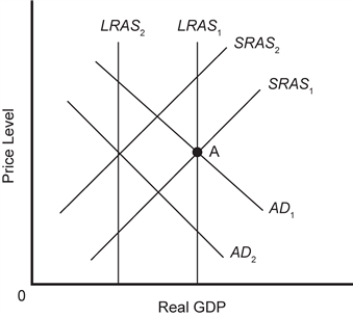 -Refer to Exhibit 16-4.If LRAS1 shifts to LRAS2,and this causes AD1 to shift to AD2,economists would call this a
 (Multiple Choice)
4.9/5 (88)
(88) A fall in the expected price level leads to an expectation that real wages will ____________,which will cause people to work __________,shifting the SRAS curve _______________.
(Multiple Choice)
4.8/5 (72)
(72) In what ways does the original Phillips curve differ from the Phillips curve created by economists Samuelson and Solow? What conclusions did economists draw based on the findings of Phillips,Samuelson and Solow?
(Essay)
4.7/5 (84)
(84) New classical economists believe that if policy is correctly anticipated and if rational expectations hold,when the Fed increases the money supply the result will be a(n)______________ in the price level and ____________________________.
(Multiple Choice)
4.8/5 (88)
(88) 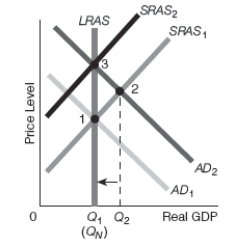 -Refer to Exhibit 16-7.Assume that the starting point is point 1.Suppose that the Fed implements expansionary monetary policy that raises aggregate demand.Which of the following best goes with the diagram shown?
 (Multiple Choice)
4.8/5 (94)
(94) According to new classical theory,if the public correctly anticipates a government policy to increase aggregate demand,then the
(Multiple Choice)
4.8/5 (91)
(91) Starting from long-run equilibrium,if the public anticipates that policymakers will increase aggregate demand by less than policymakers do increase aggregate demand,and if the short-run aggregate supply curve fully adjusts to the (incorrectly)anticipated increase in aggregate demand,then Real GDP will __________ and the price level will __________.
(Multiple Choice)
4.8/5 (85)
(85) Implicit in the new Keynesian theory is that individuals form their expectations adaptively.
(True/False)
4.7/5 (71)
(71) According to Friedman,in which of the following situations is the economy in long-run equilibrium?
(Multiple Choice)
4.8/5 (78)
(78)  -Refer to Exhibit 16-2.Suppose the economy starts at point B.Fed monetary policy shifts the AD curve to AD1.If policy is correctly anticipated and people hold rational expectations,according to new classical theory the economy in the short run will
 (Multiple Choice)
4.9/5 (79)
(79) According to Milton Friedman,the reason there are two Phillips curves is because
(Multiple Choice)
4.8/5 (70)
(70) Suppose that the government implements expansionary fiscal policy that raises aggregate demand,but the policy is unanticipated.According to new classical theory,in the short run the price level would ____________ and Real GDP would ______________.In the long run,new classical theory would predict that the price level would ______________ compared to its original long-run equilibrium level and that Real GDP would ____________.
(Multiple Choice)
4.8/5 (78)
(78) As incorrectly low inflation expectations catch up with the higher actual inflation rate,the SRAS curve shifts __________ and the short-run Phillips curve shifts __________.
(Multiple Choice)
4.8/5 (81)
(81) 
Filters
- Essay(0)
- Multiple Choice(0)
- Short Answer(0)
- True False(0)
- Matching(0)