



 Chat with AI
Exam 1: What Economics Is About

Exam 1: What Economics Is About174 Questions
Exam 2: Production Possibilities Frontier Framework156 Questions
Exam 3: Supply and Demand: Theory224 Questions
Exam 4: Prices: Free,controlled,and Relative122 Questions
Exam 5: Supply,demand,and Price: Applications64 Questions
Exam 6: Elasticity151 Questions
Exam 7: Consumer Choice: Maximizing Utility and Behavioral Economics147 Questions
Exam 8: Production and Costs204 Questions
Exam 9: Perfect Competition172 Questions
Exam 10: Monopoly200 Questions
Exam 11: Monopolistic Competition, oligopoly, and Game Theory167 Questions
Exam 12: Government and Product Markets: Antitrust and Regulation150 Questions
Exam 13: Factor Markets: With Emphasis on the Labor Market180 Questions
Exam 14: Wages,union,and Labor150 Questions
Exam 15: The Distribution of Income and Poverty185 Questions
Exam 16: Interest,rent,and Profit150 Questions
Exam 17: Market Failure: Externalities, public Goods, and Asymmetric Information103 Questions
Exam 18: Public Choice and Special-Interest-Group Politics100 Questions
Exam 19: Building Theories to Explain Everyday Life: From Observations to Questions to Theories to Predictions128 Questions
Exam 20: International Trade61 Questions
Exam 21: International Finance153 Questions
Exam 22: The Economic Case for and Against Government: Five Topics Considered121 Questions
Exam 23: Stocks,bonds,futures,and Options82 Questions
Exam 24: Stocks,bonds,futures,and Options110 Questions
Select questions type


Most states have instituted mandatory seatbelt laws to reduce traffic fatalities.An economist may point out that an unintended effect of these laws is
(Multiple Choice)
4.9/5  (90)
(90) The coordinates of point A are 30 units of X and 70 units of Y.The coordinates of point B are 28 units of X and 76 units of Y.With X on the horizontal axis and Y on the vertical axis,the slope of the line between points A and B is
(Multiple Choice)
4.9/5 (78)
(78) The primary reason why people cannot have everything they want is because
(Multiple Choice)
4.7/5 (85)
(85) Which of the following pairs of variables is most likely to be inversely related?
(Multiple Choice)
4.8/5 (83)
(83) Which of the following issues is most unlikely to be addressed by an economist practicing positive economics?
(Multiple Choice)
5.0/5 (81)
(81) 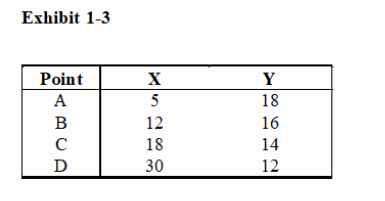 -Refer to Exhibit 1-3.Based on the data provided in this table,if these data were plotted in a two-variable diagram the result would be a ______________ sloping _____________.
 (Multiple Choice)
4.8/5 (78)
(78)
-Refer to Exhibit 1-3.Based on the data provided in this table,what type of relationship exists between variables X and Y?
-Refer to Exhibit 1-3.Based on the data provided in this table,what type of relationship exists between variables X and Y? (Multiple Choice)
4.9/5 (83)
(83) What is the most prominent rationing device you will likely find at your campus bookstore?
(Multiple Choice)
4.9/5 (84)
(84) Making a decision at the margin is __________ an all-or-nothing decision.
(Multiple Choice)
4.9/5 (81)
(81) Which of the following is an example of a positive economic statement?
(Multiple Choice)
5.0/5 (85)
(85) Which of the following is not one of the four broad categories of resources?
(Multiple Choice)
4.8/5 (83)
(83) Which of the following is not one of the four broad categories of resources?
(Multiple Choice)
4.7/5 (87)
(87) The purpose of the ceteris paribus assumption is to allow economists to
(Multiple Choice)
4.9/5 (81)
(81) Which of the following would NOT be considered a macroeconomic topic?
(Multiple Choice)
4.7/5 (76)
(76) 
Filters
- Essay(0)
- Multiple Choice(0)
- Short Answer(0)
- True False(0)
- Matching(0)