
Exam 6: Cost-Volume-Profit Relationships

arrow
  • Select Tags
search iconSearch Question
  • Select Tags

Laraia Corporation has provided the following contribution format income statement.All questions concern situations that are within the relevant range. Laraia Corporation has provided the following contribution format income statement.All questions concern situations that are within the relevant range.   Required: a.What is the contribution margin per unit? b.What is the contribution margin ratio? c.What is the variable expense ratio? d.If sales increase to 3,050 units, what would be the estimated increase in net operating income? e.If sales decline to 2,900 units, what would be the estimated net operating income? f.If the selling price increases by $4 per unit and the sales volume decreases by 200 units, what would be the estimated net operating income? g.If the variable cost per unit increases by $5, spending on advertising increases by $3,000, and unit sales increase by 450 units, what would be the estimated net operating income? h.What is the break-even point in unit sales? i.What is the break-even point in dollar sales? j.Estimate how many units must be sold to achieve a target profit of $54,000. k.What is the margin of safety in dollars? l.What is the margin of safety percentage? m.What is the degree of operating leverage? n.Using the degree of operating leverage, what is the estimated percent increase in net operating income of a 15% increase in sales? Required: a.What is the contribution margin per unit? b.What is the contribution margin ratio? c.What is the variable expense ratio? d.If sales increase to 3,050 units, what would be the estimated increase in net operating income? e.If sales decline to 2,900 units, what would be the estimated net operating income? f.If the selling price increases by $4 per unit and the sales volume decreases by 200 units, what would be the estimated net operating income? g.If the variable cost per unit increases by $5, spending on advertising increases by $3,000, and unit sales increase by 450 units, what would be the estimated net operating income? h.What is the break-even point in unit sales? i.What is the break-even point in dollar sales? j.Estimate how many units must be sold to achieve a target profit of $54,000. k.What is the margin of safety in dollars? l.What is the margin of safety percentage? m.What is the degree of operating leverage? n.Using the degree of operating leverage, what is the estimated percent increase in net operating income of a 15% increase in sales?

Free
(Essay)
4.9/5
(85)
Correct Answer:
Verified

a. a.   Alternatively,   b.CM ratio = Contribution margin ÷ Sales = $60,000 ÷ $150,000 = 40% c.Variable expense ratio = Variable expenses ÷ Sales = $90,000 ÷ $150,000 = 60% d.The increase in net operating income would be the increased contribution margin because fixed expenses are not affected.   e.   f.   g.     h.Unit sales to break even = Fixed expenses ÷ Unit CM = $48,000 ÷ $20 per unit = 2,400 units  i.Dollar sales to break even = Fixed expenses ÷ CM ratio = $48,000 ÷ 40% = $120,000  j.Unit sales to attain a target profit = (Target profit + Fixed expenses)÷ Unit CM = ($54,000 + $48,000)÷ $20 per unit = $102,000÷ $20 per unit = 5,100 units  k.Margin of safety in dollars = Total budgeted (or actual)sales - Break-even sales = $150,000 − $120,000 = $30,000  l.Margin of safety percentage = Margin of safety in dollars ÷ Total budgeted (or actual)sales = $30,000 ÷ $150,000 = 20%  m.Degree of operating leverage = Contribution margin ÷ Net operating income = $60,000 ÷ $12,000 = 5.0  n.Percentage change in net operating income = Degree of operating leverage × Percentage change in sales = 5.0 × 15% = 75% Alternatively, a.   Alternatively,   b.CM ratio = Contribution margin ÷ Sales = $60,000 ÷ $150,000 = 40% c.Variable expense ratio = Variable expenses ÷ Sales = $90,000 ÷ $150,000 = 60% d.The increase in net operating income would be the increased contribution margin because fixed expenses are not affected.   e.   f.   g.     h.Unit sales to break even = Fixed expenses ÷ Unit CM = $48,000 ÷ $20 per unit = 2,400 units  i.Dollar sales to break even = Fixed expenses ÷ CM ratio = $48,000 ÷ 40% = $120,000  j.Unit sales to attain a target profit = (Target profit + Fixed expenses)÷ Unit CM = ($54,000 + $48,000)÷ $20 per unit = $102,000÷ $20 per unit = 5,100 units  k.Margin of safety in dollars = Total budgeted (or actual)sales - Break-even sales = $150,000 − $120,000 = $30,000  l.Margin of safety percentage = Margin of safety in dollars ÷ Total budgeted (or actual)sales = $30,000 ÷ $150,000 = 20%  m.Degree of operating leverage = Contribution margin ÷ Net operating income = $60,000 ÷ $12,000 = 5.0  n.Percentage change in net operating income = Degree of operating leverage × Percentage change in sales = 5.0 × 15% = 75% b.CM ratio = Contribution margin ÷ Sales = $60,000 ÷ $150,000 = 40%
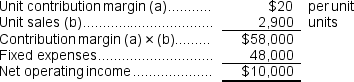
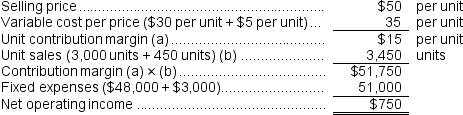
c.Variable expense ratio = Variable expenses ÷ Sales = $90,000 ÷ $150,000 = 60%
d.The increase in net operating income would be the increased contribution margin because fixed expenses are not affected. a.   Alternatively,   b.CM ratio = Contribution margin ÷ Sales = $60,000 ÷ $150,000 = 40% c.Variable expense ratio = Variable expenses ÷ Sales = $90,000 ÷ $150,000 = 60% d.The increase in net operating income would be the increased contribution margin because fixed expenses are not affected.   e.   f.   g.     h.Unit sales to break even = Fixed expenses ÷ Unit CM = $48,000 ÷ $20 per unit = 2,400 units  i.Dollar sales to break even = Fixed expenses ÷ CM ratio = $48,000 ÷ 40% = $120,000  j.Unit sales to attain a target profit = (Target profit + Fixed expenses)÷ Unit CM = ($54,000 + $48,000)÷ $20 per unit = $102,000÷ $20 per unit = 5,100 units  k.Margin of safety in dollars = Total budgeted (or actual)sales - Break-even sales = $150,000 − $120,000 = $30,000  l.Margin of safety percentage = Margin of safety in dollars ÷ Total budgeted (or actual)sales = $30,000 ÷ $150,000 = 20%  m.Degree of operating leverage = Contribution margin ÷ Net operating income = $60,000 ÷ $12,000 = 5.0  n.Percentage change in net operating income = Degree of operating leverage × Percentage change in sales = 5.0 × 15% = 75% e. a.   Alternatively,   b.CM ratio = Contribution margin ÷ Sales = $60,000 ÷ $150,000 = 40% c.Variable expense ratio = Variable expenses ÷ Sales = $90,000 ÷ $150,000 = 60% d.The increase in net operating income would be the increased contribution margin because fixed expenses are not affected.   e.   f.   g.     h.Unit sales to break even = Fixed expenses ÷ Unit CM = $48,000 ÷ $20 per unit = 2,400 units  i.Dollar sales to break even = Fixed expenses ÷ CM ratio = $48,000 ÷ 40% = $120,000  j.Unit sales to attain a target profit = (Target profit + Fixed expenses)÷ Unit CM = ($54,000 + $48,000)÷ $20 per unit = $102,000÷ $20 per unit = 5,100 units  k.Margin of safety in dollars = Total budgeted (or actual)sales - Break-even sales = $150,000 − $120,000 = $30,000  l.Margin of safety percentage = Margin of safety in dollars ÷ Total budgeted (or actual)sales = $30,000 ÷ $150,000 = 20%  m.Degree of operating leverage = Contribution margin ÷ Net operating income = $60,000 ÷ $12,000 = 5.0  n.Percentage change in net operating income = Degree of operating leverage × Percentage change in sales = 5.0 × 15% = 75% f. a.   Alternatively,   b.CM ratio = Contribution margin ÷ Sales = $60,000 ÷ $150,000 = 40% c.Variable expense ratio = Variable expenses ÷ Sales = $90,000 ÷ $150,000 = 60% d.The increase in net operating income would be the increased contribution margin because fixed expenses are not affected.   e.   f.   g.     h.Unit sales to break even = Fixed expenses ÷ Unit CM = $48,000 ÷ $20 per unit = 2,400 units  i.Dollar sales to break even = Fixed expenses ÷ CM ratio = $48,000 ÷ 40% = $120,000  j.Unit sales to attain a target profit = (Target profit + Fixed expenses)÷ Unit CM = ($54,000 + $48,000)÷ $20 per unit = $102,000÷ $20 per unit = 5,100 units  k.Margin of safety in dollars = Total budgeted (or actual)sales - Break-even sales = $150,000 − $120,000 = $30,000  l.Margin of safety percentage = Margin of safety in dollars ÷ Total budgeted (or actual)sales = $30,000 ÷ $150,000 = 20%  m.Degree of operating leverage = Contribution margin ÷ Net operating income = $60,000 ÷ $12,000 = 5.0  n.Percentage change in net operating income = Degree of operating leverage × Percentage change in sales = 5.0 × 15% = 75% g. a.   Alternatively,   b.CM ratio = Contribution margin ÷ Sales = $60,000 ÷ $150,000 = 40% c.Variable expense ratio = Variable expenses ÷ Sales = $90,000 ÷ $150,000 = 60% d.The increase in net operating income would be the increased contribution margin because fixed expenses are not affected.   e.   f.   g.     h.Unit sales to break even = Fixed expenses ÷ Unit CM = $48,000 ÷ $20 per unit = 2,400 units  i.Dollar sales to break even = Fixed expenses ÷ CM ratio = $48,000 ÷ 40% = $120,000  j.Unit sales to attain a target profit = (Target profit + Fixed expenses)÷ Unit CM = ($54,000 + $48,000)÷ $20 per unit = $102,000÷ $20 per unit = 5,100 units  k.Margin of safety in dollars = Total budgeted (or actual)sales - Break-even sales = $150,000 − $120,000 = $30,000  l.Margin of safety percentage = Margin of safety in dollars ÷ Total budgeted (or actual)sales = $30,000 ÷ $150,000 = 20%  m.Degree of operating leverage = Contribution margin ÷ Net operating income = $60,000 ÷ $12,000 = 5.0  n.Percentage change in net operating income = Degree of operating leverage × Percentage change in sales = 5.0 × 15% = 75%

h.Unit sales to break even = Fixed expenses ÷ Unit CM = $48,000 ÷ $20 per unit = 2,400 units

i.Dollar sales to break even = Fixed expenses ÷ CM ratio = $48,000 ÷ 40% = $120,000

j.Unit sales to attain a target profit = (Target profit + Fixed expenses)÷ Unit CM
= ($54,000 + $48,000)÷ $20 per unit = $102,000÷ $20 per unit = 5,100 units

k.Margin of safety in dollars = Total budgeted (or actual)sales - Break-even sales
= $150,000 − $120,000 = $30,000

l.Margin of safety percentage = Margin of safety in dollars ÷ Total budgeted (or actual)sales
= $30,000 ÷ $150,000 = 20%

m.Degree of operating leverage = Contribution margin ÷ Net operating income
= $60,000 ÷ $12,000 = 5.0

n.Percentage change in net operating income = Degree of operating leverage × Percentage change in sales
= 5.0 × 15% = 75%

How many units would the company have to sell in order to have a net operating income of $40,000?

Free
(Multiple Choice)
4.9/5
(72)
Correct Answer:
Verified

C

Mcmurtry Corporation sells a product for $170 per unit.The product's current sales are 10,000 units and its break-even sales are 8,100 units.The margin of safety as a percentage of sales is closest to:

Free
(Multiple Choice)
4.8/5
(68)
Correct Answer:
Verified

C

What is the margin of safety in dollars?

(Multiple Choice)
4.7/5
(68)

Fawn Company's margin of safety is $90,000.If the company's sales drop by $80,000, it will still have positive net operating income.

(True/False)
4.8/5
(77)

The number of units that must be sold to achieve a target profit of $24,000 is closest to:

(Multiple Choice)
4.9/5
(89)

If sales volume increases and all other factors remain constant, then the:

(Multiple Choice)
4.8/5
(72)

The company's break-even in unit sales is closest to:

(Multiple Choice)
4.9/5
(79)

Which of the following statements is correct with regard to a CVP graph?

(Multiple Choice)
4.7/5
(82)

In July, Meers Corporation sold 3,700 units of its only product.Its total sales were $107,300, its total variable expenses were $66,600, and its total fixed expenses were $34,800. Required: a.Construct the company's contribution format income statement for July. b.Redo the company's contribution format income statement assuming that the company sells 3,400 units.

(Essay)
4.9/5
(73)

This question is to be considered independently of all other questions relating to Houpe Corporation.Refer to the original data when answering this question. The marketing manager would like to introduce sales commissions as an incentive for the sales staff.The marketing manager has proposed a commission of $11 per unit.In exchange, the sales staff would accept a decrease in their salaries of $58,000 per month.(This is the company's savings for the entire sales staff.)The marketing manager predicts that introducing this sales incentive would increase monthly sales by 100 units.What should be the overall effect on the company's monthly net operating income of this change?

(Multiple Choice)
4.9/5
(78)

The company's degree of operating leverage is closest to:

(Multiple Choice)
4.7/5
(92)

Rovinsky Corporation, a company that produces and sells a single product, has provided its contribution format income statement for November. Rovinsky Corporation, a company that produces and sells a single product, has provided its contribution format income statement for November.   If the company sells 5,300 units, its net operating income should be closest to: If the company sells 5,300 units, its net operating income should be closest to:

(Multiple Choice)
4.8/5
(82)

This question is to be considered independently of all other questions relating to Lemelin Corporation.Refer to the original data when answering this question. The marketing manager would like to introduce sales commissions as an incentive for the sales staff.The marketing manager has proposed a commission of $20 per unit.In exchange, the sales staff would accept a decrease in their salaries of $113,000 per month.(This is the company's savings for the entire sales staff.)The marketing manager predicts that introducing this sales incentive would increase monthly sales by 300 units.What should be the overall effect on the company's monthly net operating income of this change?

(Multiple Choice)
5.0/5
(88)

Bristo Corporation has sales of 2,000 units at $35 per unit.Variable expenses are 40% of the selling price.If total fixed expenses are $22,000, the degree of operating leverage is:

(Multiple Choice)
4.8/5
(78)

The company's unit contribution margin is closest to:

(Multiple Choice)
4.9/5
(87)

The break-even point can be determined by simply adding together all of the expenses from the income statement.

(True/False)
4.7/5
(75)

Assume the company's target profit is $11,000.The unit sales to attain that target profit is closest to:

(Multiple Choice)
4.8/5
(92)

Mossfeet Shoe Corporation is a single product firm.The company is predicting that a price increase next year will not cause unit sales to decrease.What effect would this price increase have on the following items for next year? Mossfeet Shoe Corporation is a single product firm.The company is predicting that a price increase next year will not cause unit sales to decrease.What effect would this price increase have on the following items for next year?

(Short Answer)
4.8/5
(74)

Warrix Corporation has provided the following contribution format income statement.All questions concern situations that are within the relevant range. Warrix Corporation has provided the following contribution format income statement.All questions concern situations that are within the relevant range.   If sales increase to 3,020 units, the increase in net operating income would be closest to: If sales increase to 3,020 units, the increase in net operating income would be closest to:

(Multiple Choice)
4.9/5
(69)
Showing 1 - 20 of 260
close modal

Filters

  • Essay(0)
  • Multiple Choice(0)
  • Short Answer(0)
  • True False(0)
  • Matching(0)

