



 Chat with AI
Exam 14: Analysis of Variance

Exam 1: What Is Statistics46 Questions
Exam 2: Graphical Descriptive Techniques 194 Questions
Exam 3: Graphical Descriptive Techniques 2156 Questions
Exam 4: Numerical Descriptive Techniques275 Questions
Exam 5: Data Collection and Sampling84 Questions
Exam 6: Probability240 Questions
Exam 7: Random Variables and Discrete Probability Distributions283 Questions
Exam 8: Continuous Probability Distributions224 Questions
Exam 9: Sampling Distributions156 Questions
Exam 10: Introduction to Estimation154 Questions
Exam 11: Introduction to Hypothesis Testing189 Questions
Exam 12: Inference About a Population153 Questions
Exam 13: Inference About Comparing Two Populations170 Questions
Exam 14: Analysis of Variance157 Questions
Exam 15: Chi-Squared Tests179 Questions
Exam 16: Simple Linear Regression and Correlation304 Questions
Exam 17: Multiple Regression160 Questions
Exam 18: Model Building148 Questions
Exam 19: Nonparametric Statistics175 Questions
Exam 20: Time-Series Analytics and Forecasting225 Questions
Exam 21: Statistical Process Control140 Questions
Exam 22: Decision Analysis123 Questions
Exam 23: Conclusion47 Questions
Select questions type


Food Irradiation
In recent years the irradiation of food to reduce bacteria and preserve the food longer has become more common.A company that performs this service has developed four different methods of irradiating food.To determine which is best,it conducts an experiment where different foods are irradiated and the bacteria count is measured.As part of the experiment the following foods are irradiated: meat,poultry,veal,tuna,and yogurt.The results are shown below. 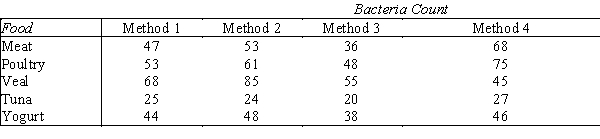
-{Food Irradiation Narrative} Set up the ANOVA Table.Use α = 0.01 to determine the critical values.
-{Food Irradiation Narrative} Set up the ANOVA Table.Use α = 0.01 to determine the critical values. (Essay)
4.8/5  (98)
(98) The analysis of variance (ANOVA)tests hypotheses about population variances and requires all the population means to be equal.
(True/False)
4.7/5 (81)
(81) In a two-factor ANOVA,there are 4 levels for factor A,5 levels for factor B,and 3 observations for each combination of factor A and factor B levels.The number of treatments in this experiment equals:
(Multiple Choice)
4.9/5 (71)
(71) The randomized block design with exactly two treatments is equivalent to a two-tail:
(Multiple Choice)
4.7/5 (78)
(78) When the objective is to compare more than two populations,the experimental design that is the counterpart of the matched pairs experiment is called a:
(Multiple Choice)
4.8/5 (75)
(75) In the one-way ANOVA where there are k treatments and n observations,the degrees of freedom for the F-statistic are equal to,respectively:
(Multiple Choice)
4.7/5 (87)
(87) If the numerator (MST)degrees of freedom is 3 and the denominator (MSE)degrees of freedom is 18,the total number of observations must equal 21.
(True/False)
4.9/5 (72)
(72) Migraine Treatments
The following data were generated from a 2 × 2 factorial experiment with 3 replicates,where factor A levels represent two different injection procedures of an anesthetic to the occipital nerve (located in the back of the neck),and factor B levels represent two different drugs,which physicians recommend to increase the effectiveness of the injections.Three migraine patients were randomly selected for each combination of injection and drug. 
-{Migraine Treatments Narrative} Test at the 5% significance level to determine if differences exist among the levels of factor B.
-{Migraine Treatments Narrative} Test at the 5% significance level to determine if differences exist among the levels of factor B. (Essay)
4.8/5 (92)
(92) In the one-way ANOVA where k is the number of treatments and n is the number of observations in all samples,the number of degrees of freedom for error is:
(Multiple Choice)
4.8/5 (71)
(71) The F-test of the randomized block design of the analysis of variance has the same requirements as the independent samples design; that is,the random variable must be normally distributed and the population variances must be equal.
(True/False)
4.9/5 (83)
(83) The F-test in ANOVA is an expansion of the t-test for two independent population means.
(True/False)
4.8/5 (85)
(85) Acid Reflux
A partial ANOVA table in a randomized block design is shown below,where the treatments refer to different acid reflux medicines,and the blocks refer to groups of men with similar levels of stomach acid. 
-{Acid Reflux Narrative} Can we infer at the 5% significance level that the treatment means differ?
-{Acid Reflux Narrative} Can we infer at the 5% significance level that the treatment means differ? (Essay)
4.9/5 (89)
(89) One-way ANOVA is applied to independent samples taken from three normally distributed populations with equal variances.Which of the following is the null hypothesis for this procedure?
(Multiple Choice)
4.9/5 (72)
(72) {Food Irradiation Narrative} Can the company infer at the 1% significance level that differences in the bacteria count exist among the four irradiation methods?
(Essay)
5.0/5 (73)
(73) Fisher's least significant difference method (LSD)substitutes the pooled variance estimator from the equal variances t-test with the MSE from ANOVA.
(True/False)
4.8/5 (72)
(72) 
Filters
- Essay(0)
- Multiple Choice(0)
- Short Answer(0)
- True False(0)
- Matching(0)