



 Chat with AI
Exam 25: Standard Cost Systems: a Financial Reporting Perspective Using Microsoft Excel

Exam 1: Managerial Accounting and Cost Concepts299 Questions
Exam 2: Job-Order Costing: Calculating Unit Production Costs292 Questions
Exam 3: Job-Order Costing: Cost Flows and External Reporting255 Questions
Exam 4: Process Costing138 Questions
Exam 5: Cost-Volume-Profit Relationships260 Questions
Exam 6: Variable Costing and Segment Reporting: Tools for Management291 Questions
Exam 7: Super-Variable Costing49 Questions
Exam 8: Master Budgeting234 Questions
Exam 9: Flexible Budgets and Performance Analysis417 Questions
Exam 10: Standard Costs and Variances247 Questions
Exam 11: Performance Measurement in Decentralized Organizations180 Questions
Exam 12: Differential Analysis: The Key to Decision Making203 Questions
Exam 13: Capital Budgeting Decisions179 Questions
Exam 14: Statement of Cash Flows132 Questions
Exam 15: Financial Statement Analysis289 Questions
Exam 16: Cost of Quality66 Questions
Exam 17: Activity-Based Absorption Costing20 Questions
Exam 18: The Predetermined Overhead Rate and Capacity42 Questions
Exam 19: Job-Order Costing: a Microsoft Excel-Based Approach28 Questions
Exam 20: Fifo Method100 Questions
Exam 21: Service Department Allocations60 Questions
Exam 22: Analyzing Mixed Costs81 Questions
Exam 23: Time-Driven Activity-Based Costing: a Microsoft Excel-Based Approach123 Questions
Exam 24: Predetermined Overhead Rates and Overhead Analysis in a Standard Costing System177 Questions
Exam 25: Standard Cost Systems: a Financial Reporting Perspective Using Microsoft Excel138 Questions
Exam 26: Transfer Pricing102 Questions
Exam 27: Service Department Charges44 Questions
Exam 28: Pricing Decisions149 Questions
Exam 29: The Concept of Present Value16 Questions
Exam 30: Income Taxes and the Present Value Method150 Questions
Exam 31: the Direct Method of Determining the Net Cash Provided by Operating Activities56 Questions
Select questions type


Neuhaus Corporation manufactures one product. It does not maintain any beginning or ending Work in Process inventories. The company uses a standard cost system in which inventories are recorded at their standard costs. There is no variable manufacturing overhead. The standard cost card for the company's only product is as follows:
 During the year, the company completed the following transactions:
a. Purchased 52,900 gallons of raw material at a price of $7.60 per gallon.
b. Used 46,820 gallons of the raw material to produce 27,600 units of work in process.
Assume that all transactions are recorded on the below worksheet, which is similar to the worksheet shown in your text except that it has been divided into two parts so that it fits on one page. The beginning balances in each of the accounts have been given. PP&E (net) stands for Property, Plant, and Equipment net of depreciation.

 -When recording the raw materials used in production in transaction (b)above,the Raw Materials inventory account will increase (decrease)by:
During the year, the company completed the following transactions:
a. Purchased 52,900 gallons of raw material at a price of $7.60 per gallon.
b. Used 46,820 gallons of the raw material to produce 27,600 units of work in process.
Assume that all transactions are recorded on the below worksheet, which is similar to the worksheet shown in your text except that it has been divided into two parts so that it fits on one page. The beginning balances in each of the accounts have been given. PP&E (net) stands for Property, Plant, and Equipment net of depreciation.
-When recording the raw materials used in production in transaction (b)above,the Raw Materials inventory account will increase (decrease)by: (Multiple Choice)
4.9/5  (79)
(79) Catherman Corporation manufactures one product. It does not maintain any beginning or ending inventories. The company uses a standard cost system in which inventories are recorded at their standard costs and any variances are closed directly to Cost of Goods Sold.
During the year, the company produced and sold 32,400 units at a price of $42.30 per unit. Its standard cost per unit produced is $36.90 and its selling and administrative expenses totaled $102,000. The company does not have any variable manufacturing overhead costs and it recorded the following variances during the year:
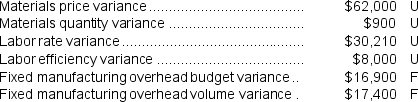 -The net operating income for the year is closest to:
 (Multiple Choice)
4.8/5 (75)
(75) Woodhead Inc. manufactures one product. It does not maintain any beginning or ending inventories. The company uses a standard cost system in which inventories are recorded at their standard costs and any variances are closed directly to Cost of Goods Sold. Its standard cost per unit produced is $37.45. During the year, the company produced and sold 24,400 units at a price of $47.40 per unit and its selling and administrative expenses totaled $92,000. The company does not have any variable manufacturing overhead costs. It recorded the following variances during the year:
 -The net operating income for the year is closest to:
 (Multiple Choice)
4.7/5 (78)
(78) Bohon Corporation manufactures one product. It does not maintain any beginning or ending Work in Process inventories. The company uses a standard cost system in which inventories are recorded at their standard costs. There is no variable manufacturing overhead. The standard cost card for the company's only product contains the following information concerning direct materials:
 During the year, the company completed the following transactions concerning direct materials:
a. Purchased 19,700 pounds of raw material at a price of $4.70 per pound.
b. Used 18,500 pounds of the raw material to produce 18,400 units of work in process.
The company calculated the following direct materials variances for the year:
 Assume that all transactions are recorded on the below worksheet, which is similar to the worksheet shown in your text except that it has been divided into two parts so that it fits on one page. The beginning balances in each of the accounts have been given. PP&E (net) stands for Property, Plant, and Equipment net of depreciation.

 -When the purchase of raw materials is recorded in transaction (a)above,which of the following entries will be made?
During the year, the company completed the following transactions concerning direct materials:
a. Purchased 19,700 pounds of raw material at a price of $4.70 per pound.
b. Used 18,500 pounds of the raw material to produce 18,400 units of work in process.
The company calculated the following direct materials variances for the year:
Assume that all transactions are recorded on the below worksheet, which is similar to the worksheet shown in your text except that it has been divided into two parts so that it fits on one page. The beginning balances in each of the accounts have been given. PP&E (net) stands for Property, Plant, and Equipment net of depreciation.
-When the purchase of raw materials is recorded in transaction (a)above,which of the following entries will be made? (Multiple Choice)
4.9/5 (75)
(75) Johanson Corporation uses a standard cost system in which inventories are recorded at their standard costs and any variances are closed directly to Cost of Goods Sold.The standard cost card for the company's only product is as follows:
 During the year,the company purchased 89,600 pounds of raw material at a price of $7.80 per pound and used 79,120 pounds of the raw material to produce 23,300 units of work in process.
Assume that all transactions are recorded on a worksheet as shown in the text.On the left-hand side of the equals sign in the worksheet are columns for Cash,Raw Materials,Work in Process,Finished Goods,and PP&E (net).All of the variance columns are on the right-hand-side of the equals sign along with the column for Retained Earnings.
When recording the raw materials purchases,the Raw Materials inventory account will increase (decrease)by:
During the year,the company purchased 89,600 pounds of raw material at a price of $7.80 per pound and used 79,120 pounds of the raw material to produce 23,300 units of work in process.
Assume that all transactions are recorded on a worksheet as shown in the text.On the left-hand side of the equals sign in the worksheet are columns for Cash,Raw Materials,Work in Process,Finished Goods,and PP&E (net).All of the variance columns are on the right-hand-side of the equals sign along with the column for Retained Earnings.
When recording the raw materials purchases,the Raw Materials inventory account will increase (decrease)by: (Multiple Choice)
4.9/5 (85)
(85) Lakatos Corporation manufactures one product. It does not maintain any beginning or ending Work in Process inventories. The company uses a standard cost system in which inventories are recorded at their standard costs. There is no variable manufacturing overhead. The standard cost card for the company's only product contains the following information concerning direct materials:
 During the year, the company completed the following transactions concerning direct materials:
a. Purchased 151,800 kilos of raw material at a price of $9.70 per kilo.
b. Used 140,870 kilos of the raw material to produce 38,100 units of work in process.
The company calculated the following direct materials variances for the year:
 Assume that all transactions are recorded on the below worksheet, which is similar to the worksheet shown in your text except that it has been divided into two parts so that it fits on one page. The beginning balances in each of the accounts have been given. PP&E (net) stands for Property, Plant, and Equipment net of depreciation.

 -When the raw materials used in production are recorded in transaction (b)above,which of the following entries will be made?
During the year, the company completed the following transactions concerning direct materials:
a. Purchased 151,800 kilos of raw material at a price of $9.70 per kilo.
b. Used 140,870 kilos of the raw material to produce 38,100 units of work in process.
The company calculated the following direct materials variances for the year:
Assume that all transactions are recorded on the below worksheet, which is similar to the worksheet shown in your text except that it has been divided into two parts so that it fits on one page. The beginning balances in each of the accounts have been given. PP&E (net) stands for Property, Plant, and Equipment net of depreciation.
-When the raw materials used in production are recorded in transaction (b)above,which of the following entries will be made? (Multiple Choice)
4.8/5 (70)
(70) Scogin Corporation uses a standard cost system in which inventories are recorded at their standard costs and any variances are closed directly to Cost of Goods Sold.The standard cost card for the company's only product is as follows:
 During the year,the company purchased 76,500 pounds of raw material at a price of $8.70 per pound and used 71,880 pounds of the raw material to produce 19,400 units of work in process.
Assume that all transactions are recorded on a worksheet as shown in the text.On the left-hand side of the equals sign in the worksheet are columns for Cash,Raw Materials,Work in Process,Finished Goods,and PP&E (net).All of the variance columns are on the right-hand-side of the equals sign along with the column for Retained Earnings.
When recording the raw materials used in production,the Work in Process inventory account will increase (decrease)by:
During the year,the company purchased 76,500 pounds of raw material at a price of $8.70 per pound and used 71,880 pounds of the raw material to produce 19,400 units of work in process.
Assume that all transactions are recorded on a worksheet as shown in the text.On the left-hand side of the equals sign in the worksheet are columns for Cash,Raw Materials,Work in Process,Finished Goods,and PP&E (net).All of the variance columns are on the right-hand-side of the equals sign along with the column for Retained Earnings.
When recording the raw materials used in production,the Work in Process inventory account will increase (decrease)by: (Multiple Choice)
4.7/5 (97)
(97) Phann Corporation manufactures one product. It does not maintain any beginning or ending Work in Process inventories. The company uses a standard cost system in which inventories are recorded at their standard costs and any variances are closed directly to Cost of Goods Sold. There is no variable manufacturing overhead. The standard cost card for the company's only product is as follows:
 The standard fixed manufacturing overhead rate was based on budgeted fixed manufacturing overhead of $90,000 and budgeted activity of 7,500 hours.
During the year, the company completed the following transactions:
a. Purchased 59,000 kilos of raw material at a price of $9.20 per kilo.
b. Used 51,340 kilos of the raw material to produce 18,300 units of work in process.
c. Assigned direct labor costs to work in process. The direct labor workers (who were paid in cash) worked 8,850 hours at an average cost of $23.70 per hour.
d. Applied fixed overhead to the 18,300 units in work in process inventory using the predetermined overhead rate multiplied by the number of direct labor-hours allowed. Actual fixed overhead costs for the year were $79,400. Of this total, $22,400 related to items such as insurance, utilities, and indirect labor salaries that were all paid in cash and $57,000 related to depreciation of manufacturing equipment.
e. Completed and transferred 18,300 units from work in process to finished goods.
Assume that all transactions are recorded on the below worksheet, which is similar to the worksheet shown in your text except that it has been divided into two parts so that it fits on one page. The beginning balances in each of the accounts have been given. PP&E (net) stands for Property, Plant, and Equipment net of depreciation.
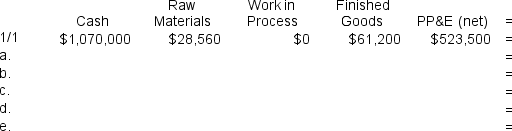
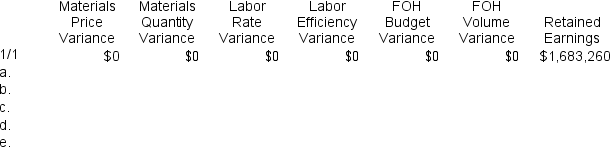 -When recording the raw materials used in production in transaction (b)above,the Raw Materials inventory account will increase (decrease)by:
The standard fixed manufacturing overhead rate was based on budgeted fixed manufacturing overhead of $90,000 and budgeted activity of 7,500 hours.
During the year, the company completed the following transactions:
a. Purchased 59,000 kilos of raw material at a price of $9.20 per kilo.
b. Used 51,340 kilos of the raw material to produce 18,300 units of work in process.
c. Assigned direct labor costs to work in process. The direct labor workers (who were paid in cash) worked 8,850 hours at an average cost of $23.70 per hour.
d. Applied fixed overhead to the 18,300 units in work in process inventory using the predetermined overhead rate multiplied by the number of direct labor-hours allowed. Actual fixed overhead costs for the year were $79,400. Of this total, $22,400 related to items such as insurance, utilities, and indirect labor salaries that were all paid in cash and $57,000 related to depreciation of manufacturing equipment.
e. Completed and transferred 18,300 units from work in process to finished goods.
Assume that all transactions are recorded on the below worksheet, which is similar to the worksheet shown in your text except that it has been divided into two parts so that it fits on one page. The beginning balances in each of the accounts have been given. PP&E (net) stands for Property, Plant, and Equipment net of depreciation.
-When recording the raw materials used in production in transaction (b)above,the Raw Materials inventory account will increase (decrease)by: (Multiple Choice)
5.0/5 (89)
(89) Phann Corporation manufactures one product. It does not maintain any beginning or ending Work in Process inventories. The company uses a standard cost system in which inventories are recorded at their standard costs and any variances are closed directly to Cost of Goods Sold. There is no variable manufacturing overhead. The standard cost card for the company's only product is as follows:
The standard fixed manufacturing overhead rate was based on budgeted fixed manufacturing overhead of $90,000 and budgeted activity of 7,500 hours.
During the year, the company completed the following transactions:
a. Purchased 59,000 kilos of raw material at a price of $9.20 per kilo.
b. Used 51,340 kilos of the raw material to produce 18,300 units of work in process.
c. Assigned direct labor costs to work in process. The direct labor workers (who were paid in cash) worked 8,850 hours at an average cost of $23.70 per hour.
d. Applied fixed overhead to the 18,300 units in work in process inventory using the predetermined overhead rate multiplied by the number of direct labor-hours allowed. Actual fixed overhead costs for the year were $79,400. Of this total, $22,400 related to items such as insurance, utilities, and indirect labor salaries that were all paid in cash and $57,000 related to depreciation of manufacturing equipment.
e. Completed and transferred 18,300 units from work in process to finished goods.
Assume that all transactions are recorded on the below worksheet, which is similar to the worksheet shown in your text except that it has been divided into two parts so that it fits on one page. The beginning balances in each of the accounts have been given. PP&E (net) stands for Property, Plant, and Equipment net of depreciation.
-When applying fixed manufacturing overhead to production in transaction (d)above,the Work in Process inventory account will increase (decrease)by:
The standard fixed manufacturing overhead rate was based on budgeted fixed manufacturing overhead of $90,000 and budgeted activity of 7,500 hours.
During the year, the company completed the following transactions:
a. Purchased 59,000 kilos of raw material at a price of $9.20 per kilo.
b. Used 51,340 kilos of the raw material to produce 18,300 units of work in process.
c. Assigned direct labor costs to work in process. The direct labor workers (who were paid in cash) worked 8,850 hours at an average cost of $23.70 per hour.
d. Applied fixed overhead to the 18,300 units in work in process inventory using the predetermined overhead rate multiplied by the number of direct labor-hours allowed. Actual fixed overhead costs for the year were $79,400. Of this total, $22,400 related to items such as insurance, utilities, and indirect labor salaries that were all paid in cash and $57,000 related to depreciation of manufacturing equipment.
e. Completed and transferred 18,300 units from work in process to finished goods.
Assume that all transactions are recorded on the below worksheet, which is similar to the worksheet shown in your text except that it has been divided into two parts so that it fits on one page. The beginning balances in each of the accounts have been given. PP&E (net) stands for Property, Plant, and Equipment net of depreciation.
-When applying fixed manufacturing overhead to production in transaction (d)above,the Work in Process inventory account will increase (decrease)by: (Multiple Choice)
4.9/5 (85)
(85) Alvino Corporation manufactures one product. It does not maintain any beginning or ending Work in Process inventories. The company uses a standard cost system in which inventories are recorded at their standard costs and any variances are closed directly to Cost of Goods Sold. There is no variable manufacturing overhead.
The standard cost card for the company's only product is as follows:
 The standard fixed manufacturing overhead rate was based on budgeted fixed manufacturing overhead of $70,000 and budgeted activity of 14,000 hours.
During the year, the company completed the following transactions:
a. Purchased 32,200 kilos of raw material at a price of $7.80 per kilo. The materials price variance was $22,540 F.
b. Used 30,480 kilos of the raw material to produce 27,800 units of work in process. The materials quantity variance was $850 F.
c. Assigned direct labor costs to work in process. The direct labor workers (who were paid in cash) worked 18,260 hours at an average cost of $20.50 per hour. The direct labor rate variance was $9,130 U. The labor efficiency variance was $24,000 F.
d. Applied fixed overhead to the 27,800 units in work in process inventory using the predetermined overhead rate multiplied by the number of direct labor-hours allowed. Actual fixed overhead costs for the year were $59,500. Of this total, -$22,500 related to items such as insurance, utilities, and indirect labor salaries that were all paid in cash and $82,000 related to depreciation of manufacturing equipment. The fixed manufacturing overhead budget variance was $10,500 F. The fixed manufacturing overhead volume variance was $27,300 F.
e. Completed and transferred 27,800 units from work in process to finished goods.
f. Sold (for cash) 29,000 units to customers at a price of $31.90 per unit.
g. Transferred the standard cost associated with the 29,000 units sold from finished goods to cost of goods sold.
h. Paid $101,000 of selling and administrative expenses.
i. Closed all standard cost variances to cost of goods sold.
To answer the following questions, you will need to record transactions a through i in the worksheet below. This worksheet is similar to the worksheets in your text except that it has been split into two parts to fit on the page. PP&E (net) stands for Property, Plant, and Equipment net of depreciation.
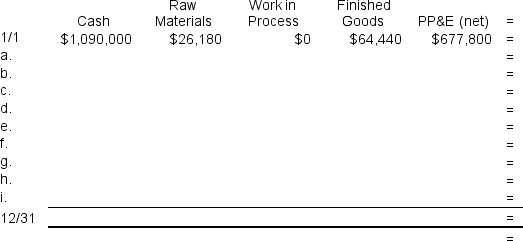
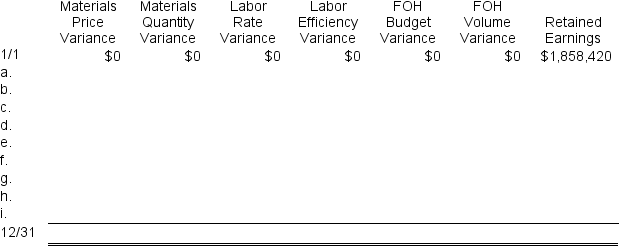 -The ending balance in the PP&E (net)account will be closest to:
The standard fixed manufacturing overhead rate was based on budgeted fixed manufacturing overhead of $70,000 and budgeted activity of 14,000 hours.
During the year, the company completed the following transactions:
a. Purchased 32,200 kilos of raw material at a price of $7.80 per kilo. The materials price variance was $22,540 F.
b. Used 30,480 kilos of the raw material to produce 27,800 units of work in process. The materials quantity variance was $850 F.
c. Assigned direct labor costs to work in process. The direct labor workers (who were paid in cash) worked 18,260 hours at an average cost of $20.50 per hour. The direct labor rate variance was $9,130 U. The labor efficiency variance was $24,000 F.
d. Applied fixed overhead to the 27,800 units in work in process inventory using the predetermined overhead rate multiplied by the number of direct labor-hours allowed. Actual fixed overhead costs for the year were $59,500. Of this total, -$22,500 related to items such as insurance, utilities, and indirect labor salaries that were all paid in cash and $82,000 related to depreciation of manufacturing equipment. The fixed manufacturing overhead budget variance was $10,500 F. The fixed manufacturing overhead volume variance was $27,300 F.
e. Completed and transferred 27,800 units from work in process to finished goods.
f. Sold (for cash) 29,000 units to customers at a price of $31.90 per unit.
g. Transferred the standard cost associated with the 29,000 units sold from finished goods to cost of goods sold.
h. Paid $101,000 of selling and administrative expenses.
i. Closed all standard cost variances to cost of goods sold.
To answer the following questions, you will need to record transactions a through i in the worksheet below. This worksheet is similar to the worksheets in your text except that it has been split into two parts to fit on the page. PP&E (net) stands for Property, Plant, and Equipment net of depreciation.
-The ending balance in the PP&E (net)account will be closest to: (Multiple Choice)
4.8/5 (75)
(75) Lusher Corporation manufactures one product.It does not maintain any beginning or ending Work in Process inventories.The company uses a standard cost system in which inventories are recorded at their standard costs and any variances are closed directly to Cost of Goods Sold.There is no variable manufacturing overhead.The standard cost card for the company's only product is as follows:
 The company calculated the following variances for the year:
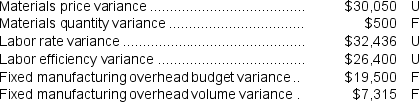 The standard fixed manufacturing overhead rate was based on budgeted fixed manufacturing overhead of $134,750 and budgeted activity of 24,500 hours.
During the year,the company completed the following transactions:
a.Purchased 60,100 kilos of raw material at a price of $5.50 per kilo.
b.Used 55,250 kilos of the raw material to produce 36,900 units of work in process.
c.Assigned direct labor costs to work in process.The direct labor workers (who were paid in cash)worked 27,030 hours at an average cost of $23.20 per hour.
d.Applied fixed overhead to the 36,900 units in work in process inventory using the predetermined overhead rate multiplied by the number of direct labor-hours allowed.Actual fixed overhead costs for the year were $115,250.Of this total,$40,250 related to items such as insurance,utilities,and indirect labor salaries that were all paid in cash and $75,000 related to depreciation of manufacturing equipment.
e.Transferred 36,900 units from work in process to finished goods.
f.Sold for cash 39,700 units to customers at a price of $33.60 per unit.
g.Completed and transferred the standard cost associated with the 39,700 units sold from finished goods to cost of goods sold.
h.Paid $171,000 of selling and administrative expenses.
i.Closed all standard cost variances to cost of goods sold.
Required:
1.Record the above transactions in the worksheet that appears below.Because of the width of the worksheet,it is in two parts.In your text,these two parts would be joined side-by-side to make one very wide worksheet.The beginning balances have been provided for each of the accounts,including the Property,Plant,and Equipment (net)account which is abbreviated as PP&E (net).
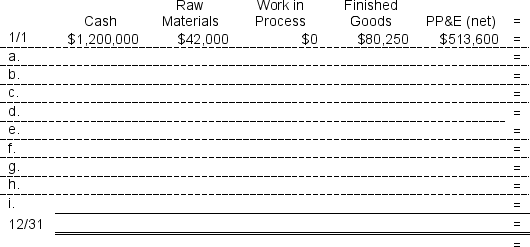
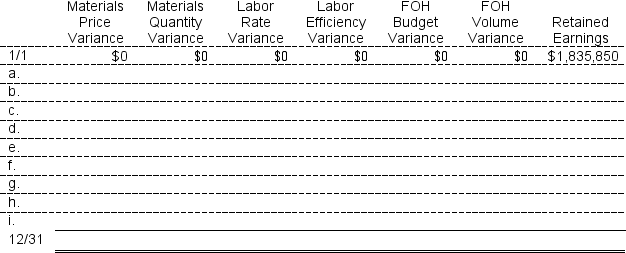 2.Determine the ending balance (e.g.,12/31 balance)in each account.
3.Prepare an income statement for the year.
The company calculated the following variances for the year:
The standard fixed manufacturing overhead rate was based on budgeted fixed manufacturing overhead of $134,750 and budgeted activity of 24,500 hours.
During the year,the company completed the following transactions:
a.Purchased 60,100 kilos of raw material at a price of $5.50 per kilo.
b.Used 55,250 kilos of the raw material to produce 36,900 units of work in process.
c.Assigned direct labor costs to work in process.The direct labor workers (who were paid in cash)worked 27,030 hours at an average cost of $23.20 per hour.
d.Applied fixed overhead to the 36,900 units in work in process inventory using the predetermined overhead rate multiplied by the number of direct labor-hours allowed.Actual fixed overhead costs for the year were $115,250.Of this total,$40,250 related to items such as insurance,utilities,and indirect labor salaries that were all paid in cash and $75,000 related to depreciation of manufacturing equipment.
e.Transferred 36,900 units from work in process to finished goods.
f.Sold for cash 39,700 units to customers at a price of $33.60 per unit.
g.Completed and transferred the standard cost associated with the 39,700 units sold from finished goods to cost of goods sold.
h.Paid $171,000 of selling and administrative expenses.
i.Closed all standard cost variances to cost of goods sold.
Required:
1.Record the above transactions in the worksheet that appears below.Because of the width of the worksheet,it is in two parts.In your text,these two parts would be joined side-by-side to make one very wide worksheet.The beginning balances have been provided for each of the accounts,including the Property,Plant,and Equipment (net)account which is abbreviated as PP&E (net).
2.Determine the ending balance (e.g.,12/31 balance)in each account.
3.Prepare an income statement for the year. (Essay)
4.8/5 (91)
(91) Freiling Corporation manufactures one product. It does not maintain any beginning or ending Work in Process inventories. The company uses a standard cost system in which inventories are recorded at their standard costs. There is no variable manufacturing overhead. The standard cost card for the company's only product is as follows:
 During the year, the company assigned direct labor costs to work in process. The direct labor workers (who were paid in cash) worked 14,890 hours at an average cost of $22.80 per hour.
Assume that all transactions are recorded on the below worksheet, which is similar to the worksheet shown in your text except that it has been divided into two parts so that it fits on one page. The beginning balances in each of the accounts have been given. PP&E (net) stands for Property, Plant, and Equipment net of depreciation.

 -When recording the direct labor costs,the Work in Process inventory account will increase (decrease)by:
During the year, the company assigned direct labor costs to work in process. The direct labor workers (who were paid in cash) worked 14,890 hours at an average cost of $22.80 per hour.
Assume that all transactions are recorded on the below worksheet, which is similar to the worksheet shown in your text except that it has been divided into two parts so that it fits on one page. The beginning balances in each of the accounts have been given. PP&E (net) stands for Property, Plant, and Equipment net of depreciation.
-When recording the direct labor costs,the Work in Process inventory account will increase (decrease)by: (Multiple Choice)
4.8/5 (73)
(73) Samples Corporation manufactures one product. It does not maintain any beginning or ending Work in Process inventories. The company uses a standard cost system in which inventories are recorded at their standard costs and any variances are closed directly to Cost of Goods Sold. There is no variable manufacturing overhead.
The standard cost card for the company's only product is as follows:
 The standard fixed manufacturing overhead rate was based on budgeted fixed manufacturing overhead of $140,000 and budgeted activity of 20,000 hours.
During the year, the company completed the following transactions:
a. Purchased 49,500 liters of raw material at a price of $8.00 per liter. The materials price variance was $24,750 F.
b. Used 45,820 liters of the raw material to produce 32,800 units of work in process. The materials quantity variance was $850 F.
c. Assigned direct labor costs to work in process. The direct labor workers (who were paid in cash) worked 28,440 hours at an average cost of $17.00 per hour. The direct labor rate variance was $28,440 F. The labor efficiency variance was $39,600 U.
d. Applied fixed overhead to the 32,800 units in work in process inventory using the predetermined overhead rate multiplied by the number of direct labor-hours allowed. Actual fixed overhead costs for the year were $154,700. Of this total, $83,700 related to items such as insurance, utilities, and indirect labor salaries that were all paid in cash and $71,000 related to depreciation of manufacturing equipment. The fixed manufacturing overhead budget variance was $14,700 U. The fixed manufacturing overhead volume variance was $43,680 F.
e. Completed and transferred 32,800 units from work in process to finished goods.
f. Sold (for cash) 32,000 units to customers at a price of $38.20 per unit.
g. Transferred the standard cost associated with the 32,000 units sold from finished goods to cost of goods sold.
h. Paid $133,000 of selling and administrative expenses.
i. Closed all standard cost variances to cost of goods sold.
To answer the following questions, it would be advisable to record transactions a through i in the worksheet below. This worksheet is similar to the worksheets in your text except that it has been split into two parts to fit on the page. PP&E (net) stands for Property, Plant, and Equipment net of depreciation.
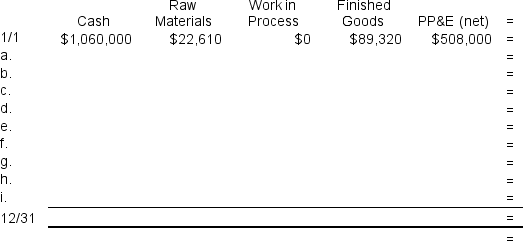
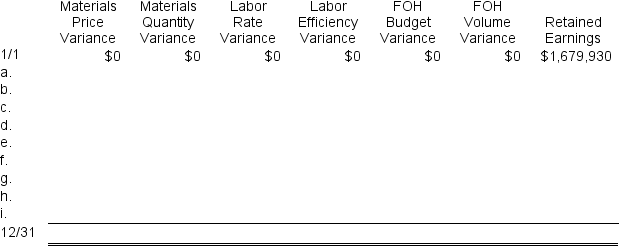 -The adjusted Cost of Goods Sold after closing all of the variances to Cost of Goods Sold will be closest to:
The standard fixed manufacturing overhead rate was based on budgeted fixed manufacturing overhead of $140,000 and budgeted activity of 20,000 hours.
During the year, the company completed the following transactions:
a. Purchased 49,500 liters of raw material at a price of $8.00 per liter. The materials price variance was $24,750 F.
b. Used 45,820 liters of the raw material to produce 32,800 units of work in process. The materials quantity variance was $850 F.
c. Assigned direct labor costs to work in process. The direct labor workers (who were paid in cash) worked 28,440 hours at an average cost of $17.00 per hour. The direct labor rate variance was $28,440 F. The labor efficiency variance was $39,600 U.
d. Applied fixed overhead to the 32,800 units in work in process inventory using the predetermined overhead rate multiplied by the number of direct labor-hours allowed. Actual fixed overhead costs for the year were $154,700. Of this total, $83,700 related to items such as insurance, utilities, and indirect labor salaries that were all paid in cash and $71,000 related to depreciation of manufacturing equipment. The fixed manufacturing overhead budget variance was $14,700 U. The fixed manufacturing overhead volume variance was $43,680 F.
e. Completed and transferred 32,800 units from work in process to finished goods.
f. Sold (for cash) 32,000 units to customers at a price of $38.20 per unit.
g. Transferred the standard cost associated with the 32,000 units sold from finished goods to cost of goods sold.
h. Paid $133,000 of selling and administrative expenses.
i. Closed all standard cost variances to cost of goods sold.
To answer the following questions, it would be advisable to record transactions a through i in the worksheet below. This worksheet is similar to the worksheets in your text except that it has been split into two parts to fit on the page. PP&E (net) stands for Property, Plant, and Equipment net of depreciation.
-The adjusted Cost of Goods Sold after closing all of the variances to Cost of Goods Sold will be closest to: (Multiple Choice)
4.9/5 (84)
(84) Robins Corporation manufactures one product. It does not maintain any beginning or ending Work in Process inventories. The company uses a standard cost system in which inventories are recorded at their standard costs and any variances are closed directly to Cost of Goods Sold. There is no variable manufacturing overhead. The standard cost card for the company's only product is as follows:
 The standard fixed manufacturing overhead rate was based on budgeted fixed manufacturing overhead of $360,000 and budgeted activity of 20,000 hours.
During the year, the company completed the following transactions:
a. Purchased 134,700 pounds of raw material at a price of $9.10 per pound.
b. Used 122,080 pounds of the raw material to produce 32,100 units of work in process.
c. Assigned direct labor costs to work in process. The direct labor workers (who were paid in cash) worked 26,680 hours at an average cost of $17.20 per hour.
d. Applied fixed overhead to the 32,100 units in work in process inventory using the predetermined overhead rate multiplied by the number of direct labor-hours allowed. Actual fixed overhead costs for the year were $378,400. Of this total, $297,400 related to items such as insurance, utilities, and indirect labor salaries that were all paid in cash and $81,000 related to depreciation of manufacturing equipment.
e. Completed and transferred 32,100 units from work in process to finished goods.
Assume that all transactions are recorded on the below worksheet, which is similar to the worksheet shown in your text except that it has been divided into two parts so that it fits on one page. The beginning balances in each of the accounts have been given. PP&E (net) stands for Property, Plant, and Equipment net of depreciation.
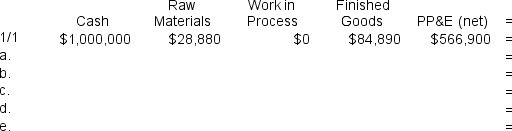
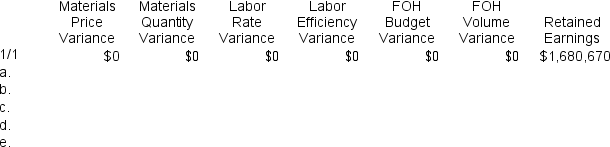 -When recording the raw materials purchases in transaction (a)above,the Cash account will increase (decrease)by:
The standard fixed manufacturing overhead rate was based on budgeted fixed manufacturing overhead of $360,000 and budgeted activity of 20,000 hours.
During the year, the company completed the following transactions:
a. Purchased 134,700 pounds of raw material at a price of $9.10 per pound.
b. Used 122,080 pounds of the raw material to produce 32,100 units of work in process.
c. Assigned direct labor costs to work in process. The direct labor workers (who were paid in cash) worked 26,680 hours at an average cost of $17.20 per hour.
d. Applied fixed overhead to the 32,100 units in work in process inventory using the predetermined overhead rate multiplied by the number of direct labor-hours allowed. Actual fixed overhead costs for the year were $378,400. Of this total, $297,400 related to items such as insurance, utilities, and indirect labor salaries that were all paid in cash and $81,000 related to depreciation of manufacturing equipment.
e. Completed and transferred 32,100 units from work in process to finished goods.
Assume that all transactions are recorded on the below worksheet, which is similar to the worksheet shown in your text except that it has been divided into two parts so that it fits on one page. The beginning balances in each of the accounts have been given. PP&E (net) stands for Property, Plant, and Equipment net of depreciation.
-When recording the raw materials purchases in transaction (a)above,the Cash account will increase (decrease)by: (Multiple Choice)
4.8/5 (83)
(83) Alberts Corporation manufactures one product. It does not maintain any beginning or ending Work in Process inventories. The company uses a standard cost system in which inventories are recorded at their standard costs. The standard cost card for the company's only product is as follows:
 The standard fixed manufacturing overhead rate was based on budgeted fixed manufacturing overhead of $240,000 and budgeted activity of 20,000 hours.
During the year, the company applied fixed overhead to the 15,200 units in work in process inventory using the predetermined overhead rate multiplied by the number of direct labor-hours allowed. Actual fixed overhead costs for the year were $223,700. Of this total, $147,700 related to items such as insurance, utilities, and indirect labor salaries that were all paid in cash and $76,000 related to depreciation of manufacturing equipment.
Assume that all transactions are recorded on the below worksheet, which is similar to the worksheet shown in your text except that it has been divided into two parts so that it fits on one page. The beginning balances in each of the accounts have been given. PP&E (net) stands for Property, Plant, and Equipment net of depreciation.

 -When applying fixed manufacturing overhead to production,the Work in Process inventory account will increase (decrease)by:
The standard fixed manufacturing overhead rate was based on budgeted fixed manufacturing overhead of $240,000 and budgeted activity of 20,000 hours.
During the year, the company applied fixed overhead to the 15,200 units in work in process inventory using the predetermined overhead rate multiplied by the number of direct labor-hours allowed. Actual fixed overhead costs for the year were $223,700. Of this total, $147,700 related to items such as insurance, utilities, and indirect labor salaries that were all paid in cash and $76,000 related to depreciation of manufacturing equipment.
Assume that all transactions are recorded on the below worksheet, which is similar to the worksheet shown in your text except that it has been divided into two parts so that it fits on one page. The beginning balances in each of the accounts have been given. PP&E (net) stands for Property, Plant, and Equipment net of depreciation.
-When applying fixed manufacturing overhead to production,the Work in Process inventory account will increase (decrease)by: (Multiple Choice)
4.8/5 (80)
(80) Robnett Corporation manufactures one product. It does not maintain any beginning or ending Work in Process inventories. The company uses a standard cost system in which inventories are recorded at their standard costs. There is no variable manufacturing overhead. The standard cost card for the company's only product is as follows:
 During the year, the company completed the following transactions:
a. Purchased 106,900 liters of raw material at a price of $6.80 per liter.
b. Used 93,760 liters of the raw material to produce 24,700 units of work in process.
Assume that all transactions are recorded on the below worksheet, which is similar to the worksheet shown in your text except that it has been divided into two parts so that it fits on one page. The beginning balances in each of the accounts have been given. PP&E (net) stands for Property, Plant, and Equipment net of depreciation.

 -When recording the raw materials used in production in transaction (b)above,the Raw Materials inventory account will increase (decrease)by:
During the year, the company completed the following transactions:
a. Purchased 106,900 liters of raw material at a price of $6.80 per liter.
b. Used 93,760 liters of the raw material to produce 24,700 units of work in process.
Assume that all transactions are recorded on the below worksheet, which is similar to the worksheet shown in your text except that it has been divided into two parts so that it fits on one page. The beginning balances in each of the accounts have been given. PP&E (net) stands for Property, Plant, and Equipment net of depreciation.
-When recording the raw materials used in production in transaction (b)above,the Raw Materials inventory account will increase (decrease)by: (Multiple Choice)
4.8/5 (79)
(79) Rhudy Corporation uses a standard cost system in which inventories are recorded at their standard costs and any variances are closed directly to Cost of Goods Sold.The direct labor standards for the company's only product specify 0.60 hours per unit at $20.00 per hour.During the year,the company started and completed 20,700 units.Direct labor employees worked 12,120 hours at an average cost of $18.90 per hour. Assume that all transactions are recorded on a worksheet as shown in the text.On the left-hand side of the equals sign in the worksheet are columns for Cash,Raw Materials,Work in Process,Finished Goods,and PP&E (net).All of the variance columns are on the right-hand-side of the equals sign along with the column for Retained Earnings.
When recording the direct labor costs,the Work in Process inventory account will increase (decrease)by:
(Multiple Choice)
4.8/5 (75)
(75) Robnett Corporation manufactures one product. It does not maintain any beginning or ending Work in Process inventories. The company uses a standard cost system in which inventories are recorded at their standard costs. There is no variable manufacturing overhead. The standard cost card for the company's only product is as follows:
During the year, the company completed the following transactions:
a. Purchased 106,900 liters of raw material at a price of $6.80 per liter.
b. Used 93,760 liters of the raw material to produce 24,700 units of work in process.
Assume that all transactions are recorded on the below worksheet, which is similar to the worksheet shown in your text except that it has been divided into two parts so that it fits on one page. The beginning balances in each of the accounts have been given. PP&E (net) stands for Property, Plant, and Equipment net of depreciation.
-When the raw materials used in production are recorded in transaction (b)above,which of the following entries will be made?
During the year, the company completed the following transactions:
a. Purchased 106,900 liters of raw material at a price of $6.80 per liter.
b. Used 93,760 liters of the raw material to produce 24,700 units of work in process.
Assume that all transactions are recorded on the below worksheet, which is similar to the worksheet shown in your text except that it has been divided into two parts so that it fits on one page. The beginning balances in each of the accounts have been given. PP&E (net) stands for Property, Plant, and Equipment net of depreciation.
-When the raw materials used in production are recorded in transaction (b)above,which of the following entries will be made? (Multiple Choice)
4.8/5 (72)
(72) Yordy Corporation manufactures one product.It does not maintain any beginning or ending Work in Process inventories.The company uses a standard cost system in which inventories are recorded at their standard costs and any variances are closed directly to Cost of Goods Sold.There is no variable manufacturing overhead.The company's balance sheet at the beginning of the year was as follows:
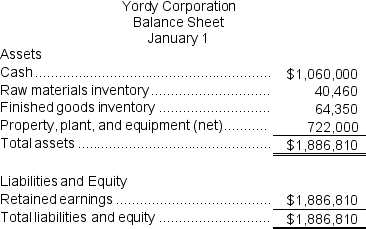 The standard cost card for the company's only product is as follows:
 The company calculated the following variances for the year:
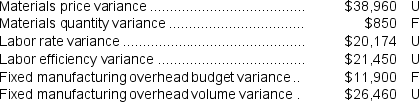 The standard fixed manufacturing overhead rate was based on budgeted fixed manufacturing overhead of $220,500 and budgeted activity of 31,500 hours.
During the year,the company completed the following transactions:
a.Purchased 48,700 kilos of raw material at a price of $9.30 per kilo.
b.Used 43,020 kilos of the raw material to produce 30,800 units of work in process.
c.Assigned direct labor costs to work in process.The direct labor workers (who were paid in cash)worked 28,820 hours at an average cost of $20.20 per hour.
d.Applied fixed overhead to the 30,800 units in work in process inventory using the predetermined overhead rate multiplied by the number of direct labor-hours allowed.Actual fixed overhead costs for the year were $208,600.Of this total,$124,600 related to items such as insurance,utilities,and indirect labor salaries that were all paid in cash and $84,000 related to depreciation of manufacturing equipment.
e.Transferred 30,800 units from work in process to finished goods.
f.Sold for cash 32,200 units to customers at a price of $46.60 per unit.
g.Completed and transferred the standard cost associated with the 32,200 units sold from finished goods to cost of goods sold.
h.Paid $155,000 of selling and administrative expenses.
i.Closed all standard cost variances to cost of goods sold.
Required:
1.Enter the beginning balances and record the above transactions in the worksheet that appears below.Because of the width of the worksheet,it is in two parts.In your text,these two parts would be joined side-by-side to make one very wide worksheet.
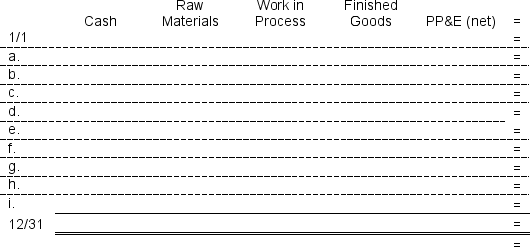
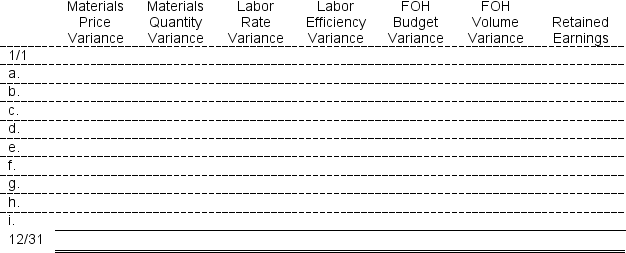 2.Determine the ending balance (e.g.,12/31 balance)in each account.
3.Prepare an income statement for the year.
The standard cost card for the company's only product is as follows:
The company calculated the following variances for the year:
The standard fixed manufacturing overhead rate was based on budgeted fixed manufacturing overhead of $220,500 and budgeted activity of 31,500 hours.
During the year,the company completed the following transactions:
a.Purchased 48,700 kilos of raw material at a price of $9.30 per kilo.
b.Used 43,020 kilos of the raw material to produce 30,800 units of work in process.
c.Assigned direct labor costs to work in process.The direct labor workers (who were paid in cash)worked 28,820 hours at an average cost of $20.20 per hour.
d.Applied fixed overhead to the 30,800 units in work in process inventory using the predetermined overhead rate multiplied by the number of direct labor-hours allowed.Actual fixed overhead costs for the year were $208,600.Of this total,$124,600 related to items such as insurance,utilities,and indirect labor salaries that were all paid in cash and $84,000 related to depreciation of manufacturing equipment.
e.Transferred 30,800 units from work in process to finished goods.
f.Sold for cash 32,200 units to customers at a price of $46.60 per unit.
g.Completed and transferred the standard cost associated with the 32,200 units sold from finished goods to cost of goods sold.
h.Paid $155,000 of selling and administrative expenses.
i.Closed all standard cost variances to cost of goods sold.
Required:
1.Enter the beginning balances and record the above transactions in the worksheet that appears below.Because of the width of the worksheet,it is in two parts.In your text,these two parts would be joined side-by-side to make one very wide worksheet.
2.Determine the ending balance (e.g.,12/31 balance)in each account.
3.Prepare an income statement for the year. (Essay)
5.0/5 (80)
(80) Robins Corporation manufactures one product. It does not maintain any beginning or ending Work in Process inventories. The company uses a standard cost system in which inventories are recorded at their standard costs and any variances are closed directly to Cost of Goods Sold. There is no variable manufacturing overhead. The standard cost card for the company's only product is as follows:
The standard fixed manufacturing overhead rate was based on budgeted fixed manufacturing overhead of $360,000 and budgeted activity of 20,000 hours.
During the year, the company completed the following transactions:
a. Purchased 134,700 pounds of raw material at a price of $9.10 per pound.
b. Used 122,080 pounds of the raw material to produce 32,100 units of work in process.
c. Assigned direct labor costs to work in process. The direct labor workers (who were paid in cash) worked 26,680 hours at an average cost of $17.20 per hour.
d. Applied fixed overhead to the 32,100 units in work in process inventory using the predetermined overhead rate multiplied by the number of direct labor-hours allowed. Actual fixed overhead costs for the year were $378,400. Of this total, $297,400 related to items such as insurance, utilities, and indirect labor salaries that were all paid in cash and $81,000 related to depreciation of manufacturing equipment.
e. Completed and transferred 32,100 units from work in process to finished goods.
Assume that all transactions are recorded on the below worksheet, which is similar to the worksheet shown in your text except that it has been divided into two parts so that it fits on one page. The beginning balances in each of the accounts have been given. PP&E (net) stands for Property, Plant, and Equipment net of depreciation.
-When applying fixed manufacturing overhead to production in transaction (d)above,the Work in Process inventory account will increase (decrease)by:
The standard fixed manufacturing overhead rate was based on budgeted fixed manufacturing overhead of $360,000 and budgeted activity of 20,000 hours.
During the year, the company completed the following transactions:
a. Purchased 134,700 pounds of raw material at a price of $9.10 per pound.
b. Used 122,080 pounds of the raw material to produce 32,100 units of work in process.
c. Assigned direct labor costs to work in process. The direct labor workers (who were paid in cash) worked 26,680 hours at an average cost of $17.20 per hour.
d. Applied fixed overhead to the 32,100 units in work in process inventory using the predetermined overhead rate multiplied by the number of direct labor-hours allowed. Actual fixed overhead costs for the year were $378,400. Of this total, $297,400 related to items such as insurance, utilities, and indirect labor salaries that were all paid in cash and $81,000 related to depreciation of manufacturing equipment.
e. Completed and transferred 32,100 units from work in process to finished goods.
Assume that all transactions are recorded on the below worksheet, which is similar to the worksheet shown in your text except that it has been divided into two parts so that it fits on one page. The beginning balances in each of the accounts have been given. PP&E (net) stands for Property, Plant, and Equipment net of depreciation.
-When applying fixed manufacturing overhead to production in transaction (d)above,the Work in Process inventory account will increase (decrease)by: (Multiple Choice)
4.8/5 (67)
(67) 
Filters
- Essay(0)
- Multiple Choice(0)
- Short Answer(0)
- True False(0)
- Matching(0)