



 Chat with AI
Exam 10: Credit Risk: Individual Loan Risk

Exam 1: Why Are Financial Institutions Special97 Questions
Exam 2: Financial Services: Depository Institutions116 Questions
Exam 3: Financial Services: Finance Companies75 Questions
Exam 4: Financial Services: Securities Brokerage and Investment Banking111 Questions
Exam 5: Financial Services: Mutual Funds and Hedge Funds112 Questions
Exam 6: Financial Services: Insurance100 Questions
Exam 7: Risks of Financial Institutions111 Questions
Exam 8: Interest Rate Risk I110 Questions
Exam 9: Interest Rate Risk II98 Questions
Exam 10: Credit Risk: Individual Loan Risk112 Questions
Exam 11: Credit Risk: Loan Portfolio and Concentration Risk59 Questions
Exam 12: Liquidity Risk100 Questions
Exam 13: Foreign Exchange Risk100 Questions
Exam 14: Sovereign Risk90 Questions
Exam 15: Market Risk97 Questions
Exam 16: Off-Balance-Sheet Risk107 Questions
Exam 17: Technology and Other Operational Risks108 Questions
Exam 18: Liability and Liquidity Management131 Questions
Exam 19: Deposit Insurance and Other Liability Guarantees105 Questions
Exam 20: Capital Adequacy148 Questions
Exam 21: Product and Geographic Expansion156 Questions
Exam 22: Futures and Forwards127 Questions
Exam 23: Options, Caps, Floors, and Collars114 Questions
Exam 24: Swaps97 Questions
Exam 25: Loan Sales92 Questions
Exam 26: Securitization114 Questions
Select questions type


The following information on the mortality rate of loans as estimated by an FI: 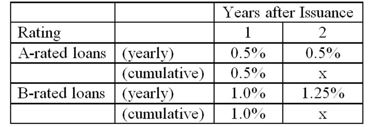 -What is the cumulative mortality rate of the A-rated and B-rated loans for year 2?
 (Multiple Choice)
4.7/5  (86)
(86) The following information on the mortality rate of loans as estimated by an FI:
-If the cumulative mortality rate in year 3 is 3.46 percent for the B-rated loan, what is its yearly mortality rate in year 3?
-If the cumulative mortality rate in year 3 is 3.46 percent for the B-rated loan, what is its yearly mortality rate in year 3? (Multiple Choice)
4.7/5 (81)
(81) Use the following information and the option valuation model for the next two problems. Onyx Corporation has a $200,000 loan that will mature in one year. The risk free interest rate is 6 percent. The standard deviation in the rate of change in the underlying asset's value is 12 percent, and the leverage ratio for Onyx is 0.8 (80 percent). The value for N(h1) is 0.02743, and the value for N(h2) is 0.96406.
-What is the required yield on this risky loan?
(Multiple Choice)
4.8/5 (76)
(76) At some point, further increases in interest rates on specific loans may decrease expected loan returns because of increased probability of default by the borrower.
(True/False)
4.8/5 (80)
(80) Long-term loans are more likely to be made under a loan commitment agreement than short-term loans.
(True/False)
4.8/5 (86)
(86) Which of the following is a problem in using discriminant analysis to evaluate credit risk?
(Multiple Choice)
4.8/5 (89)
(89) The exact interest rate to be charged on a fixed-rate loan is agreed upon by all parties at the time the commitment is negotiated.
(True/False)
4.8/5 (81)
(81) Using a modified discriminant function similar to Altman's, Burger Bank estimates the following coefficients for its portfolio of loans:
Z = 1.4X₁ + 1.09X₂ + 1.5X₃
where X₁ = debt to asset ratio; X₂= net income and X₃ = dividend payout ratio.
-What is the Z-score if the debt to asset ratio is 40 percent, net income is 12 percent, and the dividend payout ratio is 60 percent?
(Multiple Choice)
4.8/5 (91)
(91) The marginal mortality rate is the probability of a bond or loan defaulting in any given year after it is issued.
(True/False)
4.8/5 (82)
(82) Discriminant models often ignore hard-to-quantify factors in the credit decision.
(True/False)
4.7/5 (78)
(78) Adjustable rate mortgages have interest rates that adjust periodically according to the movement in some index.
(True/False)
4.8/5 (68)
(68) Because a compensating balance is the proportion of a loan that must be kept on deposit at the lending institution, the actual return to the lender on the usable portion of these loans is higher.
(True/False)
4.9/5 (70)
(70) Using a modified discriminant function similar to Altman's, Burger Bank estimates the following coefficients for its portfolio of loans:
Z = 1.4X₁ + 1.09X₂ + 1.5X₃
where X₁ = debt to asset ratio; X₂= net income and X₃ = dividend payout ratio.
-Using Z = 1.682 as the cut-off rate, what should be the debt to asset ratio of the firm in order for the bank to approve the loan?
(Multiple Choice)
4.9/5 (81)
(81) The primary difficulty in arranging a syndicated loan is having all of the various lending and borrowing parties reach agreement on terms, rates, and collateral.
(True/False)
4.8/5 (85)
(85) Which of the following observations concerning floating-rate loans is NOT true?
(Multiple Choice)
4.9/5 (89)
(89) The following represents two yield curves. Maturity Pure Discount Treasury Yields B-rated Corporate Bond Yields (Pure Discount Bonds) 1 year 3 percent 6 percent 2 year 6 percent 10 percent 20 year 12 percent 17 percent
-What is the implied probability of repayment on one-year B-rated debt?
(Multiple Choice)
4.9/5 (81)
(81) 
Filters
- Essay(0)
- Multiple Choice(0)
- Short Answer(0)
- True False(0)
- Matching(0)