



 Chat with AI
Exam 13: Project Scheduling: Pertcpm

Exam 1: Introduction61 Questions
Exam 2: Introduction to Probability66 Questions
Exam 3: Probability Distributions66 Questions
Exam 4: Decision Analysis64 Questions
Exam 5: Utility and Game Theory67 Questions
Exam 6: Times Series Analysis and Forecasting63 Questions
Exam 7: Introduction to Linear Programming60 Questions
Exam 8: Linear Programming: Sensitivity Analysis and Interpretation of Solution64 Questions
Exam 9: Linear Programming Applications in Marketing, Finance, and Operations Management60 Questions
Exam 10: Distribution and Network Models67 Questions
Exam 11: Integer Linear Programming61 Questions
Exam 12: Advanced Optimization Applications56 Questions
Exam 13: Project Scheduling: Pertcpm66 Questions
Exam 14: Inventory Models66 Questions
Exam 15: Waiting Line Models62 Questions
Exam 16: Simulation62 Questions
Exam 17: Markov Processes55 Questions
Select questions type


Consider the following PERT/CPM network with estimated times in weeks.The project is scheduled to begin on May 1. 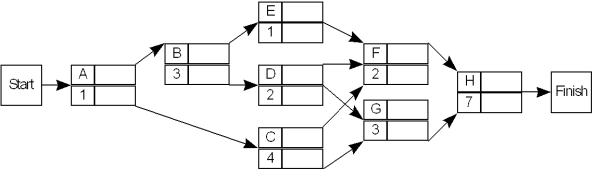 The three-time estimate approach was used to calculate the expected times and the following table gives the variance for each activity: Activity Variance Activity Variance A 1.1 0.3 B 0.5 0.6 C 1.2 0.6 D 0.8 1.0
a.Give the expected project completion date and the critical path.
b.By what date are you 99% sure the project will be completed?
The three-time estimate approach was used to calculate the expected times and the following table gives the variance for each activity: Activity Variance Activity Variance A 1.1 0.3 B 0.5 0.6 C 1.2 0.6 D 0.8 1.0
a.Give the expected project completion date and the critical path.
b.By what date are you 99% sure the project will be completed? (Essay)
4.8/5  (79)
(79) A project has the following activities,precedence relationships,and time estimates in weeks: Activity Immediate Predecessor Activities Optimistic Time Most Likely Time Pessimistic Time A -\cdot 15 20 25 B - 8 10 12 C A 25 30 40 D B 15 15 15 E B 22 25 27 F E 15 20 22 G D 20 20 22
a. Compute the expected time and variance for each activity.
b. Determine the critical path and the expected duration of the project.
c. What is the probability that the project will take longer than 56 weeks to complete?
(Essay)
4.9/5 (83)
(83) The difference between an activity's earliest finish time and latest finish time equals the difference between its earliest start time and latest start time.
(True/False)
4.8/5 (78)
(78) For an activity with more than one immediate predecessor activity,which of the following is used to compute its earliest finish (EF)time?
(Multiple Choice)
4.7/5 (81)
(81) Use the following network of related activities with their duration times to complete a row for each activity under the column headings below. 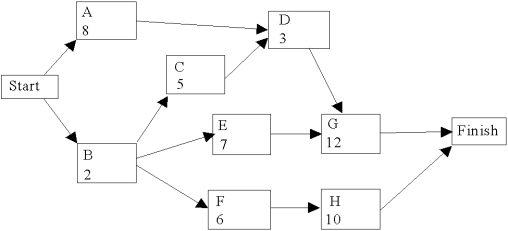 Actixty Immediate Predecessors Activity Time ES LS EF LF Slack Critical Path?
 (Essay)
4.8/5 (79)
(79) 
Filters
- Essay(0)
- Multiple Choice(0)
- Short Answer(0)
- True False(0)
- Matching(0)