



 Chat with AI
Exam 14: Weathering and Mass Movements

Exam 1: Introduction to Physical Geography54 Questions
Exam 2: The Geographers Tools172 Questions
Exam 3: Earth-Sun Geometry and the Seasons107 Questions
Exam 4: The Global Energy System145 Questions
Exam 5: Global Temperature Patterns112 Questions
Exam 6: Atmospheric Pressure, wind, and Global Circulation119 Questions
Exam 7: Atmospheric Moisture and Precipitation103 Questions
Exam 8: Air Masses and Cyclonic Weather Systems141 Questions
Exam 9: Global Climates and Global Climate Change176 Questions
Exam 10: Plant Geography153 Questions
Exam 11: The Global Distribution and Character of Soils138 Questions
Exam 12: Earth S Internal Structure, rock Cycle, and Geologic Time124 Questions
Exam 13: Tectonic Processes and Landforms132 Questions
Exam 14: Weathering and Mass Movements130 Questions
Exam 15: Groundwater and Karst Landscapes105 Questions
Exam 16: Fluvial Systems and Landforms125 Questions
Exam 17: Glacial Geomorphology: Processes and Landforms114 Questions
Exam 18: Arid Landscapes and Eolian Processes117 Questions
Exam 19: Coastal Processes and Landforms125 Questions
Exam 20: Population Growth and Environmental Impacts146 Questions
Select questions type


Rocks that would be especially susceptible to carbonation include
(Multiple Choice)
4.9/5  (67)
(67) Fissures or breaks in rock along which no movement has occurred are called __________.
(Short Answer)
4.9/5 (85)
(85) The gradual accumulation of debris at the base of a steep slope is __________.
(Short Answer)
4.8/5 (82)
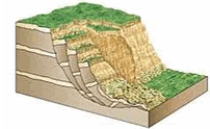
(82) 
Repeated heating and cooling of rocks results in mechanical weathering.
(True/False)
5.0/5 (75)
(75) A slow-to-rapid type of mass movement that involves soil and other loose sediments,some of which may be coarse,is
(Multiple Choice)
4.8/5 (82)
(82) The decomposition and alteration of rocks due to chemical actions of natural physical and biological processes is
(Multiple Choice)
4.7/5 (85)
(85) The impacts of the Madison Slide included which of the following?
(Multiple Choice)
4.9/5 (79)
(79) The mass wasting that is continually active on a hillside and causes retaining walls to tilt and topple is soil __________.
(Short Answer)
4.7/5 (78)
(78) Fissures in rocks that allow for water to infiltrate are known to scientists as
(Multiple Choice)
4.8/5 (81)
(81) Earthquake Lake near Yellowstone formed because the earthquake created a graben.
(True/False)
4.8/5 (82)
(82) The movement of rock,sediment,and soil downslope due to the force of gravity is
(Multiple Choice)
4.8/5 (75)
(75) The precipitation by rain,fog,or snow of strong mineral acids primarily sulfur dioxide and nitrogen dioxides is
(Multiple Choice)
4.9/5 (78)
(78) 
Filters
- Essay(0)
- Multiple Choice(0)
- Short Answer(0)
- True False(0)
- Matching(0)