



 Chat with AI
Exam 4: Why Do Interest Rates Change?

Exam 1: Why Study Financial Markets and Institutions?67 Questions
Exam 2: Overview of the Financial System92 Questions
Exam 3: What Do Interest Rates Mean and What Is Their Role in Valuation?106 Questions
Exam 4: Why Do Interest Rates Change?115 Questions
Exam 5: How Do Risk and Term Structure Affect Interest Rates?107 Questions
Exam 6: Are Financial Markets Efficient?63 Questions
Exam 7: Why Do Financial Institutions Exist?127 Questions
Exam 8: Why Do Financial Crises Occur and39 Questions
Exam 9: Central Banks and the Federal Reserve System101 Questions
Exam 10: Conduct of Monetary Policy: Tools, Goals, Strategy, and Tactics115 Questions
Exam 11: The Money Markets79 Questions
Exam 12: The Bond Market90 Questions
Exam 13: The Stock Market69 Questions
Exam 14: The Mortgage Markets74 Questions
Exam 15: The Foreign Exchange Market87 Questions
Exam 16: The International Financial System93 Questions
Exam 17: Banking and the Management of Financial Institutions104 Questions
Exam 18: Financial Regulation83 Questions
Exam 19: Banking Industry: Structure and Competition135 Questions
Exam 20: The Mutual Fund Industry66 Questions
Exam 21: Insurance Companies and Pension Funds81 Questions
Exam 22: Investment Banks, Security Brokers and Dealers, and Venture Capital Firms102 Questions
Exam 23: Risk Management in Financial Institutions69 Questions
Exam 24: Hedging with Financial Derivatives117 Questions
Exam 25: Financial Crises In Emerging Market Economies24 Questions
Exam 26: Savings Associations and Credit Unions88 Questions
Exam 27: Finance Companies41 Questions
Select questions type


Figure 4.4
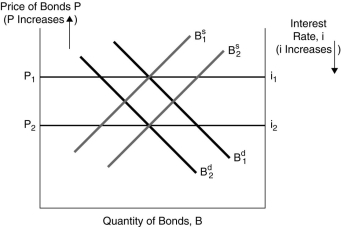 -In Figure 4.4,the most likely cause of the increase in the equilibrium interest rate from i? to i? is
 (Multiple Choice)
4.7/5  (84)
(84) When people begin to expect a large run up in stock prices,the demand curve for bonds shifts to the ________ and the interest rate ________.
(Multiple Choice)
4.7/5 (72)
(72) Figure 4.4
-In Figure 4.4,the most likely cause of the increase in the equilibrium interest rate from i? to i? is a(n)________ in the ________.
-In Figure 4.4,the most likely cause of the increase in the equilibrium interest rate from i? to i? is a(n)________ in the ________. (Multiple Choice)
4.7/5 (78)
(78) When the growth rate of the money supply increases,interest rates end up being permanently lower if
(Multiple Choice)
4.8/5 (70)
(70) When the interest rate on a bond is ________ the equilibrium interest rate,there is excess ________ in the bond market and the interest rate will ________.
(Multiple Choice)
4.9/5 (77)
(77) If the Fed wants to permanently lower interest rates,then it should raise the rate of money growth if
(Multiple Choice)
4.9/5 (89)
(89) Explain the differences between the loanable funds framework and the liquidity preference framework.
(Essay)
4.9/5 (78)
(78) The higher the standard deviation of returns on an asset,the ________ the asset's ________.
(Multiple Choice)
4.8/5 (75)
(75) When the price of a bond is below the equilibrium price,there is excess ________ in the bond market and the price will ________.
(Multiple Choice)
4.8/5 (79)
(79) An increase in the expected rate of inflation will ________ the expected return on bonds relative to that on ________ assets,and shift the ________ curve to the left.
(Multiple Choice)
4.8/5 (87)
(87) If investors perceive greater interest rate risk,what will happen to the equilibrium interest rate in the bond market? Explain using the bond demand and supply framework.
(Essay)
4.9/5 (86)
(86) When the economy enters into a boom,normally the demand for bonds ________, the supply of bonds ________,and the interest rate ________.
(Multiple Choice)
4.7/5 (68)
(68) A decline in the expected inflation rate causes the demand for money to ________ and the demand curve to shift to the ________.
(Multiple Choice)
4.7/5 (74)
(74) A person who is risk averse prefers to hold assets that are more,not less,risky.
(True/False)
4.9/5 (70)
(70) When the federal government's budget deficit decreases,the ________ curve for bonds shifts to the ________.
(Multiple Choice)
4.9/5 (81)
(81) Factors that cause the demand curve for bonds to shift to the left include
(Multiple Choice)
4.7/5 (72)
(72) A movement along the demand (or supply)curve occurs when the quantity demanded (or supplied)changes at each given price (or interest rate)of the bond in response to a change in some other factor besides the bond's price or interest rate.
(True/False)
4.9/5 (78)
(78) When the price of a bond is above the equilibrium price,there is excess ________ in the bond market and the price will ________.
(Multiple Choice)
4.8/5 (82)
(82) What is the model whose equations are estimated using statistical procedures used in forecasting interest rates called?
(Multiple Choice)
4.8/5 (76)
(76) 
Filters
- Essay(0)
- Multiple Choice(0)
- Short Answer(0)
- True False(0)
- Matching(0)