



 Chat with AI
Exam 23: Flexible Budgets and Standard Costs

Exam 1: Accounting in Business241 Questions
Exam 2: Analyzing and Recording Transactions188 Questions
Exam 3: Adjusting Accounts and Preparing Financial Statements213 Questions
Exam 4: Completing the Accounting Cycle168 Questions
Exam 5: Accounting for Merchandising Operations189 Questions
Exam 7: Accounting Information Systems164 Questions
Exam 8: Cash and Internal Controls193 Questions
Exam 9: Accounting for Receivables170 Questions
Exam 10: Plant Assets, natural Resources, and Intangibles216 Questions
Exam 11: Current Liabilities and Payroll Accounting194 Questions
Exam 12: Accounting for Partnerships133 Questions
Exam 13: Accounting for Corporations210 Questions
Exam 14: Long-Term Liabilities199 Questions
Exam 15: Investments and International Operations175 Questions
Exam 16: Reporting the Statement of Cash Flows178 Questions
Exam 17: Analysis of Financial Statements178 Questions
Exam 18: Managerial Accounting Concepts and Principles203 Questions
Exam 19: Job Order Costing160 Questions
Exam 20: Process Costing156 Questions
Exam 21: Cost-Volume-Profit Analysis180 Questions
Exam 22: Master Budgets and Planning153 Questions
Exam 23: Flexible Budgets and Standard Costs168 Questions
Exam 24: Performance Measurement and Responsibility Accounting163 Questions
Exam 25: Capital Budgeting and Managerial Decisions131 Questions
Exam 26: Time Value of Money B60 Questions
Exam 27: Activity-Based Costing C37 Questions
Select questions type


The following information describes production activities of the Central Corp.:
 30,000 units were completed during the year
Budgeted standards for each unit produced:
1/2 lb.of raw material at $4.15 per lb.
10 minutes of direct labor at $12.50 per hour
Compute the direct materials price and quantity and the direct labor rate and efficiency variances.Indicate whether each variance is favorable or unfavorable.
30,000 units were completed during the year
Budgeted standards for each unit produced:
1/2 lb.of raw material at $4.15 per lb.
10 minutes of direct labor at $12.50 per hour
Compute the direct materials price and quantity and the direct labor rate and efficiency variances.Indicate whether each variance is favorable or unfavorable. (Essay)
4.8/5  (66)
(66) Management by exception allows managers to focus on the most significant variances in performance.
(True/False)
4.9/5 (72)
(72) Stanton Co.produces and sells two lines of t-shirts,Deluxe and Mega.Stanton provides the following data.Compute the sales price and the sales volume variances for each product.
Unit salesprice - Deluxe \ldots. \1 5 \1 6 Unit sales price-Mega \ldots\ldots \ 20 \ 19 Unit sales-Deluxe \ldots\ldots\ldots. 2,400 2,500 Unit sales-Mega \ldots\ldots\ldots\ldots. 2,000 1,900
(Essay)
5.0/5 (83)
(83) A standard that takes into account the reality that some loss usually occurs with any process under normal application of the process is known as a _______________ standard.
(Short Answer)
4.8/5 (76)
(76) The following company information is available.The direct materials quantity variance is:

(Multiple Choice)
4.8/5 (92)
(92) Gates Company reports the following information regarding the production on one of its products for the month.Compute the direct materials cost variance,the direct materials price variance,the direct materials quantity variance and identify each as either favorable or unfavorable.

(Essay)
4.9/5 (93)
(93) While companies strive to achieve ideal standards,reality implies that some loss of materials usually occurs with any process.
(True/False)
4.9/5 (89)
(89) A planning budget based on a single predicted amount of sales or production volume is called a:
(Multiple Choice)
4.8/5 (69)
(69) A _______________________ contains relevant information that compares actual results to planned activities.
(Short Answer)
4.9/5 (73)
(73) The difference between the actual overhead cost incurred and the standard overhead applied is the __________________________.
(Short Answer)
4.8/5 (89)
(89) Big Bend Co.fixed budget for the year is shown below:
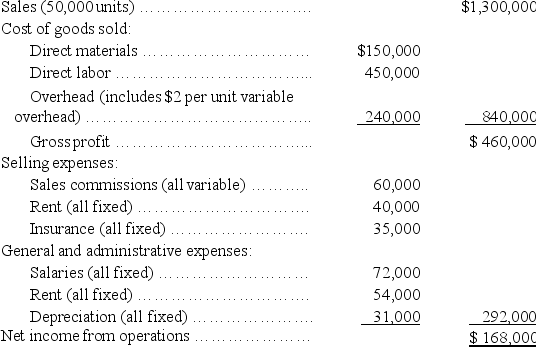 Prepare a flexible budget for Big Bend Co.that shows a detailed budget for its actual sales volume of 42,000 units.Use the contribution margin format.
 (Essay)
4.8/5 (77)
(77) How are unfavorable variances recorded?
How are favorable variances recorded?
(Essay)
4.7/5 (80)
(80) Cabot Company collected the following data regarding production of one of its products.Compute the fixed overhead cost variance. 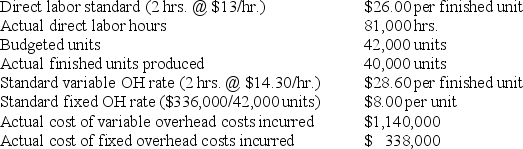
(Multiple Choice)
4.8/5 (84)
(84) Presented below are terms preceded by letters a through j and followed by a list of definitions 1 through 10.Enter the letter of the term with the definition,using the space preceding the definition.
(a)Cost variance
(b)Volume variance
(c)Price variance
(d)Quantity variance
(e)Standard costs
(f)Controllable variance
(g)Fixed budget
(h)Flexible budget
(i)Variance analysis
(j)Management by exception
__________ (1)The difference between the total budgeted overhead cost and the overhead
cost that was allocated to products using the predetermined fixed overhead rate.
__________ (2)A planning budget based on a single predicted amount of sales or production
volume; unsuitable for evaluations if the actual volume differs from the predicted volume.
__________ (3)Preset costs for delivering a product,component,or service under normal
conditions.
__________ (4)A process of examining the differences between actual and budgeted sales or
costs and describing them in terms of the amounts that resulted from price and quantity
differences.
__________ (5)The difference between actual and budgeted sales or cost caused by the
difference between the actual price per unit and the budgeted price per unit.
__________ (6)A budget prepared based on predicted amounts of revenues and expenses
corresponding to the actual level of output.
__________ (7)The difference between actual and budgeted cost caused by the difference
between the actual quantity and the budgeted quantity.
__________ (8)The combination of both overhead spending variances (variable and fixed)
and the variable overhead efficiency variance.
__________ (9)A management process to focus on significant variances and give less
attention to areas where performance is close to the standard.
__________ (10)The difference between actual cost and standard cost,made up of a price
variance and a quantity variance.
(Short Answer)
4.9/5 (72)
(72) A company has established 5 pounds of Material M at $2 per pound as the standard for the material in its Product A.The company has just produced 1,000 units of this product,using 5,200 pounds of Material M that cost $9,880.The direct materials price variance is:
(Multiple Choice)
4.8/5 (90)
(90) A cost variance equals the sum of the quantity variance and the price variance.
(True/False)
4.8/5 (83)
(83) The costs that should be incurred under normal conditions to produce a specific product or component or to perform a specific service are:
(Multiple Choice)
4.9/5 (87)
(87) Adams Co.uses the following standard to produce a single unit of its product: variable overhead (2 hrs.@ $3/hr.)$6.Actual data for the month show variable overhead costs of $150,000,and 24,000 units produced.The total variable overhead variance is:
(Multiple Choice)
4.9/5 (79)
(79) A direct labor cost variance may be broken down into a controllable variance and a volume variance.
(True/False)
4.9/5 (66)
(66) For the current period,Boggs Company's manufacturing operations yield a $5,250 unfavorable price variance on its direct materials usage.The actual price per pound is $56.50 and the standard price per pound is $55.00.How many pounds of material are used in the current period?
(Multiple Choice)
4.7/5 (89)
(89) 
Filters
- Essay(0)
- Multiple Choice(0)
- Short Answer(0)
- True False(0)
- Matching(0)