



 Chat with AI
Exam 14: Analyzing Financial Statements


Which of the following ratios increases when inventory is sold on account for a price equal to its original cost?

 (78)
 Verified
B
The debt-to-equity ratio measures which of the following?
(93) VerifiedB
Packers Corporation reported the following data for the year ended December 31,2010:
Net sales revenue \ 400,000 Net income \ 25,000 Interest expense (net of tax) \ 3,000 Average total assets \ 200,000 Average stockholders' equity \ 160,000 Average net fixed assets \ 100,000 Average shares of common stock outstanding 15,000 Market value per share \ 16.00 Calculate each of the following ratios:
A.Profit margin
B.Return on assets
C.Return on equity
D.Earnings per share
E.Price/earnings ratio
F.Debt-to-equity ratio
G.Financial leverage percentage
H.Fixed asset turnover ratio
(76)  Answered by Examlex AI Copilot
To calculate the financial ratios for Packers Corporation, we will use the provided data. Here's how each ratio is calculated:
A. Profit Margin
The profit margin ratio measures how much net income is generated for each dollar of sales. It is calculated as:
B. Return on Assets (ROA)
The return on assets ratio indicates how efficiently a company uses its assets to generate profit. It is calculated as:
C. Return on Equity (ROE)
The return on equity ratio measures the return generated on the shareholders' equity. It is calculated as:
D. Earnings Per Share (EPS)
Earnings per share is the portion of a company's profit allocated to each outstanding share of common stock. It is calculated as:
E. Price/Earnings Ratio (P/E)
The price/earnings ratio compares a company's current share price to its earnings per share. It is calculated as:
F. Debt-to-Equity Ratio
The debt-to-equity ratio measures the relative proportion of shareholders' equity and debt used to finance a company's assets. However, we do not have the total debt provided in the data, so we cannot calculate this ratio with the given information.
G. Financial Leverage Percentage
Financial leverage percentage is a measure of how much a company is using debt to finance its assets relative to equity. Like the debt-to-equity ratio, we cannot calculate this without the total debt information.
H. Fixed Asset Turnover Ratio
The fixed asset turnover ratio measures how effectively a company uses its fixed assets to generate sales. It is calculated as:
These are the calculated ratios based on the provided data. For the ratios that require debt information (F and G), additional data would be needed to perform the calculations.
The following data were reported by Universe Company at year-end:
Total assets \ 525,000 Quick assets 105,000 Noncurrent assets 375,000 Current liabilities 75,000 Long-term liabilities 75,000 Common stock (par \ 10) 170,000 Total owners' equity 375,000 Calculate each of the following ratios:
A.Debt-to-equity
B.Current ratio
C.Quick ratio
D.Which,if any,of the above are liquidity ratios?
E.Which,if any,of the above are profitability ratios?
(80) If the current ratio is 2,the payment of a cash dividend,which was recorded as a liability on the date of declaration,will result in which of the following?
(79) The return on assets ratio is influenced significantly by a company's relative debt and equity financing of its assets.
(83) The dividend yield ratio decreases when earnings per share increases.
(65) The following data were shown in the records of Victoria Company at the end of 2010:
Quick assets \ 180,000 Current assets 225,000 Average net receivables 10,000 Average inventory 42,000 Current liabilities 50,000 Net credit sales 120,000 Cost of goods sold 84,000 Assume 365 days in the year Calculate each of the following ratios:
A.Quick ratio
B.Current ratio
C.Receivable turnover ratio
D.Inventory turnover ratio
E.Average age of receivables
F.Average days' supply in inventory
(76) The following return on investment ratios were computed for Steven Company:
2007 Return on assets 12\% 15\% 15\% 18\% Return on equity 12\% 15\% 11\% 20\% Requirements:
A.Compute financial leverage percentage for each year.
B.Explain briefly the stockholders' advantage or disadvantage for each year.
(73) Finding comparable companies in order to compare performance is important because ratios in isolation are difficult to evaluate.
(82) The records of Everyday Electronics Corporation for a particular period include the following: Average total assets \ 760,000 Average total liabilities 485,000 Total revenue 200,500 Total expenses (including income tax) 135,000 What is the return on equity ratio?
(81) Indicate the effect of each item on the ratios given below in the following manner:
if an item would cause an increase in the ratio,place a check in the + column; if a decrease place a check in - column; and if no change,check the 0 column.Each item is independent of the others. 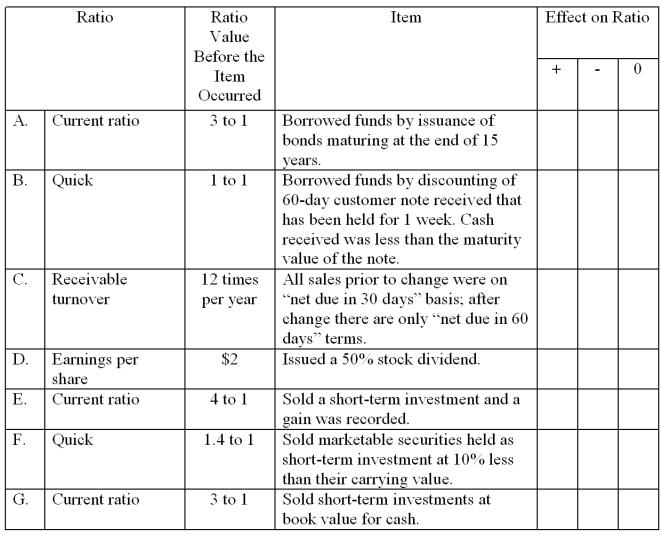
Carolina Company computed the following ratios for a two year period:
A. Current ratio 1.3 to 1 .6 to 1 B. Return on equity 25\% 16\% C. Quality of income 1.7 .5 D. Cash coverage ratio 346 122 E. Profit margin 6\% 4\% Required:
Comment on the trend of each of the ratios from 2009 to 2010.State concerns or possible implications for the future of each.
(87) The records of Marshall Company include the following: Average total assets \ 3,500,000 Average total liabilities 1,220,000 Total revenue 4,580,000 Total expense (including income tax) 4,100,000 Interest expense (included in total expenses) 90,000 Income tax rate 40\% The financial leverage percentage is which of the following?
(92) Thomas Company had income before interest and taxes of $120,000.Interest expense for the period was $17,000 and income taxes amounted to $28,500.The average stockholders' equity was $680,000.What is Thomas' return on equity (ROE)?
(76) Financial statement analysis is very precise and doesn't involve judgment.
(89) The cash ratio is less sensitive to small transactions involving cash than is either the current or quick ratios.
(81) Cromwell Company began the year with a balance in inventory of $110,000 and ended the year with a balance of $102,000.The net sales for the year were $983,000 with a gross profit on sales of $295,000.What was the inventory turnover ratio?
(86) 
Filters
- Essay(0)
- Multiple Choice(0)
- Short Answer(0)
- True False(0)
- Matching(0)