



 Chat with AI
Exam 17: How Chemicals React

Exam 1: Patterns of Motion and Equilibrium126 Questions
Exam 2: Newtons Laws of Motion127 Questions
Exam 3: Momentum and Energy181 Questions
Exam 4: Gravity, Projectiles, and Satellites147 Questions
Exam 5: Fluid Mechanics148 Questions
Exam 6: Thermal Energy and Thermodynamics113 Questions
Exam 7: Heat Transfer and Change of Phase158 Questions
Exam 8: Static and Current Electricity178 Questions
Exam 9: Magnetism and Electromagnetic Induction130 Questions
Exam 10: Waves and Sound146 Questions
Exam 11: Light163 Questions
Exam 12: Atoms and the Periodic Table137 Questions
Exam 13: The Atomic Nucleus and Radioactivity127 Questions
Exam 14: Elements of Chemistry69 Questions
Exam 15: How Atoms Bond and Molecules Attract150 Questions
Exam 16: Mixtures141 Questions
Exam 17: How Chemicals React120 Questions
Exam 18: Two Classes of Chemical Reactions177 Questions
Exam 19: Organic Compounds96 Questions
Exam 20: Rocks and Minerals169 Questions
Exam 21: Plate Tectonics and Earths Interior181 Questions
Exam 22: Shaping Earths Surface180 Questions
Exam 23: Geologic Time - Reading the Rock Record167 Questions
Exam 24: The Oceans, Atmosphere, and Climatic Effects188 Questions
Exam 25: Driving Forces of Weather166 Questions
Exam 26: The Solar System108 Questions
Exam 27: Stars and Galaxies107 Questions
Exam 28: The Structure of Space and Time73 Questions
Exam 29: Prologue: The Nature of Science22 Questions
Select questions type


For the following balanced reaction,which of the following is a gas? 2 Na(l)+ Cl2(g)→ 2 NaCl(s)
(Multiple Choice)
4.8/5  (86)
(86) How is Avogadro's number related to the numbers on the periodic table?
(Multiple Choice)
4.9/5 (79)
(79) The ________ is what needs to be overcome in a reaction so that it can proceed to the products.
(Multiple Choice)
4.7/5 (90)
(90) Use the bond energies below to determine whether the following reaction is exothermic or endothermic: + ? 2 HCl H-H (bond energy: 436 kJ/mol)
Cl-Cl (bond energy: 243 kJ/mol)
H-Cl (bond energy: 431 kJ/mol)
(Multiple Choice)
4.9/5 (99)
(99) If the relative mass of a hydrogen atom is 1/4 that of a helium atom,how many hydrogen atoms would you need to equal the mass of four helium atoms?
(Multiple Choice)
4.8/5 (74)
(74) If the relative mass of a pingpong ball is 1/20 that of a golf ball,how many golf balls would you need to equal the mass of 200 pingpong balls?
(Multiple Choice)
4.8/5 (83)
(83) What is the number of grams of CO2 produced if you combust 0.50 mole of CH4 according to the following balanced equation? CH4 + 2 O2 → CO2 + 2 H2O
(Multiple Choice)
4.8/5 (85)
(85) 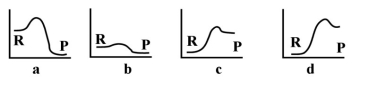 -Given that the above energy profiles have the same scale,which of the reactions is the most exothermic?
 (Multiple Choice)
4.9/5 (82)
(82) Why might increasing the concentration of a set of reactants increase the rate of reaction?
(Multiple Choice)
4.9/5 (84)
(84) For the following balanced reaction,which of the following is a solid? 2 Na(l)+ Cl2(g)→ 2 NaCl(s)
(Multiple Choice)
4.9/5 (80)
(80) What coefficients balance the following equation? ________ (s)+ ________ (g)? ________ P (g)
(Multiple Choice)
4.9/5 (71)
(71) Balance these equations. ________ (g)+ ________ (g)? ________ N (g)
(Multiple Choice)
4.7/5 (89)
(89) Wild plants readily grow "all by themselves" yet the molecules of the growing plant have less entropy than the materials used to make the plant.How is it possible for a there to be this decrease in entropy for a process that occurs all by itself?
(Multiple Choice)
4.8/5 (73)
(73)
-Given the following energy profiles,which of the following reactions is endothermic? 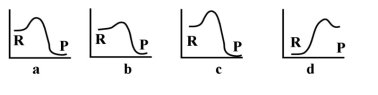 R= reactants P = products
-Given the following energy profiles,which of the following reactions is endothermic? R= reactants P = products (Multiple Choice)
5.0/5 (84)
(84) Balance the following chemical equation. ________ N2 + ________ H2 → ________ NH3
(Multiple Choice)
4.8/5 (74)
(74) Since some of the compounds that are destroying ozone are found in nature normally,how is it possible to tell that the reactive molecules destroying the ozone are due to our actions?
(Multiple Choice)
4.9/5 (83)
(83) 
Filters
- Essay(0)
- Multiple Choice(0)
- Short Answer(0)
- True False(0)
- Matching(0)