



 Chat with AI
Exam 11: Diversification and Risky Asset Allocation

Exam 1: A Brief History of Risk and Return100 Questions
Exam 2: The Investment Process98 Questions
Exam 3: Overview of Security Types94 Questions
Exam 4: Mutual Funds and Other Investment Companies101 Questions
Exam 5: The Stock Market104 Questions
Exam 6: Common Stock Valuation102 Questions
Exam 7: Stock Price Behavior and Market Efficiency82 Questions
Exam 8: Behavioral Finance and the Psychology of Investing84 Questions
Exam 9: Interest Rates100 Questions
Exam 10: Bond Prices and Yields95 Questions
Exam 11: Diversification and Risky Asset Allocation84 Questions
Exam 12: Return, Risk, and the Security Market Line84 Questions
Exam 13: Performance Evaluation and Risk Management91 Questions
Exam 14: Futures Contracts97 Questions
Exam 15: Stock Options100 Questions
Exam 16: Option Valuation72 Questions
Exam 17: Projecting Cash Flow and Earnings100 Questions
Exam 18: Corporate and Government Bonds107 Questions
Exam 19: Global Economic Activity and Industry Analysis70 Questions
Exam 20: Mortgage-Backed Securities92 Questions
Select questions type


There is a 30 percent probability that a particular stock will earn a 17 percent return and a 70 percent probability that it will earn 11 percent.What is the risk-free rate if the risk premium on the stock is 8.60 percent?
(Multiple Choice)
4.8/5  (76)
(76) The division of a portfolio's dollars among various types of assets is referred to as:
(Multiple Choice)
4.7/5 (72)
(72) What is the variance of the expected returns on this stock? 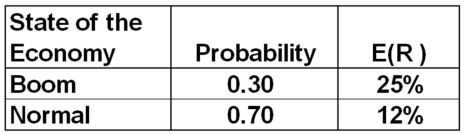
(Multiple Choice)
4.8/5 (89)
(89) What is the extra compensation paid to an investor who invests in a risky asset rather than in a risk-free asset called?
(Multiple Choice)
4.9/5 (72)
(72) 
Filters
- Essay(0)
- Multiple Choice(0)
- Short Answer(0)
- True False(0)
- Matching(0)