



 Chat with AI
Exam 12: Return, Risk, and the Security Market Line

Exam 1: A Brief History of Risk and Return100 Questions
Exam 2: The Investment Process98 Questions
Exam 3: Overview of Security Types94 Questions
Exam 4: Mutual Funds and Other Investment Companies101 Questions
Exam 5: The Stock Market104 Questions
Exam 6: Common Stock Valuation102 Questions
Exam 7: Stock Price Behavior and Market Efficiency82 Questions
Exam 8: Behavioral Finance and the Psychology of Investing84 Questions
Exam 9: Interest Rates100 Questions
Exam 10: Bond Prices and Yields95 Questions
Exam 11: Diversification and Risky Asset Allocation84 Questions
Exam 12: Return, Risk, and the Security Market Line84 Questions
Exam 13: Performance Evaluation and Risk Management91 Questions
Exam 14: Futures Contracts97 Questions
Exam 15: Stock Options100 Questions
Exam 16: Option Valuation72 Questions
Exam 17: Projecting Cash Flow and Earnings100 Questions
Exam 18: Corporate and Government Bonds107 Questions
Exam 19: Global Economic Activity and Industry Analysis70 Questions
Exam 20: Mortgage-Backed Securities92 Questions
Select questions type


Which two of the following determine how sensitive a security is relative to movements in the overall market?
I.the standard deviation of the security
II.correlation between the security's return and the market return
III.the volatility of the security relative to the market
IV.the amount of unsystematic risk inherent in the security
(Multiple Choice)
4.9/5  (78)
(78) Which one of the following betas represents the greatest level of systematic risk?
(Multiple Choice)
4.8/5 (84)
(84) What is the covariance of security A to the market given the following information? 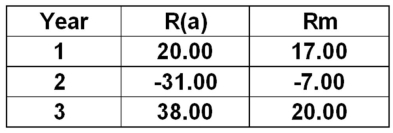
(Multiple Choice)
4.9/5 (83)
(83) Which one of the following has the highest expected risk premium?
(Multiple Choice)
4.9/5 (79)
(79) Which one of the following is the best example of systematic risk?
(Multiple Choice)
4.8/5 (88)
(88) Laura has one risk-free asset and one risky stock in her portfolio.The risk-free asset has an expected return of 3.2 percent.The risky asset has a beta of 1.3 and an expected return of 14.9 percent.What is the expected return on the portfolio if the portfolio beta is .975?
(Multiple Choice)
4.8/5 (78)
(78) The market has a standard deviation of 10.8 percent (0.108)while a risky security has a standard deviation of 22.5 (0.225)percent.The covariance of the stock with the market is .0149.What is the beta of the stock?
(Multiple Choice)
4.9/5 (85)
(85) The market has an expected return of 11.4 percent and a risky asset with a beta of 1.18 has an expected return of 13 percent.Based on this information,what is the pure time value of money?
(Multiple Choice)
4.9/5 (85)
(85) Which one of the following terms is the measure of the tendency of two things to move or vary together?
(Multiple Choice)
4.8/5 (70)
(70) What is the beta of a portfolio which consists of the following? 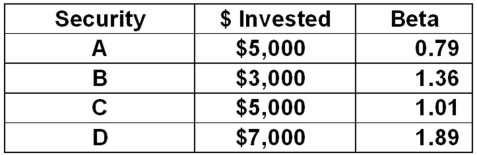
(Multiple Choice)
4.8/5 (79)
(79) Which one of the following announcements is most apt to cause the price of a firm's stock to increase?
(Multiple Choice)
4.9/5 (94)
(94) What is the covariance of security A to the market given the following information? 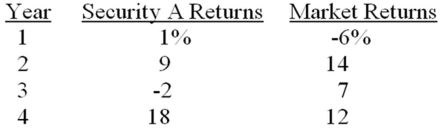
(Multiple Choice)
4.8/5 (88)
(88) Identify and describe each of the three components of a security's expected return according to the capital asset pricing model.
(Short Answer)
4.9/5 (83)
(83) Which one of the following is most commonly used as the measure of the overall market rate of return?
(Multiple Choice)
4.9/5 (81)
(81) According to the capital asset pricing model,which of the following will increase the expected rate of return on a security that has a beta that is less than that of the market? Assume the market rate of return is greater than the risk-free rate and both rates are positive.
I.increase in the risk-free rate
II.decrease in the risk-free rate
III.increase in the market risk premium
IV.decrease in the market rate of return
(Multiple Choice)
4.9/5 (89)
(89) You own three stocks which have betas of 1.16,1.34,and 1.02.You would like to add a fourth security such that your portfolio beta will match that of the market.Given this situation,the new security:
(Multiple Choice)
4.7/5 (88)
(88) Which one of the following statements applies to unsystematic risk?
(Multiple Choice)
4.7/5 (74)
(74) The reward-to-risk ratio is 6.8 percent and the risk-free rate is 5.3 percent.What is the expected return on a risky asset if the beta of that asset is 1.03?
(Multiple Choice)
4.8/5 (79)
(79) The risk-free rate is 3.0 percent and the expected return on the market is 9 percent.Stock A has a beta of 1.20.For a given year,Stock A returned 12.5 percent while the market returned 9.75 percent.The systematic portion of Stock A's unexpected return was _____ percent and the unsystematic portion was _____ percent.
(Multiple Choice)
4.8/5 (84)
(84) 
Filters
- Essay(0)
- Multiple Choice(0)
- Short Answer(0)
- True False(0)
- Matching(0)