



 Chat with AI
Exam 30: Quantum Physics

Exam 1: Introduction to Physics100 Questions
Exam 2: One-Dimensional Kinematics112 Questions
Exam 3: Vectors in Physics82 Questions
Exam 4: Two-Dimensional Kinematics95 Questions
Exam 5: Newtons Laws of Motion101 Questions
Exam 6: Applications of Newtons Laws105 Questions
Exam 7: Work and Kinetic Energy92 Questions
Exam 8: Potential Energy and Conservation of Energy99 Questions
Exam 9: Linear Momentum and Collisions102 Questions
Exam 10: Rotational Kinematics and Energy102 Questions
Exam 11: Rotational Dynamics and Static Equilibrium97 Questions
Exam 12: Gravity94 Questions
Exam 13: Oscillations About Equilibrium102 Questions
Exam 14: Waves and Sound104 Questions
Exam 15: Fluids107 Questions
Exam 16: Temperature and Heat103 Questions
Exam 17: Phases and Phase Changes100 Questions
Exam 18: The Laws of Thermodynamics97 Questions
Exam 19: Electric Charges, Forces, and Fields88 Questions
Exam 20: Electric Potential and Electric Potential Energy99 Questions
Exam 21: Electric Current and Direct-Current Circuits99 Questions
Exam 22: Magnetism101 Questions
Exam 23: Magnetic Flux and Faradays Law of Induction99 Questions
Exam 24: Alternating-Current Circuits93 Questions
Exam 25: Electromagnetic Waves90 Questions
Exam 26: Geometrical Optics92 Questions
Exam 27: Optical Instruments102 Questions
Exam 28: Physical Optics: Interference and Diffraction93 Questions
Exam 29: Relativity100 Questions
Exam 30: Quantum Physics100 Questions
Exam 31: Atomic Physics75 Questions
Exam 32: Nuclear Physics and Nuclear Radiation89 Questions
Select questions type


A certain photon after being scattered from a free electron at rest moves at an angle of 120° with respect to the incident direction. If the wavelength of the incident photon is 0.611 nm, what is the kinetic energy of the recoiling electron?
(Multiple Choice)
4.7/5  (73)
(73) A crystal diffracted a beam of electrons. The crystal spacing was 0.18 nm and the maximum scattering occurred at 80.° relative to the surface normal. The electrons were directed normally onto the crystal.
(a) What is the wavelength of the electrons?
(b) What potential difference accelerated the electrons?
(Short Answer)
4.9/5 (83)
(83) The radius of a typical nucleus is about 5.0 × 10⁻¹⁵ m. Assuming this to be the uncertainty in the position of a proton in the nucleus, estimate the uncertainty in the proton's energy (in eV).
(Short Answer)
4.8/5 (67)
(67) The de Broglie wavelength is inversely proportional to the momentum of the particle.
(True/False)
4.9/5 (71)
(71) An electron is moving with the speed of 1780 m/s. What is its de Broglie wavelength?
(Multiple Choice)
4.9/5 (60)
(60) The frequency of a light beam is doubled. Which one of the following is correct for the momentum of the photons in that beam of light?
(Multiple Choice)
4.9/5 (70)
(70) Protons are being accelerated in a particle accelerator. When the speed of the protons is doubled, their de Broglie wavelength will
(Multiple Choice)
4.8/5 (81)
(81) Which one of the following is the correct expression for the Heisenberg uncertainty principle?
(Multiple Choice)
5.0/5 (76)
(76) In the spectrum of white light which one of the following colors corresponds to the highest temperature?
(Multiple Choice)
4.8/5 (75)
(75) A metallic surface has a work function of 2.50 eV. What is the longest wavelength that will eject electrons from the surface of this metal?
(Short Answer)
4.9/5 (74)
(74) A beam of white light of a certain frequency is incident on a metal surface. If the work function of this surface is 2.20 eV, what frequency of light would give a maximum kinetic energy of 0.25 eV to the photoelectrons ejected from this surface?
(Multiple Choice)
4.8/5 (84)
(84) Which of the following is the correct equation for the momentum of a photon?
(Multiple Choice)
4.8/5 (82)
(82) What is the momentum of a photon of light that has a frequency of 2.8 × 10¹⁴ Hz?
(Multiple Choice)
4.8/5 (79)
(79) FIGURE 30-1 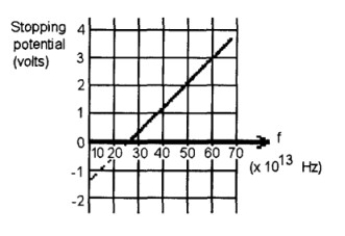 -The graph shown in Figure 30-1 is a plot based on student data from their testing of a
photoelectric material.
(a) Determine the cutoff frequency.
(b) Determine the work function.
-The graph shown in Figure 30-1 is a plot based on student data from their testing of a
photoelectric material.
(a) Determine the cutoff frequency.
(b) Determine the work function. (Short Answer)
4.9/5 (86)
(86) The distribution of energy in the blackbody radiation depends upon the material from which the blackbody is constructed.
(True/False)
4.9/5 (86)
(86) Mathilda collects photoelectric data in her physics laboratory. She measures a stopping potential of 5.82 volts for radiation of wavelength 100. nm, and 17.99 volts stops 50.0 nm.
(a) What is the work function for the material in eV?
(b) From her data one determines Planck's constant to be what?
(Short Answer)
4.9/5 (89)
(89) If the frequency of a photon is halved, what happens to its energy?
(Multiple Choice)
4.8/5 (87)
(87) A photon has an energy of 6.60 eV. To what wavelength does this energy correspond?
(Multiple Choice)
4.8/5 (100)
(100) 
Filters
- Essay(0)
- Multiple Choice(0)
- Short Answer(0)
- True False(0)
- Matching(0)