



 Chat with AI
Exam 13: Oscillations About Equilibrium

Exam 1: Introduction to Physics100 Questions
Exam 2: One-Dimensional Kinematics112 Questions
Exam 3: Vectors in Physics82 Questions
Exam 4: Two-Dimensional Kinematics95 Questions
Exam 5: Newtons Laws of Motion101 Questions
Exam 6: Applications of Newtons Laws105 Questions
Exam 7: Work and Kinetic Energy92 Questions
Exam 8: Potential Energy and Conservation of Energy99 Questions
Exam 9: Linear Momentum and Collisions102 Questions
Exam 10: Rotational Kinematics and Energy102 Questions
Exam 11: Rotational Dynamics and Static Equilibrium97 Questions
Exam 12: Gravity94 Questions
Exam 13: Oscillations About Equilibrium102 Questions
Exam 14: Waves and Sound104 Questions
Exam 15: Fluids107 Questions
Exam 16: Temperature and Heat103 Questions
Exam 17: Phases and Phase Changes100 Questions
Exam 18: The Laws of Thermodynamics97 Questions
Exam 19: Electric Charges, Forces, and Fields88 Questions
Exam 20: Electric Potential and Electric Potential Energy99 Questions
Exam 21: Electric Current and Direct-Current Circuits99 Questions
Exam 22: Magnetism101 Questions
Exam 23: Magnetic Flux and Faradays Law of Induction99 Questions
Exam 24: Alternating-Current Circuits93 Questions
Exam 25: Electromagnetic Waves90 Questions
Exam 26: Geometrical Optics92 Questions
Exam 27: Optical Instruments102 Questions
Exam 28: Physical Optics: Interference and Diffraction93 Questions
Exam 29: Relativity100 Questions
Exam 30: Quantum Physics100 Questions
Exam 31: Atomic Physics75 Questions
Exam 32: Nuclear Physics and Nuclear Radiation89 Questions
Select questions type


An oscillating system has a small amount of damping. It is observed that in the course of 20.0 s the amplitude has decreased from A to A/2. What additional time is required for the amplitude to decrease to A/10?
(Short Answer)
4.7/5  (86)
(86) A mass is attached to a vertical spring and bobs up and down between points A and B. Where is the mass located when its potential energy is a maximum?
(Multiple Choice)
4.9/5 (71)
(71) A mass of 500 g is resting on a vertical spring with a force constant of 55.0 N/m. A mass of 250 g is dropped from a height of 12.0 cm onto the larger mass and sticks to it. What is the amplitude of the resulting oscillations?
(Multiple Choice)
4.7/5 (79)
(79) A spring with a force constant of 2.00 N/m is attached to a mass of 75.0 g. The system has a small amount of damping. If the amplitude of the oscillations decreases from 10.0 mm to 5.00 mm in 15.0 s, what is the magnitude of the damping constant?
(Multiple Choice)
4.8/5 (89)
(89) A mass is attached to a vertical spring and bobs up and down between points A and B. Where is the mass located when its kinetic energy is a maximum?
(Multiple Choice)
4.7/5 (71)
(71) The position of a mass that is oscillating on a spring is given by x = (12.3 cm) cos[(1.26 s-1)t]. What is the speed of the mass when t = 0.805 s?
(Multiple Choice)
4.8/5 (71)
(71) Doubling only the spring constant of a vibrating mass-and-spring system produces what effect on the system's mechanical energy?
(Multiple Choice)
4.7/5 (74)
(74) Grandfather clocks are designed in a way that the weight at the bottom of the pendulum can be moved up or down by turning a small screw. Suppose you have a grandfather clock at home that runs slow. Should you turn the adjusting screw so as to raise the weight or lower the weight?
(Multiple Choice)
4.8/5 (95)
(95) Two players are enjoying a steady volley in a game of ping-pong, in which the motion of the ball is repeated regularly. Is the motion of the ball simple harmonic motion?
(Essay)
4.8/5 (90)
(90) Doubling only the amplitude of a vibrating mass-and-spring system produces what effect on the system's mechanical energy?
(Multiple Choice)
4.8/5 (70)
(70) In designing buildings to be erected in an area prone to earthquakes, should you try to have a small or a large amount of damping?
(Essay)
4.8/5 (72)
(72) 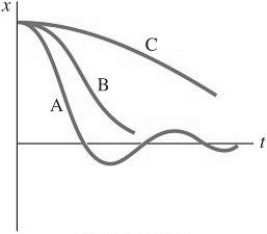 -Curve C in Figure 13-1 represents
Increasing the damping constant beyond that required for critical damping makes the system approach equilibrium more quickly.
(True/False)
4.9/5 (94)
(94) A thin hoop is supported in a vertical plane by a nail. What should the radius of the hoop be in order for it to have a period of oscillation of 1.00 s? The moment of inertia of a hoop of mass M and radius R about a point on its rim is 2MR2.
(Multiple Choice)
4.9/5 (85)
(85) The position of a mass that is oscillating on a spring is given by x = (17.4 cm) cos[(5.46 s-1)t]. What is the period of this motion?
(Multiple Choice)
4.9/5 (96)
(96) A mass is oscillating on a spring with an amplitude of 8.3 cm and a period of 4.6 s. Write an expression for its position, x, as a function of time, if x is equal to 8.3 cm at t = 0 s.
(Essay)
5.0/5 (86)
(86) A mass of 0.150 kg is attached to a spring with a force constant of 3.58 N/m and undergoes simple harmonic oscillations with an amplitude of 7.50 cm. What is the total mechanical energy of the system?
(Multiple Choice)
4.9/5 (98)
(98) In simple harmonic motion, the acceleration is proportional to
(Multiple Choice)
4.7/5 (88)
(88) What is the length of a simple pendulum with a period of 2.00 s?
(Multiple Choice)
4.9/5 (77)
(77) 
Filters
- Essay(0)
- Multiple Choice(0)
- Short Answer(0)
- True False(0)
- Matching(0)