



 Chat with AI
Exam 19: Professional Conduct, Independence, and Quality Control

Exam 1: An Introduction to Assurance and Financial Statement Auditing46 Questions
Exam 2: The Financial Statement Auditing Environment63 Questions
Exam 3: Audit Planning, Types of Audit Tests, and Materiality74 Questions
Exam 4: Risk Assessment55 Questions
Exam 5: Evidence and Documentation95 Questions
Exam 6: Internal Control in a Financial Statement Audit103 Questions
Exam 7: Auditing Internal Control Over Financial Reporting64 Questions
Exam 8: Audit Sampling: An Overview and Application to Tests of Controls67 Questions
Exam 9: Audit Sampling: An Application to Substantive Tests of Account Balances54 Questions
Exam 10: Auditing the Revenue Process94 Questions
Exam 11: Auditing the Purchasing Process80 Questions
Exam 12: Auditing the Human Resource Management Process64 Questions
Exam 13: Auditing the Inventory Management Process74 Questions
Exam 14: Auditing the Financing Investing Process: Prepaid Expenses Intangible Assets and Property Plant and Equipment71 Questions
Exam 15: Auditing the Financing Investing Process: Long-Term Liabilities Stockholders Equity and Income Statement Accounts63 Questions
Exam 16: Auditing the Financinginvesting Process: Cash and Investments68 Questions
Exam 17: Completing the Audit Engagement83 Questions
Exam 18: Reports on Audited Financial Statements74 Questions
Exam 19: Professional Conduct, Independence, and Quality Control72 Questions
Exam 20: Legal Liability65 Questions
Exam 21: Assurance, Attestation, and Internal Auditing Services99 Questions
Select questions type


The primary purpose of establishing quality control policies and procedures for deciding whether to accept a new client is to
(Multiple Choice)
4.7/5  (92)
(92) For private companies, accounting firms are prohibited from providing
(Multiple Choice)
4.9/5 (73)
(73) When can a CPA disclose confidential information without the client's consent?
(Essay)
4.9/5 (71)
(71) Ms. Lembke is a partner for DTS, a CPA firm. She is the lead partner for the firm's largest client, The Grey Elephant. Ms. Zadina, who works in the same office as Ms. Lembke, has a sister who is the controller for The Grey Elephant. Because of potential independence issues, Ms. Zadina does no work for The Grey Elephant. Ms. Zadina is being considered for promotion to partner. What independence issues should Ms. Lembke consider before promoting Ms. Zadina?
(Essay)
5.0/5 (70)
(70) A CPA firm would be reasonably assured of meeting its overall responsibility to provide services that conform with professional standards by
(Multiple Choice)
4.9/5 (68)
(68) A basic objective of a CPA firm is to provide professional services that conform to professional standards. Reasonable assurance of achieving this basic objective is provided through
(Multiple Choice)
4.8/5 (80)
(80) The AICPA Code of Professional Conduct deals mainly with behavior and actions of individual auditors.
(True/False)
4.9/5 (82)
(82) If a CPA owns an insurance policy issued by an attest client, independence would be considered impaired, even if the policy was purchased under the insurance company's normal terms and procedures and does not offer an investment option.
(True/False)
4.8/5 (81)
(81) In auditing a privately held entity, an auditor must follow the professional standards established by all of the following except:
(Multiple Choice)
4.8/5 (70)
(70) Professionalism refers to the conduct, aims, or qualities that characterize or mark a given profession.
(True/False)
4.8/5 (86)
(86) Match each term below with its definition as provided by the AICPA Rules of Conduct.
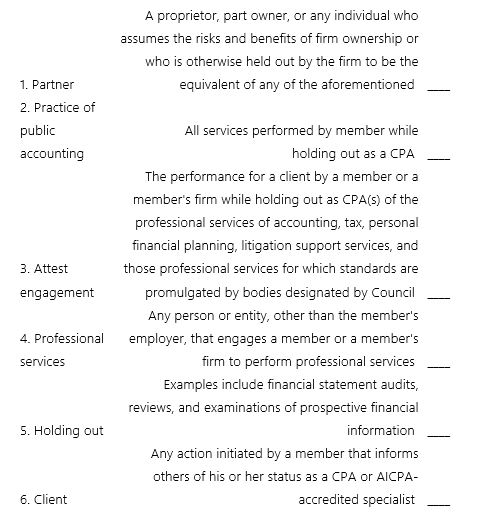
(Essay)
4.8/5 (81)
(81) According to the ethical standards of the profession, which of the following acts is generally prohibited?
(Multiple Choice)
4.9/5 (85)
(85) A CPA firm evaluates its personnel advancement experience to ascertain whether individuals assigned to increased degrees of responsibility meet predetermined criteria. This policy is evidence of the firm's adherence to which of the following prescribed standards?
(Multiple Choice)
4.8/5 (75)
(75) Which professional and regulatory bodies establish the ethical and professional rules for auditors of: (1) public companies and (2) private companies?
(Essay)
4.7/5 (85)
(85) Distinguish between the following theories of ethical behavior: utilitarianism, a rights-based approach, and a justice-based approach.
(Essay)
4.9/5 (90)
(90) The rules contained in Section 100 cover issues relating to independence, integrity, and auditing standards.
(True/False)
4.8/5 (66)
(66) In connection with a lawsuit, a third party attempts to gain access to the auditor's working papers. The client's defense of privileged communication will be successful only to the extent it is protected by the
(Multiple Choice)
4.8/5 (93)
(93) An indirect financial interest is defined as a financial interest that is owned or is under the control of an individual or entity.
(True/False)
4.8/5 (77)
(77) Which of the following is not a Principle of Professional Conduct as defined by the Code of Professional Conduct?
(Multiple Choice)
4.8/5 (83)
(83) 
Filters
- Essay(0)
- Multiple Choice(0)
- Short Answer(0)
- True False(0)
- Matching(0)