



 Chat with AI
Exam 12: Principles of Bond Valuation and Investment

Exam 1: The Investment Setting90 Questions
Exam 2: Security Markets95 Questions
Exam 3: Participating in the Market79 Questions
Exam 4: Investment Companies: Mutual Funds, Exchange-Traded Funds, Closed-End Funds, and Unit Investment Trusts77 Questions
Exam 5: Economic Activity79 Questions
Exam 6: Industry Analysis98 Questions
Exam 7: Valuation of the Individual Firm87 Questions
Exam 8: Financial Statement Analysis84 Questions
Exam 9: Efficient Markets and Anomalies93 Questions
Exam 10: Behavioral Finance and Technical Analysis47 Questions
Exam 11: Bond and Fixed-Income Fundamentals73 Questions
Exam 12: Principles of Bond Valuation and Investment53 Questions
Exam 13: Convertible Securities and Warrants64 Questions
Exam 14: Put and Call Options81 Questions
Exam 15: Commodities and Financial Futures79 Questions
Exam 16: Stock Index Futures and Options59 Questions
Exam 17: A Basic Look at Portfolio Management and Capital Market Theory65 Questions
Exam 18: Duration and Bond Portfolio Management55 Questions
Exam 19: International Securities Markets72 Questions
Exam 20: Investments in Real Assets63 Questions
Exam 21: Alternative Investments: Private Equity and Hedge Funds31 Questions
Exam 22: Measuring Risks and Returns of Portfolio Managers53 Questions
Exam 23: A Comprehensive Analysis for Real Estate Investment Decisions2 Questions
Exam 24: The Makeup of Institutional Investors6 Questions
Select questions type


Yield to maturity takes into account everything except:

Free
(Multiple Choice)
4.9/5  (92)
(92) Correct Answer: Verified
D
As the economy recovers from a recession, what changes can be expected in the yield spread of corporate Baa bonds and U.S. government bonds?
Free
(Multiple Choice)
4.8/5 (78)
(78) Correct Answer:Verified
VerifiedA
The value of a bond at any given time is the sum of:
Free
(Multiple Choice)
4.7/5 (77)
(77) Correct Answer:Verified
VerifiedB
When the bond investor believes interest rates are going to fall, the best strategy would be to:
(Multiple Choice)
4.9/5 (73)
(73) Deep discount bonds are not prone to calls because they sell at low prices.
(True/False)
4.7/5 (75)
(75) Interest rate changes affect low-quality issues to a greater degree than high-quality issues.
(True/False)
4.8/5 (91)
(91) a) What is the approximate yield to maturity of a 10% coupon rate, $1,000 par value bond which is currently priced at $1,200 with 11 years to maturity?
b) What would be the yield to call if the call can be made in 7 years at a price of $1,025?
(Short Answer)
5.0/5 (81)
(81) What effect, if any, will decrease in interest rates have on bond values?
(Multiple Choice)
4.7/5 (72)
(72) ABC Corp. issued a 12%, 20-year coupon rate bond 5 years ago. Interest rates are now 8%. Based on semi-annual analysis and using the table below, what is the current price of the bond? 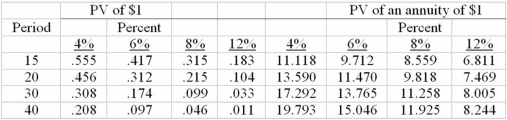
(Short Answer)
4.8/5 (80)
(80) The expectations hypothesis is that any long-term rate is an average of the expectations of future short-term rate over the applicable time horizon.
(True/False)
4.9/5 (81)
(81) The reinvestment assumption would have no effect on yield if the bond is held to maturity.
(True/False)
4.7/5 (78)
(78) If an investor needs to increase the quality of his portfolio during the low-confidence periods of a recession, he can enjoy usually high returns on lower-grade instruments relative to higher grades.
(True/False)
4.9/5 (69)
(69) An ascending term structure reflects the view that rates will increase in the future.
(True/False)
4.8/5 (89)
(89) What will happen to the market value of a bond if interest rates increase?
(Multiple Choice)
4.9/5 (74)
(74) The term structure of interest rates depicts the relationship between maturity and interest rates.
(True/False)
4.9/5 (93)
(93) What formula measure would an investor use to calculate the yield on a 20-year bond with 10 years to maturity, if he or she only intends to hold the bond for 5 years?
(Multiple Choice)
4.9/5 (80)
(80) 
Filters
- Essay(0)
- Multiple Choice(0)
- Short Answer(0)
- True False(0)
- Matching(0)