



 Chat with AI
Exam 17: Property Rights, Externalities, Rivalry, and Exclusion

Exam 1: Introduction43 Questions
Exam 2: Supply and Demand225 Questions
Exam 3: A Consumers Constrained Choice130 Questions
Exam 4: Demand123 Questions
Exam 5: Consumer Welfare and Policy Analysis73 Questions
Exam 6: Firms and Production112 Questions
Exam 7: Costs132 Questions
Exam 8: Competitive Firms and Markets112 Questions
Exam 9: Properties and Applications of the Competitive Model101 Questions
Exam 10: General Equilibrium and Economic Welfare109 Questions
Exam 11: Monopoly and Monopsony142 Questions
Exam 12: Pricing and Advertising91 Questions
Exam 13: Game Theory85 Questions
Exam 14: Oligopoly and Monopolistic Competition114 Questions
Exam 15: Factor Markets115 Questions
Exam 16: Uncertainty103 Questions
Exam 17: Property Rights, Externalities, Rivalry, and Exclusion105 Questions
Exam 18: Asymmetric Information85 Questions
Exam 19: Contracts and Moral Hazards79 Questions
Select questions type


If a production process creates pollution,a competitive market produces excessive pollution because
(Multiple Choice)
4.8/5  (90)
(90) Explain why the social demand curve for a public good is the vertical sum of the demand curves of each individual.
(Essay)
5.0/5 (85)
(85) 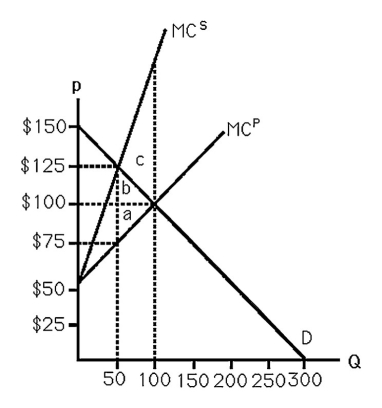 -The above figure shows the market for steel ingots.If the market is competitive,then
 (Multiple Choice)
5.0/5 (96)
(96) 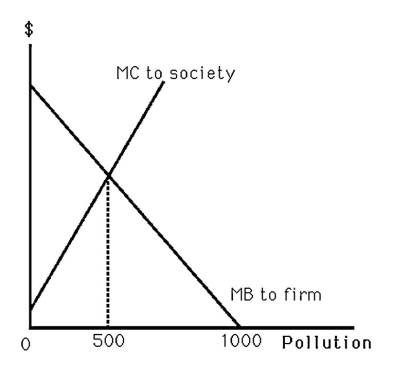 -The above figure shows the marginal benefit to a firm of polluting in the local river while producing its output,and the marginal cost to the surrounding neighbors.The marginal cost of production is zero for the firm.If the firm owns the river and there is just one neighbor affected by the pollution,how much pollution is likely to occur?
 (Multiple Choice)
4.9/5 (96)
(96)
-The above figure shows the market for steel ingots.An externality can be seen because
-The above figure shows the market for steel ingots.An externality can be seen because (Multiple Choice)
4.8/5 (77)
(77) 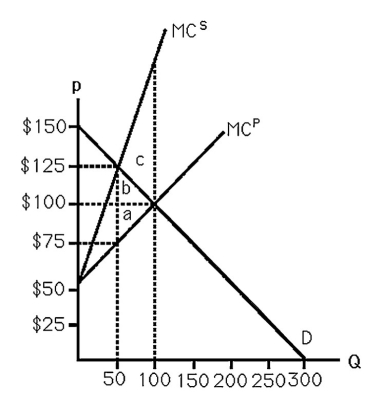 -Suppose that the market for steel is shown in the above figure.What specific tax would result in a competitive market producing the socially optimal quantity of steel?
 (Essay)
4.8/5 (90)
(90) Explain the externality generated when a shepherd grazes sheep in a field that is common property that several other shepherds use.
(Essay)
4.7/5 (76)
(76) A commodity or service whose consumption by one person does not preclude others from also consuming it is called a
(Multiple Choice)
4.9/5 (86)
(86) If a production process creates positive externalities,a competitive market produces too few positive externalities because the producer
(Multiple Choice)
5.0/5 (83)
(83) Which of the following belongs to the government regulation to control pollution?
(Multiple Choice)
4.8/5 (70)
(70) 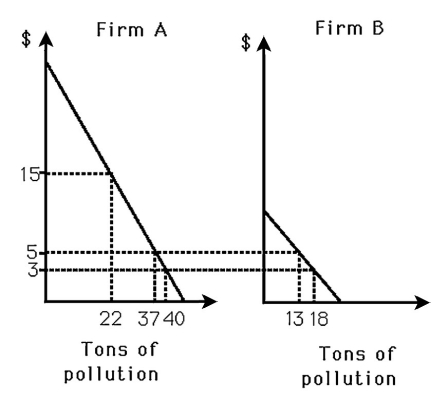 -The above figure shows the marginal benefit from pollution for two firms.If each firm receives a marketable permit to produce 25 units of pollution,which one of the following is most likely to happen?
 (Multiple Choice)
4.9/5 (80)
(80) In terms of cost-benefit analysis,explain why a competitive market with an externality produces too much pollution.
(Essay)
4.9/5 (70)
(70) In the case of a good that has no exclusion and no rivalry,private markets fail because
(Multiple Choice)
5.0/5 (75)
(75) 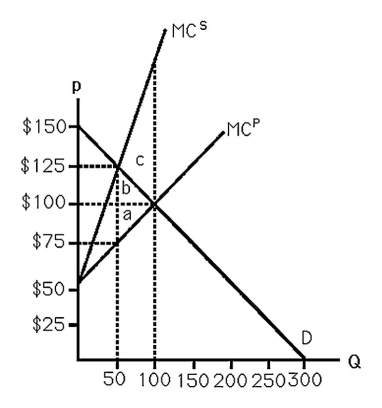 -The above figure shows the market for steel ingots.At the social optimum,the private producer surplus is
 (Multiple Choice)
4.8/5 (80)
(80) The existence of externalities is due mainly to the fact that
(Multiple Choice)
4.9/5 (71)
(71)
-The above figure shows the marginal benefit to a firm of polluting in the local river while producing its output,and the marginal cost to the surrounding neighbors.The marginal cost of production is zero for the firm.According to Coase's Theorem,which of the following scenarios is most likely to lead to the socially optimal level of pollution?
-The above figure shows the marginal benefit to a firm of polluting in the local river while producing its output,and the marginal cost to the surrounding neighbors.The marginal cost of production is zero for the firm.According to Coase's Theorem,which of the following scenarios is most likely to lead to the socially optimal level of pollution? (Multiple Choice)
4.7/5 (70)
(70) Suppose that in the market for paper,demand is p = 100 - Q.The private marginal cost is MCp = 10 + Q.Pollution generated during the production process creates external marginal harm equal to MCe = Q.What specific tax would result in a competitive market producing the socially optimal quantity of paper?
(Essay)
4.9/5 (86)
(86) 
Filters
- Essay(0)
- Multiple Choice(0)
- Short Answer(0)
- True False(0)
- Matching(0)