



 Chat with AI
Exam 14: Oligopoly and Monopolistic Competition

Exam 1: Introduction43 Questions
Exam 2: Supply and Demand225 Questions
Exam 3: A Consumers Constrained Choice130 Questions
Exam 4: Demand123 Questions
Exam 5: Consumer Welfare and Policy Analysis73 Questions
Exam 6: Firms and Production112 Questions
Exam 7: Costs132 Questions
Exam 8: Competitive Firms and Markets112 Questions
Exam 9: Properties and Applications of the Competitive Model101 Questions
Exam 10: General Equilibrium and Economic Welfare109 Questions
Exam 11: Monopoly and Monopsony142 Questions
Exam 12: Pricing and Advertising91 Questions
Exam 13: Game Theory85 Questions
Exam 14: Oligopoly and Monopolistic Competition114 Questions
Exam 15: Factor Markets115 Questions
Exam 16: Uncertainty103 Questions
Exam 17: Property Rights, Externalities, Rivalry, and Exclusion105 Questions
Exam 18: Asymmetric Information85 Questions
Exam 19: Contracts and Moral Hazards79 Questions
Select questions type


Firms A and B are identical,produce identical products,and are the only firms in a market.Firm A's output is higher than Firm B's.This means that Firm B is the
(Multiple Choice)
4.8/5  (75)
(75) Explain why a monopoly or a perfectly competitive firm does not consider a rival firm's behavior,but an oligopoly and a monopolistically competitive firm do.
(Essay)
4.8/5 (81)
(81) Suppose the demand for Pepsi is qp = 50 - 2pp + 1pc.The firm faces a constant marginal cost of m,and  denotes the price of Coke.Assuming Bertrand behavior,derive Pepsi's best-response function and explain how the firm changes price in response to changes in its own marginal cost and changes in Coke's price.
 (Essay)
4.7/5 (89)
(89) Suppose the demand for pizza in a small isolated town is p = 10 - Q.The only two firms,A and B,behave as Cournot duopolists.Each has a cost function TC = 2 + Q.If the government wants to subsidize firm A to raise its output to that of a Stackelberg leader,how large should the subsidy be?
(Essay)
4.8/5 (90)
(90) Suppose in the automobile industry with free entry and exit,the marginal cost is constant at $5,000,two identical manufacturers are currently producing 1,000 cars each and earning zero economic profit.If the equilibrium price is $20,000,then what is the fixed cost for each manufacturer?
(Multiple Choice)
4.8/5 (94)
(94) The Bertrand model of price setting assumes that a firm chooses its price
(Multiple Choice)
4.8/5 (82)
(82) Which of the following market models results in the highest level of consumer surplus,assuming a fixed number of firms with identical costs and a given demand curve?
(Multiple Choice)
4.8/5 (77)
(77) Assuming a homogeneous product,the Bertrand equilibrium price is
(Multiple Choice)
4.8/5 (78)
(78) Consider a market with (inverse)demand p = 100 - 2Q.There are two firms in the market with constant marginal and average costs of $10.
a.Determine the Cournot equilibrium quantities and price
b.What would be the collusive (joint-profit maximizing)price and quantity?
c.Derive the deadweight loss from (i)Cournot Dupoly, (ii)Collusion,and (iii)Perfect competition in this market with the two firms.
(Essay)
4.8/5 (82)
(82) Firms in all types of market structures pay attention to current rival firms' behavior.
(True/False)
4.8/5 (77)
(77) The Cournot model assumes that firm A maximizes its profit,holding firm B's output constant.
(True/False)
4.8/5 (86)
(86) If two firms behave as Cournot duopolists,the level of social welfare is lower than if the same firms act as a cartel.
(True/False)
4.9/5 (88)
(88) Monopolistic competition and monopoly have all of the following in common EXCEPT
(Multiple Choice)
4.8/5 (85)
(85) Because firms selling a homogeneous product set price in response to the (perceived)pricing decision of other firms in the Bertrand Model of oligopoly in equilibrium price exceeds marginal cost.
(True/False)
4.8/5 (76)
(76) 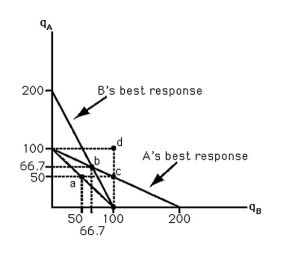 -The above figure shows the reaction functions for two pizza shops in a small isolated town.Compare the Cournot,Stackelberg,cartel,and competitive equilibria in terms of total output and welfare.
 (Essay)
4.9/5 (84)
(84) In the Stackelberg model,the leader has a first-mover advantage because it
(Multiple Choice)
4.8/5 (65)
(65) Consumers of laundry detergent view brands as different and so each brand effectively has some market power.Prices are set much higher than marginal cost,yet detergent firms earn a normal rate of return.
a.Use a diagram with demand for the output of a single firm,marginal cost and average cost curves to show a monopolistically competitive firm in equilibrium.
b.Why do firms just earn a normal rate of return? That is,why do firms in this market earn zero profits?
c.Suppose that each firm in this industry was required to pay a fixed annual fee to operate (a tax that does not vary with the output of the firm).What would this tax do to the number of firms and the price each firm charges? (Using a new graph may help your argument. )
(Essay)
4.8/5 (77)
(77) 
Filters
- Essay(0)
- Multiple Choice(0)
- Short Answer(0)
- True False(0)
- Matching(0)