



 Chat with AI
Exam 10: The Financial Plan


Identify the basic formula of a balance sheet and give an example of an item that might fall under each major component of the formula.
A.Assets = liabilities + owners equity
B.Assets - two categories
1.Current - include cash and anything else that is expected to be converted into cash or consumed in the operation of the business during a period of one year or less.Examples: cash,inventory,accounts receivable
2.Fixed - Fixed assets are those that are tangible and will be used over a long period of time.Example: equipment
C.Liabilities - two categories
1.Current - due within one year,example accounts payable
2.Long-term - anything due over one year,example notes payable/bank loan
D.Owner's Equity
1.This amount represents the excess of all assets over all liabilities.It represents the net worth of the business.Examples: retained earnings,profit,monies invested in business by entrepreneur

 (82)
 Answered by Examlex AI Copilot
The basic formula of a balance sheet is:
**Assets = Liabilities + Owner's Equity**
This equation must always balance out, meaning that the total value of the company's assets must equal the sum of its liabilities and owner's equity. Each component of the balance sheet represents a different aspect of the company's financial position.
**Assets** are resources owned by the company that have economic value and can provide future benefits. Assets are divided into two categories:
1. **Current Assets**: These are assets that are expected to be converted into cash or used up within one year or less. Examples of current assets include:
- **Cash**: Money held in the form of currency or in bank accounts.
- **Inventory**: Goods available for sale to customers.
- **Accounts Receivable**: Money owed to the company by customers who have purchased goods or services on credit.
2. **Fixed Assets**: Also known as non-current assets, these are long-term resources that are tangible and used over a period of time longer than one year. Examples of fixed assets include:
- **Equipment**: Machinery, computers, and other tools used for production or services.
**Liabilities** are obligations that the company owes to outside parties. Liabilities are also divided into two categories:
1. **Current Liabilities**: These are debts or obligations that are due to be paid within one year. Examples of current liabilities include:
- **Accounts Payable**: Money owed by the company to suppliers for goods or services purchased on credit.
2. **Long-term Liabilities**: These are obligations that are due after one year. Examples of long-term liabilities include:
- **Notes Payable/Bank Loan**: Money borrowed from a bank or other financial institution that is to be repaid over a period longer than one year.
**Owner's Equity** represents the owner's claim on the assets of the business after all liabilities have been paid off. It is essentially the net worth of the company. Examples of owner's equity include:
- **Retained Earnings**: Profits that have been reinvested in the business rather than paid out to owners or shareholders.
- **Capital Contributed by the Owner/Entrepreneur**: Money that the owner or entrepreneur has personally invested into the business.
In summary, the balance sheet provides a snapshot of a company's financial position at a specific point in time, showing what the company owns, what it owes, and the owner's share of the company's assets.
Financial projections to assess the impact of different scenarios are calculated using:
(79)  Verified
A
When projecting cash flows for the pro forma cash flow statement,it is important to be conservative in the estimates.
(74) VerifiedTrue
In projecting cash flows the most difficult problem is in determining the exact amount of monthly receipts and disbursements.
(68) Capital budgeting and decision making is complicated and therefore use of an accountant is recommended.
(79) Profit from the business would be included on the balance sheet in which section?
(76) The indirect method of projecting cash flow uses a simple determination of cash in less cash out.
(76) Microsoft Excel is a software package that includes manufacturing,order entry,and billing functions and it is usually too expensive for start-up firms.
(81) The first step in preparing a pro forma income statement is to separate fixed and variable costs.
(68) ______ is projected net profit calculated from projected revenue minus projected costs and expenses.
(84) For the Internet start-up,capital budgeting and operating expenses will tend to be consumed by equipment purchasing or leasing,inventory,and advertising expenses.
(87) The pro forma balance sheet depicts the condition of the business at one point in time.
(84) In relation to calculating a break-even point,identify two costs that are considered fixed and two costs considered variable.
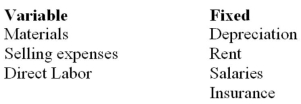 Students may list other acceptable answers,those outlined above appear on p.281.
An entrepreneur focuses on the operating costs before completion of the sales budget.
(85) Costs of goods sold should be calculated using actual cost figures;using industry standard figures is too inaccurate.
(83) 
Filters
- Essay(0)
- Multiple Choice(0)
- Short Answer(0)
- True False(0)
- Matching(0)