



 Chat with AI
Exam 26: Labor and Delivery

Exam 1: Evolution of Nursing31 Questions
Exam 2: Legal and Ethical Aspects of Nursing29 Questions
Exam 3: Documentation30 Questions
Exam 4: Communication48 Questions
Exam 5: Nursing Process and Critical Thinking53 Questions
Exam 6: Cultural and Ethnic Considerations45 Questions
Exam 7: Asepsis and Infection Control43 Questions
Exam 8: Body Mechanics and Patient Mobility25 Questions
Exam 9: Hygiene and Care of the Patient’s Environment38 Questions
Exam 10: Safety18 Questions
Exam 11: Vital Signs30 Questions
Exam 12: Physical Assessment90 Questions
Exam 13: Admission, Transfer, and Discharge18 Questions
Exam 14: Surgical Wound Care38 Questions
Exam 15: Specimen Collection and Diagnostic Testing40 Questions
Exam 16: Care of Patients Experiencing Urgent Alterations in Health37 Questions
Exam 17: Complementary and Alternative Therapies30 Questions
Exam 18: Pain Management, Comfort, Rest, and Sleep37 Questions
Exam 19: Nutritional Concepts and Related Therapies39 Questions
Exam 20: Fluids and Electrolytes29 Questions
Exam 21: Mathematics and Medication Administration39 Questions
Exam 22: Care of Patients with Alterations in Health24 Questions
Exam 23: Life Span Development63 Questions
Exam 24: Loss, Grief, Dying, and Death21 Questions
Exam 25: Health Promotion and Pregnancy35 Questions
Exam 26: Labor and Delivery36 Questions
Exam 27: Care of the Mother and Newborn35 Questions
Exam 28: Care of the High-Risk Mother, Newborn, and Family with Special Needs42 Questions
Exam 29: Health Promotion for the Infant, Child, and Adolescent22 Questions
Exam 30: Basic Pediatric Nursing Care42 Questions
Exam 31: Care of the Child with a Physical and Mental or Cognitive Disorder70 Questions
Exam 32: Health Promotion and Care of the Older Adult39 Questions
Exam 33: Concepts of Mental Health40 Questions
Exam 34: Care of the Patient with a Psychiatric Disorder39 Questions
Exam 35: Care of the Patient with an Addictive Personality36 Questions
Exam 36: Home Health Nursing31 Questions
Exam 37: Long-Term Care34 Questions
Exam 38: Rehabilitation Nursing36 Questions
Exam 39: Hospice Care36 Questions
Exam 40: Introduction to Anatomy and Physiology40 Questions
Exam 41: Care of the Surgical Patient45 Questions
Exam 42: Care of the Patient with an Integumentary Disorder42 Questions
Exam 43: Care of the Patient with a Musculoskeletal Disorder48 Questions
Exam 44: Care of the Patient with a Gastrointestinal Disorder42 Questions
Exam 45: Care of the Patient with a Gallbladder, Liver, Biliary Tract, or Exocrine Pancreatic Disorder50 Questions
Exam 46: Care of the Patient with a Blood or Lymphatic Disorder47 Questions
Exam 47: Care of the Patient with a Cardiovascular or a Peripheral Vascular Disorder58 Questions
Exam 48: Care of the Patient with a Respiratory Disorder41 Questions
Exam 49: Care of the Patient with a Urinary Disorder45 Questions
Exam 50: Care of the Patient with an Endocrine Disorder49 Questions
Exam 51: Care of the Patient with a Reproductive Disorder46 Questions
Exam 52: Care of the Patient with a Sensory Disorder44 Questions
Exam 53: Care of the Patient with a Neurologic Disorder45 Questions
Exam 54: Care of the Patient with an Immune Disorder41 Questions
Exam 55: Care of the Patient with HIV/AIDS37 Questions
Exam 56: Care of the Patient with Cancer43 Questions
Exam 57: Professional Roles and Leadership28 Questions
Select questions type


A nurse shows the patient an x-ray of the fetal spine in parallel alignment with the mother's to demonstrate a ________ lie.
(Short Answer)
4.8/5  (62)
(62) When the nurse performs the Nitrazine test on vaginal secretions of a patient who thinks her membranes have ruptured, the paper turns yellow. What does this finding indicate?
(Multiple Choice)
4.9/5 (80)
(80) What is the ideal attitude for the fetal body during labor?
(Multiple Choice)
4.9/5 (69)
(69) A woman who is 38 weeks pregnant tells the nurse that the baby has dropped and she is having urinary frequency again. What do these symptoms describe?
(Multiple Choice)
4.8/5 (78)
(78) What method is used to visualize soft tissue and to determine adequacy of the pelvis with no detrimental effects to the fetus?
(Multiple Choice)
4.8/5 (75)
(75) A patient arrives at the hospital having contractions. How should the nurse determine that the patient is in true labor?
(Multiple Choice)
4.9/5 (83)
(83) Which assessment findings suggest probable fetal distress? (Select all that apply.)
(Multiple Choice)
4.9/5 (87)
(87) After the delivery of a newborn, what is the priority action of the nurse?
(Multiple Choice)
4.8/5 (76)
(76) A pregnant woman is discussing her desire to have her baby in a birthing center. Which factors could exclude the patient from delivering in a birthing center? (Select all that apply.)
(Multiple Choice)
4.8/5 (74)
(74) Why is the size and shape of the true pelvis more important than that of the false pelvis?
(Multiple Choice)
4.7/5 (76)
(76) Using Leopold maneuvers to assess fetal position, the nurse finds a soft rounded prominence at the level of the fundus, a hard round prominence just above the symphysis pubis, and nodulations on the left side of the uterus. How should the nurse document the fetal position?
(Multiple Choice)
4.9/5 (92)
(92) The nurse explains to the patient whose membranes ruptured an hour ago that delivery is usually accomplished in ____ to _____ hours postrupture.
(Short Answer)
4.8/5 (79)
(79) In the illustration below, which item depicts the LOT position?
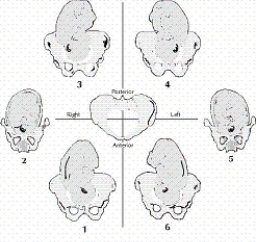
(Multiple Choice)
4.9/5 (73)
(73) The nurse is admitting a patient to the labor and delivery unit. While performing the initial assessment, which assessment is the priority?
(Multiple Choice)
4.8/5 (79)
(79) The patient's membranes have just ruptured. What is the first priority of the nurse?
(Multiple Choice)
4.8/5 (77)
(77) 
Filters
- Essay(0)
- Multiple Choice(0)
- Short Answer(0)
- True False(0)
- Matching(0)