



 Chat with AI
Exam 6: Process Costing

Exam 1: Cost Management and Strategy79 Questions
Exam 2: Implementing Strategy: The Value Chain, the Balanced Scorecard, and the Strategy Map70 Questions
Exam 3: Basic Cost Management Concepts98 Questions
Exam 4: Job Costing118 Questions
Exam 5: Activity-Based Costing and Customer Profitability Analysis149 Questions
Exam 6: Process Costing106 Questions
Exam 7: Cost Allocation: Departments, Joint Products, and By-Products96 Questions
Exam 8: Cost Estimation120 Questions
Exam 9: Short-Term Profit Planning: Cost-Volume-Profit CVP Analysis105 Questions
Exam 10: Strategy and the Master Budget146 Questions
Exam 11: Decision Making With a Strategic Emphasis137 Questions
Exam 12: Strategy and the Analysis of Capital Investments167 Questions
Exam 13: Cost Planning for the Product Life Cycle: Target Costing, Theory of Constraints, and Strategic Pricing94 Questions
Exam 14: Operational Performance Measurement: Sales, Direct-Cost Variances, and the Role of Nonfinancial Performance Measures178 Questions
Exam 15: Operational Performance Measurement: Indirect-Cost Variances and Resource-Capacity Management167 Questions
Exam 16: Operational Performance Measurement: Further Analysis of Productivity and Sales134 Questions
Exam 17: The Management and Control of Quality146 Questions
Exam 18: Strategic Performance Measurement: Cost Centers, Profit Centers, and the Balanced Scorecard130 Questions
Exam 19: Strategic Performance Measurement: Investment Centers and Transfer Pricing151 Questions
Exam 20: Management Compensation, Business Analysis, and Business Valuation108 Questions
Select questions type


In a process costing system, the cost of abnormal spoilage should be:
(Multiple Choice)
4.9/5  (74)
(74) The following table was taken from Firm X's Production Cost Report: Completed and transferred out units 44,000 Ending work-in-process equivalent units 6,000 Beginning work-in-process equivalent units 10,000 What is the number of FIFO equivalent units?
(Multiple Choice)
4.7/5 (71)
(71) The key difference between weighted-average and FIFO process costing methods is the handling of the partially completed:
(Multiple Choice)
4.8/5 (88)
(88) Bob and Nancy Barnett have recently expanded their television-based educational film business by shooting 30-second television ads for a regional television market in southern Colorado. They began business about 15 years ago with a contract to film training videos for the U.S. Army, and that business continues to provide a steady revenue base, currently about 40 percent of total revenue. Nancy Barnett is the firm's accountant, and in a visit to your accounting class last week, made a presentation detailing her firm's costing activities. Your instructor has asked you to respond to one particular statement that Nancy Barnett made: "Since our contract for military training films requires us to detail all costs, we use the process cost method that gives the maximum amount of fixed overhead cost. This almost covers all of our overhead, giving us an edge in competitively pricing our 30-second TV ads, and explains why we have grown so much in this sector of our business." Nancy knows that the U.S. Army uses cost-plus contracts on services like the Barnetts provide.
Required:
Is there an ethical problem with this approach? Does it represent acceptable accounting procedure?
(Essay)
4.9/5 (103)
(103) In the computation of manufacturing cost per equivalent unit, the weighted-average method of process costing considers:
(Multiple Choice)
4.8/5 (59)
(59) The sum of the beginning inventory units and the number of units started during the period determines the:
(Multiple Choice)
4.7/5 (79)
(79) The following table was taken from Firm X's Production Cost Report: Completed and transferred out units 44,000 Ending work-in-process equivalent units 6,000 Beginning work-in-process equivalent units 10,000 What is the number of weighted-average equivalent units?
(Multiple Choice)
4.9/5 (88)
(88) Landry Co. had the following information for the month of December. All direct materials were one hundred percent complete, and beginning materials cost $14,000.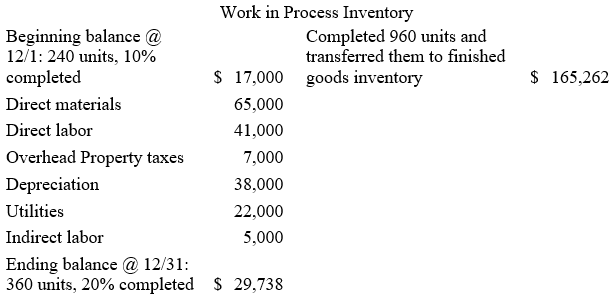 Cost per equivalent unit for materials under the FIFO method is calculated to be (rounded):
 (Multiple Choice)
4.8/5 (84)
(84) In calculating unit cost in a process costing system, "conversion cost" is defined as the sum of:
(Multiple Choice)
4.9/5 (68)
(68) In process costing, unit product cost is calculated by dividing process cost in each department by the equivalent units produced:
(Multiple Choice)
4.7/5 (80)
(80) Talamoto Co. manufactures a single product that goes through two processes — mixing and cooking. The following data pertains to the Mixing Department for September.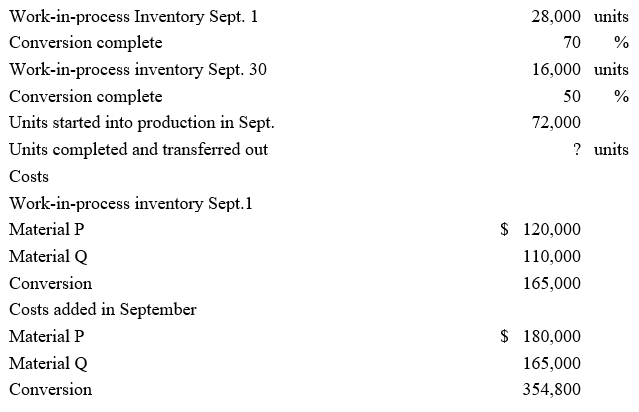 Material P is added at the beginning of work in the Mixing Department. Material Q is also added in the Mixing Department, but not until units of product are forty percent completed with regard to conversion. Conversion costs are incurred uniformly during the process.
Total equivalent units for conversion under the weighted-average method are calculated to be:
Material P is added at the beginning of work in the Mixing Department. Material Q is also added in the Mixing Department, but not until units of product are forty percent completed with regard to conversion. Conversion costs are incurred uniformly during the process.
Total equivalent units for conversion under the weighted-average method are calculated to be: (Multiple Choice)
4.9/5 (70)
(70) Landry Co. had the following information for the month of December. All direct materials were one hundred percent complete, and beginning materials cost $14,000.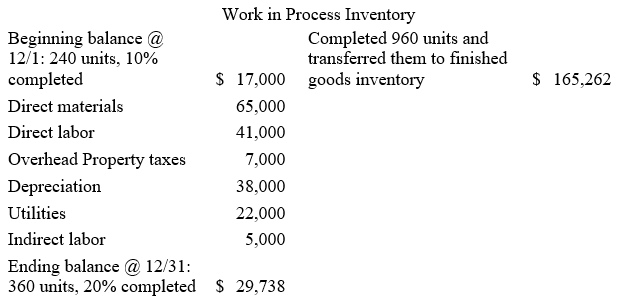 Total equivalent units for materials under the FIFO method are calculated to be:
 (Multiple Choice)
4.9/5 (87)
(87) Firms should use a process costing system when they produce products that:
(Multiple Choice)
4.8/5 (79)
(79) Place the following Process costing steps in the correct order: 1 - Calculate equivalent units
2 - Determine the total costs to account for
3 - Analyze flow of physical units
4 - Assign total manufacturing costs
5 - Compute unit costs
(Multiple Choice)
4.8/5 (75)
(75) Atlantic Manufacturing Company uses process costing.All materials are added at the beginning of the process.The normal spoilage rate is calculated as 10% of good units completed.
The cost of the beginning work-in-process in the Month of May is $3,000,000, including $1,600,000 of input of materials, 100,000 units, and $1,400,000 for conversion costs.The beginning work-in-process is 70% complete.
During May, the input includes $7,400,000 for materials, 800,000 units started and $4,190,000 for conversion costs.There were 700,000 good units finished.In addition, the ending work-in-process in May is 100,000 units with 60% complete.The abnormal spoilage is 30,000 units.All spoilage occurred when all processing was complete, at the final inspection.
Required: Use the weighted-average method to calculate:
(a) The dollar value of abnormal spoilage.
(b) The cost of the good units finished.
(c) The cost of ending work-in-process inventory.
(Essay)
4.9/5 (77)
(77) Which one of the following process costing methods includes only current costs in the calculations of cost per equivalent unit?
(Multiple Choice)
4.9/5 (83)
(83) Edenton Boat Company manufactures small pleasure boats on an assembly-line basis. The units are started in the Department A. On July 1 of this year, the Work-in-Process inventory of the Department A consisted of 200 units 100% complete as to materials and 40% complete as to conversion. During the month, 400 units were started and 500 units were completed and transferred out. The Work-in-Process on July 31 was 100% complete as to materials and 30% complete as to conversion.
Costs in process at the beginning of the period amounted to $600,000 for materials and $160,000 for conversion. Costs added during the period were materials costs of $1,802,700 and conversion costs of $905,512.
Required:
Prepare a production cost report using the weighted-average method.
(Essay)
4.8/5 (75)
(75) Giddings Pharmaceutical Company is a maker of drugs for high blood pressure and uses a process costing system. The following information pertains to the final department of Giddings's blockbuster drug called Solcax. Beginning work-in-process (40\% completed) 800 units Transferred-in 4,000 units Normal spoilage 400 units Abnormal spoilage 200 units Good units transferred out 3,600 units Ending work-in-process (1/3 completed) 600 units Conversion costs in beginning inventory \ 2,560 Current conversion costs \ 6,900 Giddings calculates separate costs of spoilage by computing both normal and abnormal spoiled units. Normal spoilage costs are reallocated to good units and abnormal spoilage costs are charged as a loss. The units of Solcax that are spoiled are the result of defects not discovered before inspection of finished units. Materials are added at the beginning of the process. Using the weighted-average method, answer the following question:
What are the unit conversion costs?
(Multiple Choice)
4.7/5 (86)
(86) 
Filters
- Essay(0)
- Multiple Choice(0)
- Short Answer(0)
- True False(0)
- Matching(0)