



 Chat with AI
Exam 9: Short-Term Profit Planning: Cost-Volume-Profit CVP Analysis

Exam 1: Cost Management and Strategy79 Questions
Exam 2: Implementing Strategy: The Value Chain, the Balanced Scorecard, and the Strategy Map70 Questions
Exam 3: Basic Cost Management Concepts98 Questions
Exam 4: Job Costing118 Questions
Exam 5: Activity-Based Costing and Customer Profitability Analysis149 Questions
Exam 6: Process Costing106 Questions
Exam 7: Cost Allocation: Departments, Joint Products, and By-Products96 Questions
Exam 8: Cost Estimation120 Questions
Exam 9: Short-Term Profit Planning: Cost-Volume-Profit CVP Analysis105 Questions
Exam 10: Strategy and the Master Budget146 Questions
Exam 11: Decision Making With a Strategic Emphasis137 Questions
Exam 12: Strategy and the Analysis of Capital Investments167 Questions
Exam 13: Cost Planning for the Product Life Cycle: Target Costing, Theory of Constraints, and Strategic Pricing94 Questions
Exam 14: Operational Performance Measurement: Sales, Direct-Cost Variances, and the Role of Nonfinancial Performance Measures178 Questions
Exam 15: Operational Performance Measurement: Indirect-Cost Variances and Resource-Capacity Management167 Questions
Exam 16: Operational Performance Measurement: Further Analysis of Productivity and Sales134 Questions
Exam 17: The Management and Control of Quality146 Questions
Exam 18: Strategic Performance Measurement: Cost Centers, Profit Centers, and the Balanced Scorecard130 Questions
Exam 19: Strategic Performance Measurement: Investment Centers and Transfer Pricing151 Questions
Exam 20: Management Compensation, Business Analysis, and Business Valuation108 Questions
Select questions type


TexFab manufactures two products, GT450 and GT600 that have the following sales and cost information. 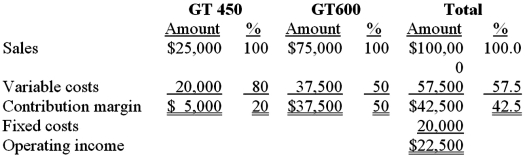 Round all dollar answers up, to the nearest whole number.
Required:
1.What is the breakeven point in dollars if sales remain at the same sales mix reflected in the income statement presented above?
2.If the TexFab Company's sales mix becomes $50,000 of product GT450 and $50,000 of product GT600, what is the breakeven point in sales dollars? Prepare an income statement-in the format given above-for this scenario.
3.Why have the breakeven point and the amount of operating income changed?
Round all dollar answers up, to the nearest whole number.
Required:
1.What is the breakeven point in dollars if sales remain at the same sales mix reflected in the income statement presented above?
2.If the TexFab Company's sales mix becomes $50,000 of product GT450 and $50,000 of product GT600, what is the breakeven point in sales dollars? Prepare an income statement-in the format given above-for this scenario.
3.Why have the breakeven point and the amount of operating income changed? (Essay)
4.9/5  (76)
(76) For the current year, Power Cords Corp. expected to sell 42,000 industrial power cords. Fixed costs were expected to total $1,650,000; unit sales price was expected to be $3,750; and unit variable costs were budgeted at $2,250.
Power Cord Corp.'s margin of safety ratio (MOS%) is (rounded to two decimal points):
(Multiple Choice)
4.7/5 (72)
(72) Walker Corp. is a retail store that sells shoes and boots. In the past, it has bought all its shoes from a supplier for $15 per unit. However, Walker has the opportunity to acquire a small manufacturing facility where it could produce its own shoes. The projected data for producing its own shoes are as follows, for a pair of shoes: selling price $25; variable costs, $5; total fixed costs (per year), $125,000.
Required
1. If Walker acquired the manufacturing facility, how many pairs of shoes (per year) would it have to produce to break even (round your answer up, to the nearest whole unit)?
2. To earn an annual after-tax profit (πA) of $100,000, how many pairs of shoes would Walker have to sell if it buys the shoes from the supplier? How many pairs would it have to sell if it produces its own shoes? Walker's combined income tax rate, t, is estimated as 35%. Round up your answers, to the nearest whole number of units.
3. At what annual volume of sales (in units) would Walker be indifferent between the two decision alternatives (ignore income tax effects)? Show a computation of operating incomes to prove your answer.
(Essay)
4.7/5 (84)
(84) The sales and cost data for two companies in the transportation industry are as follows: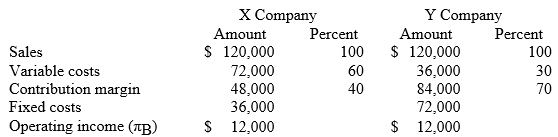 X Company's margin of safety ratio (MOS%) (rounded) is:
 (Multiple Choice)
5.0/5 (85)
(85) Cost/volume/profit (CVP) analysis is a technique available to management to understand better the interrelationships of several factors that combine to determine a firm's operating profit, πB. As with many such techniques, the accountant oversimplifies the real world by making assumptions. Which of the following is not a major assumption underlying a conventional CVP analysis?
(Multiple Choice)
4.7/5 (86)
(86) 
Filters
- Essay(0)
- Multiple Choice(0)
- Short Answer(0)
- True False(0)
- Matching(0)