



 Chat with AI
Exam 23: Options

Exam 1: Goals and Governance of the Corporation115 Questions
Exam 2: Financial Markets and Institutions107 Questions
Exam 3: Accounting and Finance121 Questions
Exam 4: Measuring Corporate Performance116 Questions
Exam 5: The Time Value of Money119 Questions
Exam 6: Valuing Bonds119 Questions
Exam 7: Valuing Stocks120 Questions
Exam 8: Net Present Value and Other Investment Criteria115 Questions
Exam 9: Using Discounted Cash-Flow Analysis to Make Investment Decisions117 Questions
Exam 10: Project Analysis116 Questions
Exam 11: Introduction to Risk, Return, and the Opportunity Cost of Capital115 Questions
Exam 12: Risk, Return, and Capital Budgeting120 Questions
Exam 13: The Weighted-Average Cost of Capital and Company Valuation113 Questions
Exam 14: Introduction to Corporate Financing121 Questions
Exam 15: How Corporations Raise Venture Capital and Issue Securities116 Questions
Exam 16: Debt Policy120 Questions
Exam 17: Payout Policy118 Questions
Exam 18: Long-Term Financial Planning119 Questions
Exam 19: Short-Term Financial Planning118 Questions
Exam 20: Working Capital Management118 Questions
Exam 21: Mergers, Acquisitions, and Corporate Control119 Questions
Exam 22: International Financial Management114 Questions
Exam 23: Options119 Questions
Exam 24: Risk Management118 Questions
Select questions type


Owning a call option that has a high probability of being exercised is said to be almost equivalent to owning the stock. In which way is owning a call not equivalent to owning the stock?

Free
(Multiple Choice)
4.8/5  (80)
(80) Correct Answer: Verified
C
Assume that call options on Microsoft stock with the same exercise date in October are available with exercise prices $45, $55, and $65. Also assume that the price of the middle call is the average of the other two calls. Show that if you sell two of the middle calls and use the proceeds to buy one each of the other calls, your proceeds in October may be positive but cannot be negative despite the fact that your net outlay today is zero. What can you deduce from this example about option pricing?
Free
(Essay)
4.9/5 (72)
(72) Correct Answer:Verified
Verified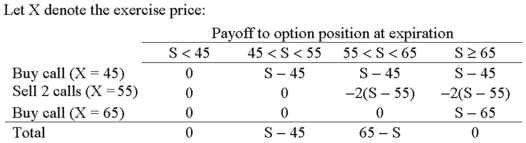 Notice that, if S is between 45 and 65 at option expiration, the total payoff to the portfolio is positive. Otherwise the total payoff is zero. This portfolio has only nonnegative payoffs. But it has zero cost if the price of the 55 call is equal to the average of the prices of the other two calls. This situation cannot persist. At a cost of zero, all investors will attempt to buy an unlimited amount of this portfolio. We conclude that the price of the 55 call must be greater than the average of the prices of the other two calls. In this case, the cost of establishing the portfolio is positive, which is consistent with the nonnegative payoffs to the portfolio.
You purchased a stock for $43 a share, a call option with an exercise price of $40 and a premium of $5, and a put option with an exercise price of $45 and a premium of $4. What will be your net profit if you close out all three positions when the stock is selling for $48 a share?
Free
(Multiple Choice)
4.7/5 (85)
(85) Correct Answer:Verified
VerifiedD
The lower limit on a call option's value is equal to the greater of zero or the exercise price minus the stock price.
(True/False)
4.8/5 (87)
(87) The price of a call option increases as the exercise price decreases.
(True/False)
4.7/5 (87)
(87) The VIX is an estimate of expected future market volatility over the next 30 calendar days.
(True/False)
4.8/5 (75)
(75) A warrant is a long-term call option that is "in the money" at the time of issuance.
(True/False)
4.7/5 (65)
(65) The value of a call option increases as the strike price increases.
(True/False)
4.9/5 (83)
(83) Assume you purchased a call option with an exercise price of $720 and a premium of $80.50. How do you compute the stock price that is required to break even on this investment? What would your percentage rate of return be if the stock price rose to $810?
(Essay)
4.7/5 (84)
(84) When the stock price is very high compared to the exercise price, the call option premium approximates the difference between the stock price and the present value of the strike price.
(True/False)
4.8/5 (64)
(64) If you feel strongly that a stock price will move, but are unsure of the direction, you could buy the stock and:
(Multiple Choice)
4.7/5 (86)
(86) The longer the time until expiration of a call option, the lower the value of the option.
(True/False)
4.9/5 (84)
(84) A stock is selling at $85 at the expiration of an option contract. Which one of the following options on the stock will most likely be exercised?
(Multiple Choice)
4.8/5 (84)
(84) What price risk is an investor exposed to if he owns a share of stock and has purchased a put option on the stock?
(Essay)
4.9/5 (70)
(70) For each of the following option and securities combinations show what the payoff would be when the option expires. Assume that each option has an exercise price of $100 and the same expiration date. Use "S" to symbolize the stock price at expiration.
a. Buy a call and invest the present value of the exercise price in a bank deposit
b. Buy a share and a put option on the share
c. Buy a share, buy a put option on the share, and sell a call option on the share
d. Buy a call option and a put option on the share
(Essay)
4.8/5 (82)
(82) Jennifer sold a call option on XXX Corp. with an exercise price of $50 and a premium of $3. The option expires today and XXX is currently trading at $40. What is Jennifer's expected profit or loss per share?
(Multiple Choice)
4.9/5 (76)
(76) If a $1,000 convertible bond with a market value of $950 has a conversion ratio of 25 when the firm's stock is selling for $36 per share, then:
(Multiple Choice)
4.9/5 (86)
(86) Which one of the following changes will decrease the value of a call option?
(Multiple Choice)
5.0/5 (77)
(77) Firms spend an increasing amount of time evaluating real options, which are:
(Multiple Choice)
4.8/5 (77)
(77) 
Filters
- Essay(0)
- Multiple Choice(0)
- Short Answer(0)
- True False(0)
- Matching(0)