



 Chat with AI
Exam 30: Quantum Physics

Exam 1: Introduction to Physics98 Questions
Exam 2: One-Dimensional Kinematics138 Questions
Exam 3: Vectors in Physics69 Questions
Exam 4: Two-Dimensional Kinematics51 Questions
Exam 5: Newtons Laws of Motion54 Questions
Exam 6: Applications of Newtons Laws104 Questions
Exam 7: Work and Kinetic Energy55 Questions
Exam 8: Potential Energy and Conservation of Energy62 Questions
Exam 9: Linear Momentum and Collisions114 Questions
Exam 10: Rotational Kinematics and Energy60 Questions
Exam 11: Rotational Dynamics and Static Equilibrium69 Questions
Exam 12: Gravity53 Questions
Exam 13: Oscillations About Equilibrium79 Questions
Exam 14: Waves and Sound142 Questions
Exam 15: Fluids103 Questions
Exam 16: Temperature and Heat110 Questions
Exam 17: Phases and Phase Changes93 Questions
Exam 18: The Laws of Thermodynamics90 Questions
Exam 19: Electric Charges, Forces, and Fields75 Questions
Exam 20: Electric Potential and Electric124 Questions
Exam 21: Electric Current and Direct-Current Circuits228 Questions
Exam 22: Magnetism147 Questions
Exam 23: Magnetic Flux and Faradays Law of Induction98 Questions
Exam 24: Alternating-Current Circuits72 Questions
Exam 25: Electromagnetic Waves63 Questions
Exam 26: Geometrical Optics133 Questions
Exam 27: Optical Instruments103 Questions
Exam 28: Physical Optics: Interference and Diffraction119 Questions
Exam 29: Relativity98 Questions
Exam 30: Quantum Physics88 Questions
Exam 31: Atomic Physics97 Questions
Exam 32: Nuclear Physics and Nuclear Radiation137 Questions
Select questions type


What is the wavelength of the matter wave associated with an electron moving with a speed of 2.5 × 10⁷ m/s? (melectron = 9.11 × 10⁻³¹ kg,h = 6.626 × 10⁻³⁴ J ∙ s)
(Multiple Choice)
4.8/5  (89)
(89) Monochromatic light is incident on a metal surface,and the ejected electrons give rise to a current in the circuit shown in the figure.The maximum kinetic energy of the ejected electrons is determined by applying a reverse ('stopping')potential,sufficient to reduce the current in the ammeter to zero.If the intensity of the incident light is increased,how will the required stopping potential change? 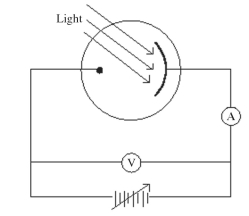
(Multiple Choice)
4.7/5 (72)
(72) What is the de Broglie wavelength of a ball of mass 200 g moving at 30 m/s? (h = 6.626 × 10⁻³⁴ J ∙ s)
(Multiple Choice)
5.0/5 (74)
(74) A photocathode that has a work function of 2.4 eV is illuminated with monochromatic light having photon energy 3.5 eV.What is the wavelength of this light? (c = 3.00 × 10⁸ m/s,h = 6.626 × 10⁻³⁴ J ∙ s,1 eV = 1.60 × 10⁻¹⁹ J)
(Multiple Choice)
4.7/5 (62)
(62) An electron has the same de Broglie wavelength as the wavelength of a 1.8 eV photon.What is the speed of the electron? (melectron = 9.11 × 10⁻³¹ kg,c = 3.00 × 10⁸ m/s,1 eV = 1.60 × 10⁻¹⁹ J)
(Multiple Choice)
4.7/5 (72)
(72) A blue laser beam is incident on a metallic surface,causing electrons to be ejected from the metal.If the frequency of the laser beam is increased while the intensity of the beam is held fixed,
(Multiple Choice)
4.9/5 (86)
(86) What is the frequency of the most intense radiation from an object with temperature 100°C? The constant in Wien's law is 0.0029 m ∙ K.(c = 3.0 × 10⁸ m/s)
(Multiple Choice)
4.9/5 (72)
(72) Find the de Broglie wavelength of a 1.30-kg missile moving at  (h = 6.626 × 10⁻³⁴ J ∙ s)
 (Multiple Choice)
4.9/5 (75)
(75) If the de Broglie wavelength of an electron is 380 nm,what is the speed of this electron? (melectron = 9.11 × 10⁻³¹ kg,h = 6.626 × 10⁻³⁴ J ∙ s)
(Multiple Choice)
4.9/5 (72)
(72) When it is struck by 240-nm photons,a metal ejects electrons with a maximum kinetic energy of  What is the work function of this material? (c = 3.00 × 10⁸ m/s,h = 6.626 × 10⁻³⁴ J ∙ s,1 eV = 16.0 × 10⁻¹⁹ J)
 (Multiple Choice)
4.9/5 (79)
(79) An electron is moving with the speed of 1780 m/s.What is its de Broglie wavelength? (melectron = 9.11 × 10⁻³¹ kg,h = 6.626 × 10⁻³⁴ J ∙ s)
(Multiple Choice)
4.8/5 (86)
(86) A beam of light falling on a metal surface is causing electrons to be ejected from the surface.If we now double the frequency of the light,which of the following statements are correct? (There could be more than one correct choice. )
(Multiple Choice)
4.8/5 (71)
(71) Monochromatic light falls on a metal surface and electrons are ejected.If the intensity of the light is increased,what will happen to the ejection rate and maximum energy of the electrons?
(Multiple Choice)
4.9/5 (78)
(78) If the wavelength of a photon in vacuum is the same as the de Broglie wavelength of an electron,which one is traveling faster through space?
(Multiple Choice)
4.7/5 (61)
(61) The work function of a certain metal is 1.90 eV.What is the longest wavelength of light that can cause photoelectron emission from this metal? (1 eV = 1.60 × 10⁻¹⁹ J,c = 3.00 × 10⁸ m/s,h = 6.626 × 10⁻³⁴ J ∙ s)
(Multiple Choice)
4.9/5 (87)
(87) If the de Broglie wavelength of an electron is 2.4 μm,what is the speed of the electron? 

(Multiple Choice)
4.8/5 (67)
(67) What is the wavelength of the matter wave associated with a 0.50-kg ball moving at 25 m/s? (h = 6.626 × 10⁻³⁴ J ∙ s)
(Multiple Choice)
4.8/5 (60)
(60) An electron is accelerated from rest through a potential difference.After acceleration the electron has a wavelength of 880 nm.What is the potential difference responsible for the acceleration of the electron? (h = 6.626 × 10⁻³⁴ J ∙ s,melectron = 9.11 × 10⁻³¹ kg,e = 1.6 10-19 C)
(Multiple Choice)
4.7/5 (86)
(86) When the surface of a metal is exposed to blue light,electrons are emitted.If the intensity of the blue light is increased,which of the following things will also increase?
(Multiple Choice)
4.8/5 (92)
(92) How much energy is carried by a photon of light having frequency 110 GHz? (h = 6.626 × 10⁻³⁴ J ∙ s)
(Multiple Choice)
4.9/5 (88)
(88) 
Filters
- Essay(0)
- Multiple Choice(0)
- Short Answer(0)
- True False(0)
- Matching(0)